Loading…


Loading…
Loading…
Loading…
Edexcel GCSE Combined Science · 1SC0
Edexcel 1SC0 · Momentum and stopping distances Check the specification (PDF) (opens in a new tab)
When a driver notices a hazard, braking does not begin instantly. There is a delay between noticing the hazard and responding by pressing the brake pedal. This delay is the driver's reaction time. Typical human reaction times are about 0.2–0.9 seconds, although they vary between people and with the conditions of the test.
Even a fraction of a second matters on a road: the vehicle continues moving throughout this delay.
A ruler-drop test uses the distance a ruler falls before it is caught as a measure of how quickly someone responds.
The ruler measures distance directly, rather than time in seconds. Its falling distance can be converted into a reaction time, but that conversion is not needed to understand this test. A missed catch should be recorded as a missed catch, not as a distance measured beyond the ruler's scale.
A vehicle's stopping distance is the total distance travelled from the driver noticing a hazard until the vehicle comes to rest. It has two distinct parts.
During the thinking distance, the driver is reacting and has not yet applied the brakes. During the braking distance, the brakes are acting and the vehicle slows down.
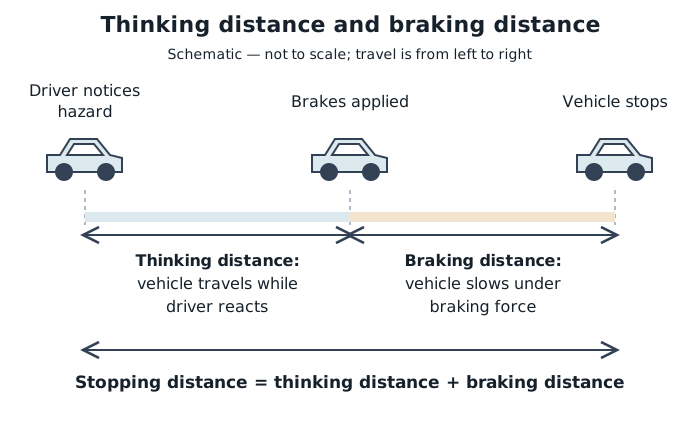
The vehicle travels during the driver's reaction time as well as while the brakes slow it down.
For example, if a vehicle travels 14 m while the driver reacts and its total stopping distance is 40 m, its braking distance is . The two distances describe consecutive stages of the same stop.
If the vehicle's speed remains approximately constant while the driver reacts:
Use speed in metres per second and reaction time in seconds to obtain distance in metres. For a fixed reaction time, doubling the speed doubles the thinking distance: the vehicle travels twice as far during the same delay.
A longer reaction time also increases thinking distance at the same speed. Important causes include:
These factors act before braking begins. Better brakes cannot remove the distance already travelled while the driver is reacting.
Brakes produce friction that slows the wheels, while friction between the tyres and the road provides the grip needed to slow the vehicle. Braking transfers the vehicle's kinetic energy, the energy it has because it is moving, mainly into thermal energy.
Higher speed increases braking distance. At the same mass, a faster vehicle has more kinetic energy to transfer before stopping. If the braking force stays constant, braking distance is proportional to speed squared: doubling the speed makes braking distance four times as large. This differs from thinking distance, which only doubles for the same reaction time.
Greater vehicle mass also increases braking distance for the same braking force. A larger mass needs a greater force to produce the same deceleration. If the force does not increase, the vehicle slows less rapidly and travels farther before stopping.
Poor brake condition can reduce the effective braking force, increasing braking distance. Brakes also heat up during use; if they become too hot, they can become less effective or fail.
Wet or icy roads reduce friction between the tyres and the road. With less grip, the vehicle cannot decelerate as effectively, so braking distance increases. Worn tyres can also reduce grip, particularly in wet conditions.
Road state and tyre condition are therefore connected through tyre–road friction. They do not change the driver's reaction time, but they can make the braking stage much longer. Several adverse factors can act together: a tired driver travelling quickly on an icy road has both an increased thinking distance and an increased braking distance.
Deceleration means a decrease in speed. A rapid stop produces a large deceleration, which requires a large resultant force:
Here, is resultant force in newtons, is mass in kilograms and is acceleration in metres per second squared. To estimate the average acceleration during a stop, use:
Here, is initial velocity, is final velocity and is the stopping time. For the same change in velocity, a shorter stopping time means a larger deceleration and a larger force.
Consider a road collision in which a passenger travelling at about 20 m/s comes to rest in 0.1 s. Take the passenger's mass as about 70 kg. Choosing the original direction of travel as positive gives:
The estimated average resultant force on the passenger is:
The force has a magnitude of about 14,000 N and acts opposite to the passenger's original motion. These are estimates, not exact values for every collision. They show why bringing a person to rest in a very short time can cause serious injury.
Sudden movement of the head relative to the body can cause a neck injury called whiplash. Severe braking can also make a vehicle harder to control, especially when grip is poor, increasing the risk of a collision.
Get unlimited access to all revision notes, key terms, and exam tips.
Get unlimited access to all revision notes, key terms, and exam tips.
Identify which stage a factor affects: reaction time changes thinking distance; brakes and tyre–road friction change braking distance; speed affects both.
A ruler-drop test measures a distance directly, not a time. A greater distance fallen indicates a longer reaction time.
When explaining the effect of mass, compare vehicles experiencing the same braking force. Do not assume that every heavier vehicle has identical brakes.
For force estimates, state sensible estimated quantities and use SI units: kilograms, metres per second and seconds.
A negative acceleration or force indicates a direction opposite to the chosen positive direction. The magnitude of the deceleration or force is positive.
Reaction time
The time between noticing a stimulus, such as a hazard, and responding to it.
Thinking distance
The distance a vehicle travels during the driver's reaction time, before braking begins.
Braking distance
The distance a vehicle travels from when the brakes are applied until it stops.
Stopping distance
The total distance a vehicle travels from the driver noticing a hazard until the vehicle stops: thinking distance plus braking distance.
Friction
A force that opposes relative movement between surfaces in contact. Friction between tyres and the road provides grip for braking.
Deceleration
A decrease in speed; acceleration acting opposite to the direction of motion.
Put your knowledge into practice — try past paper questions for Combined Science
Reaction time
The time between noticing a stimulus, such as a hazard, and responding to it.
Thinking distance
The distance a vehicle travels during the driver's reaction time, before braking begins.
Braking distance
The distance a vehicle travels from when the brakes are applied until it stops.
Stopping distance
The total distance a vehicle travels from the driver noticing a hazard until the vehicle stops: thinking distance plus braking distance.
Friction
A force that opposes relative movement between surfaces in contact. Friction between tyres and the road provides grip for braking.
Deceleration
A decrease in speed; acceleration acting opposite to the direction of motion.