Loading…


Loading…
Loading…
Loading…
Edexcel GCSE Combined Science · 1SC0
Edexcel 1SC0 · Obtaining and using metals Obtaining and using metals Check the specification (PDF) (opens in a new tab)
Deduce the relative reactivity of various metals by observing their reactions with water, acids, and salt solutions.
Explain displacement reactions as redox reactions, specifically detailing the gain and loss of electrons.
Explain the reactivity series of metals in terms of their tendency to form cations when reacting with water and dilute acids.
Recall that most metals are extracted from ores found in the Earth's crust, whereas unreactive metals exist as uncombined elements.
Explain oxidation as the gain of oxygen and reduction as the loss of oxygen in a chemical context.
Recall that the extraction of metals from their ores inherently involves reduction processes.
Explain how a metal's position in the reactivity series and extraction costs determine its extraction method, comparing heating with carbon to electrolysis.
Evaluate alternative biological methods for metal extraction, specifically bacterial extraction and phytoextraction.
Explain the relationship between a metal's position in the reactivity series and its relative resistance to oxidation.
Evaluate the economic and environmental advantages of recycling metals, including the preservation of raw materials.
Describe the purpose and stages of a life-cycle assessment for a product, from raw material extraction to final disposal.
Evaluate provided data from a life-cycle assessment to determine the environmental impact of a product.
A metal object may stop being useful even though its metal still has value. Scrap metal can be collected, sorted, melted and recast into new shapes. This is recycling. It differs from reuse: using the same metal container again is reuse, whereas melting it to make another product is recycling.
Metal ores are finite resources: their supplies are limited. Recycling returns metal to use, reducing the need to extract more from ores. For example, recycling iron conserves iron ore, helping the remaining supply last longer. It does not create more ore; it reduces how quickly we use it up.
Mining disturbs land and ecosystems. Reducing demand for newly mined ore therefore helps preserve the environment as well as valuable raw materials. Recycling also reduces the amount of metal waste sent to landfill, saving landfill space.
Melting and reshaping scrap metal generally requires less energy than extracting metal from its ore. Where the energy comes from fossil fuels, lower energy demand can reduce fuel use and the emissions that contribute to climate change. Recycling has environmental impacts of its own, but these can be smaller than those of mining and extraction.
Lower energy demand can also mean lower production costs. Recycling is particularly economically valuable for metals that are expensive to extract, such as aluminium. Collecting and processing scrap metal also creates employment.
These benefits must be weighed against costs. Scrap needs to be collected and transported, which requires vehicles, fuel and workers. It must often be sorted to keep different materials separate: unwanted materials can affect the quality of the recycled product. Sorting and operating recycling facilities require energy and labour. Recycling is therefore not free or impact-free; its advantages depend on the savings compared with obtaining new metal.
Recycling concerns what happens to materials after use, but a product can affect the environment long before it becomes waste. A life-cycle assessment, or LCA, considers environmental effects throughout a product’s life. It helps compare products and identify where their main impacts occur.
The four stages are obtaining raw materials, manufacturing, use and final disposal. Transport between stages also uses energy and may produce emissions.
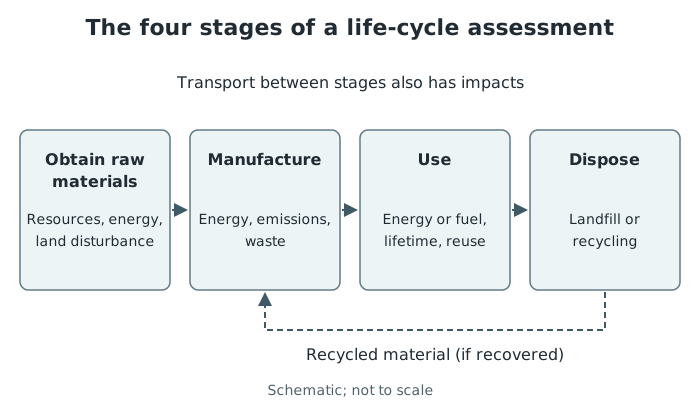
An LCA considers all four stages, including transport. Recycling can return materials to production, but also requires energy.
Obtaining raw materials: consider where the materials come from and the effects of obtaining them. Mining metal ores uses resources and disturbs land. A product made using recycled metal may reduce the amount of new ore needed.
Manufacturing: consider energy use, emissions, waste and land used for factories. Fuel-powered machinery and transport can contribute to pollution.
Using the product: the impact depends on the product. A wooden desk has relatively little environmental impact during use, whereas a fuel-powered car uses fuel and produces air pollution. How long the product lasts and whether it is reused also matter.
Disposing of the product: consider what happens when it is no longer useful. Landfill occupies space, while recycling can recover useful materials. Whether the product breaks down and whether its parts can be recycled affect its environmental impact.
An LCA can reveal a trade-off: one product may have an advantage at one stage but a disadvantage at another. Consider these qualitative comparisons for plastic and paper shopping bags.
| Stage | Plastic bag | Paper bag |
|---|---|---|
| Raw materials | Commonly made from crude oil, a finite resource. | Can be made from trees or recycled paper. |
| Manufacturing | Processing the raw material and making the plastic require energy. | Pulping and making paper require energy and produce waste. |
| Use | Can be reused; a longer useful life can reduce the number of replacement bags needed. | Reuse may be more limited if the bag is less durable. |
| Disposal | Can be recycled, but recycling has costs and environmental impacts. Conventional plastic is not biodegradable and occupies landfill space if discarded there. | Is biodegradable and can be recycled. |
Paper’s biodegradability is an advantage at disposal, but it does not remove the impacts of obtaining its raw materials or manufacturing it. Similarly, plastic’s potential for reuse is only an advantage if it is actually reused.
A justified conclusion is therefore conditional. A plastic bag used many times may be preferable to repeatedly obtaining replacement paper bags. If the plastic bag is used only once, its reuse advantage disappears. Recycling the paper bag can make the paper option more favourable. These comparisons do not establish that one material is always better.
Start by comparing products that provide the same service. Comparing one long-lasting bag with one bag used once can be misleading if they carry different amounts of shopping over their lifetimes. Check the assumptions about lifetime, number of uses and disposal.
Then identify the advantages and disadvantages at each stage. If numerical data are given, check the units and compare like with like. Energy values in the same unit can be added across stages, but an energy value cannot simply be added to a mass of waste to create a meaningful total.
Finally, explain which evidence supports your decision and what could change it. Different impacts are not always easy to measure or weigh against one another, so choices about assessment criteria can influence the conclusion. An LCA informs a decision rather than guaranteeing a single perfect answer; environmental benefits may also need to be balanced against economic costs.
Get unlimited access to all revision notes, key terms, and exam tips.
Include transport impacts between stages.
Get unlimited access to all revision notes, key terms, and exam tips.
Link each recycling advantage to a consequence: less mining preserves habitats, while lower energy demand can reduce costs and fossil-fuel emissions.
Include the costs of collecting, transporting and sorting scrap metal when evaluating recycling, rather than presenting it as cost-free.
For an LCA evaluation, use evidence from several stages and give a justified conclusion. Being biodegradable alone does not make a product the best option.
Check whether products are compared over the same amount of use. State how assumptions about reuse or recycling affect your conclusion.
Recycling
Processing waste material so that it can be used to make new products.
Reuse
Using a product again without processing its material into a new product.
Finite resource
A naturally occurring material with a limited supply that is not replaced as quickly as it is used.
Life-cycle assessment
An assessment of a product’s environmental effects across obtaining its raw materials, manufacturing it, using it and disposing of it.
Biodegradable
Able to be broken down by living organisms, such as microorganisms.
Put your knowledge into practice — try past paper questions for Combined Science
Recycling
Processing waste material so that it can be used to make new products.
Reuse
Using a product again without processing its material into a new product.
Finite resource
A naturally occurring material with a limited supply that is not replaced as quickly as it is used.
Life-cycle assessment
An assessment of a product’s environmental effects across obtaining its raw materials, manufacturing it, using it and disposing of it.
Biodegradable
Able to be broken down by living organisms, such as microorganisms.