Loading…


Loading…
Loading…
Loading…
Edexcel GCSE Combined Science · 1SC0
Edexcel 1SC0 · Reversible reactions and equilibria Check the specification (PDF) (opens in a new tab)
Understand that chemical reactions can be reversible, recognize the standard symbol for reversibility, and explain how altering reaction conditions can shift the direction of a reversible reaction.
Explain the concept and characteristics of a dynamic equilibrium in a chemical system.
Describe the synthesis of ammonia as a reversible reaction between nitrogen and hydrogen that is capable of reaching dynamic equilibrium.
Recall the specific optimal conditions required for the Haber process: a temperature of 450 °C, a pressure of 200 atmospheres, and the presence of an iron catalyst.
Predict how changes in temperature, pressure, and concentration will affect the position of a dynamic equilibrium.
In a reversible reaction, the products can react to form the original reactants. The forward reaction makes products; the reverse reaction changes those products back into reactants. Both directions can occur in the same mixture.
Instead of a single arrow, a reversible equation uses the symbol ⇌. Changing the reaction conditions can favour one direction over the other, changing the amounts of substances in the mixture. This does not mean that the other direction necessarily stops.
Imagine starting a reversible reaction with only reactants in a sealed container. Initially, the forward reaction occurs but there are no products available for the reverse reaction. As products form, they begin reacting back into reactants. Meanwhile, the reactants are being used up, so the forward reaction slows.
Eventually, the forward and reverse reactions occur at equal rates. The system has reached dynamic equilibrium. ‘Dynamic’ means that both reactions are still happening: particles continually change from reactants into products and back again.
At equilibrium, each substance is being produced as quickly as it is being used up. Its concentration therefore remains constant, provided the conditions do not change. Constant concentrations do not mean equal concentrations: an equilibrium mixture can contain much more product than reactant, or the reverse.
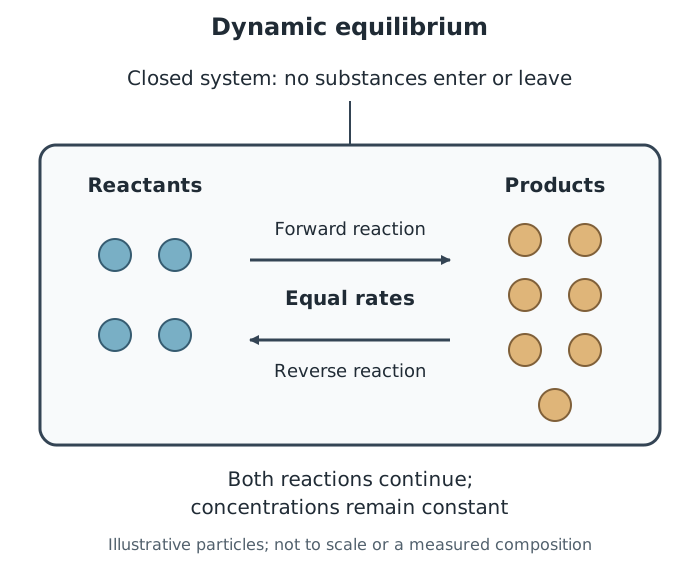
At dynamic equilibrium, both reactions continue at equal rates. The concentrations stay constant, but need not be equal.
Equilibrium requires a closed system, so substances cannot enter or leave. For example, if a gaseous product escapes from an open container, it is no longer available for the reverse reaction. Keeping the substances together allows the two reaction rates to become equal.
The Haber process manufactures ammonia from nitrogen and hydrogen. The nitrogen is extracted from the air, and the hydrogen is obtained from natural gas.
The balanced equation is:
One molecule of nitrogen reacts with three molecules of hydrogen to form two molecules of ammonia. The state symbol shows that all three substances are gases.
The reaction is reversible: ammonia can decompose back into nitrogen and hydrogen. In a closed system, the reaction can reach dynamic equilibrium. Ammonia is then being formed and broken down at equal rates, leaving a mixture of all three gases.
The conditions to recall are:
These are compromise conditions: they balance ammonia yield, reaction rate and production cost rather than giving the greatest possible yield. The iron catalyst speeds up both reaction directions, allowing equilibrium to be reached more quickly without changing the equilibrium position.
The position of equilibrium describes the relative concentrations of reactants and products at equilibrium. A shift to the right favours products; a shift to the left favours reactants.
Le Chatelier’s principle gives a way to predict a shift: when conditions affecting an equilibrium change, the position shifts to counteract that change. After the shift, a new dynamic equilibrium can be established. The forward and reverse rates are equal again, but the mixture has different concentrations.
An exothermic reaction transfers energy to the surroundings; an endothermic reaction takes energy in. In a reversible reaction, if one direction is exothermic, the opposite direction is endothermic.
For the Haber reaction, ammonia formation is exothermic. Increasing temperature therefore shifts equilibrium to the left and reduces the equilibrium yield of ammonia. Decreasing temperature shifts it to the right and increases the yield.
However, a lower temperature also makes the reaction slower. The temperature of 450 °C is a compromise between obtaining a useful ammonia yield and producing it at a useful rate. This illustrates why reaction rate and equilibrium yield are different considerations.
For gaseous equilibria, increasing pressure favours the side with fewer gaseous particles. Decreasing pressure favours the side with more gaseous particles.
Use the coefficients in the balanced equation to compare the two sides. In the Haber equation, the left has four gaseous molecules in total: one nitrogen plus three hydrogen. The right has two ammonia molecules.
Increasing pressure therefore shifts equilibrium to the right, increasing the ammonia yield. Decreasing pressure shifts it to the left. If both sides of an equation have the same number of gaseous particles, a pressure change does not favour either side. Count gases only, not solids or liquids.
Changing a concentration shifts equilibrium towards using up an added substance or replacing a removed substance.
For the Haber reaction:
The shift counteracts the change; it does not necessarily restore the original concentrations.
Get unlimited access to all revision notes, key terms, and exam tips.
Le Chatelier’s principle: the position shifts to counteract a change.
| Change | Direction favoured |
|---|---|
| Increase temperature | Endothermic |
| Decrease temperature | Exothermic |
| Increase pressure | Fewer gaseous particles |
| Decrease pressure | More gaseous particles |
| Add a substance | Uses up that substance |
| Remove a substance | Replaces that substance |
Equal numbers of gaseous particles on both sides: no pressure-induced shift.
Haber application: the forward reaction is exothermic; four gaseous molecules become two. Lower temperature, higher pressure or adding a reactant favours ammonia formation.
Get unlimited access to all revision notes, key terms, and exam tips.
Define dynamic equilibrium using equal rates of the forward and reverse reactions, not equal amounts of reactants and products.
Include the need for a closed system when explaining how equilibrium is established.
For pressure predictions, count gaseous particles using the coefficients in the balanced equation, not the numbers of atoms.
For temperature predictions, identify the endothermic and exothermic directions before deciding whether equilibrium shifts left or right.
The Haber conditions are compromise conditions, not the conditions that give the greatest possible ammonia yield.
A catalyst makes equilibrium establish more quickly; it does not change the equilibrium position.
Reversible reaction
A chemical reaction in which the products can react to form the original reactants. It is represented by the symbol .
Dynamic equilibrium
A state in a closed system in which the forward and reverse reactions continue at equal rates, so the concentrations of reactants and products remain constant.
Closed system
A system in which substances cannot enter or leave.
Haber process
The industrial manufacture of ammonia by reacting nitrogen with hydrogen using an iron catalyst at 450 °C and 200 atmospheres.
Position of equilibrium
The relative concentrations of reactants and products in a mixture at equilibrium.
Le Chatelier’s principle
The principle that, when conditions affecting a system at equilibrium change, the equilibrium position shifts to counteract the change.
Exothermic reaction
A reaction that transfers energy to the surroundings.
Endothermic reaction
A reaction that takes in energy from the surroundings.
Catalyst
A substance that increases the rate of a reaction without being used up or chemically changed overall.
Put your knowledge into practice — try past paper questions for Combined Science
Reversible reaction
A chemical reaction in which the products can react to form the original reactants. It is represented by the symbol .
Dynamic equilibrium
A state in a closed system in which the forward and reverse reactions continue at equal rates, so the concentrations of reactants and products remain constant.
Closed system
A system in which substances cannot enter or leave.
Haber process
The industrial manufacture of ammonia by reacting nitrogen with hydrogen using an iron catalyst at 450 °C and 200 atmospheres.
Position of equilibrium
The relative concentrations of reactants and products in a mixture at equilibrium.
Le Chatelier’s principle
The principle that, when conditions affecting a system at equilibrium change, the equilibrium position shifts to counteract the change.
Exothermic reaction
A reaction that transfers energy to the surroundings.
Endothermic reaction
A reaction that takes in energy from the surroundings.
Catalyst
A substance that increases the rate of a reaction without being used up or chemically changed overall.