Loading…


Loading…
Loading…
Loading…
Edexcel GCSE Business · 1BS0
Edexcel 1BS0 · 2.2.4 Check the specification (PDF) (opens in a new tab)
Place is the part of the marketing mix concerned with where and how customers can buy a product. A product may suit customers perfectly, but sales will be limited if they cannot conveniently obtain it. Businesses therefore choose distribution methods that make their products accessible to their intended customers.
A distribution channel is the route from the producer to the final customer. A producer can sell through another business, such as a retailer, or sell directly to customers. Selling online is called e-commerce; a business selling goods online is an e-tailer.
In a channel involving a retailer, the producer sells goods to the retailer, which then sells them to consumers. The retailer is an intermediary: it sits between the producer and the final customer. For example, Toshiba laptops can reach customers through Currys.
In direct distribution, the producer sells to the customer without an intermediary. An online shop can provide this route. However, online selling is not always direct distribution: an e-tailer that buys goods from other producers and resells them is still an intermediary.
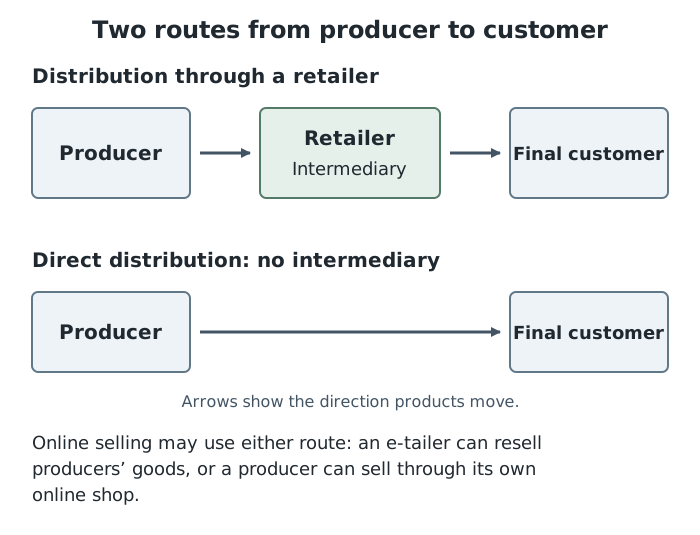
A retailer sits between the producer and the customer. Direct distribution removes this intermediary; selling online does not necessarily do so.
Selling through retailers can give a producer access to many locations and customers. Retailers display products and provide staff who help customers choose, potentially increasing sales. In return, retailers need to earn money on each sale, which can reduce the producer’s profit margin. A producer may also struggle to persuade a large retailer to stock its goods because shelf space is limited.
Selling directly gives the producer more control over how its products are sold and removes the intermediary’s share. But the producer must attract customers itself and arrange deliveries to individual buyers, which can be costly and time-consuming.
A physical retailer sells goods from a shop, sometimes called a bricks-and-mortar outlet. Examples include newsagents and high-street shops. A retailer buys goods from producers or wholesalers and usually sells them at a higher price. This difference is its mark-up. It helps cover costs such as rent and shop staff; it is not all profit.
Physical shops offer several benefits to customers. They can see, feel or test suitable products before buying, reducing uncertainty about whether a purchase will meet their needs. Face-to-face advice helps customers compare products, while staff can respond to their questions and reactions. Customers can usually take an available product away immediately rather than wait for delivery. Shopping itself can also be an enjoyable experience.
These benefits come with costs and limitations. Shop rent and staffing can increase the retailer’s costs, potentially leading to higher prices. Customers must visit during opening hours and may have to queue. Some may also feel uncomfortable buying particular products in person.
For a product customers want to examine before purchasing, the reassurance offered by a shop may outweigh the inconvenience of visiting it.
E-tailers sell goods through websites or other online shopping services. Amazon is a familiar example. Customers select products and place orders online, with goods then delivered or collected where that option is available.
An online-only business does not need a customer-facing shop, so it may have lower start-up and fixed costs than a comparable physical retailer. These savings can support lower prices. However, it may still need employees and storage premises, and developing a suitable website can be expensive.
Online selling can reach customers beyond the area around a shop, potentially including a global market. Customers can place orders without travelling to an outlet and outside normal shop opening hours. An e-tailer can also offer a wider range without being restricted by shop display space. This wider reach creates opportunities for growth, provided the business can fulfil the orders it receives.
The main limitations concern trust and fulfilment. Customers cannot physically inspect products before ordering, and unfamiliar online sellers may find it harder to establish trust. Online security and fraud are risks. Deliveries must be organised, and late delivery can damage the seller’s reputation even when the product itself is satisfactory. The potential for wider sales therefore needs to be weighed against website and distribution costs.
Businesses do not have to choose only one method. Clicks and mortar means operating both physical shops and online selling. Currys, Argos and Tesco are examples. A click-and-collect service lets customers order online and collect from an outlet, combining online ordering with access to a physical location.
Using more than one route can reach customers with different preferences and spread the risk if one method encounters problems. However, maintaining both shops and online selling also requires resources.
The best choice depends on the product, its image, customers’ shopping preferences, the size and resources of the business, and competitors’ distribution methods. There is no method that is automatically best: the business must balance customer access and service against the costs of selling and delivering its products.
Get unlimited access to all revision notes, key terms, and exam tips.
Benefits: customers can inspect or test products, receive face-to-face advice and take available goods away immediately.
Limitations: shop rent and staffing costs, restricted opening hours, queues and potentially higher prices.
Retailers add a mark-up to purchase costs, but must cover operating costs before making profit.
Benefits: potentially lower shop-related costs, wider product range, convenient ordering and access to national or global customers.
Limitations: website costs, difficulty establishing trust, security and fraud risks, and delivery costs or delays. Customers cannot physically inspect goods before ordering.
Get unlimited access to all revision notes, key terms, and exam tips.
Keep the viewpoint clear: a producer selling through a retailer faces different benefits and costs from a retailer operating its own shop.
Develop each point into a consequence: lower shop-related fixed costs may allow an e-tailer to charge lower prices, helping it attract customers.
Avoid claiming that e-tailers have no premises or staffing costs. They may still need storage, employees, a website and delivery arrangements.
When evaluating a distribution method, use the business’s product, customers and resources to explain why one advantage or limitation matters most.
Place
The element of the marketing mix concerned with where and how customers can buy a business’s products.
Distribution channel
The route a product takes from its producer to the final customer, either directly or through other businesses.
Retailer
A business that sells goods to final consumers. A physical retailer sells through shops.
E-tailer
A business that sells goods to consumers online.
E-commerce
Buying and selling goods or services over the internet.
Intermediary
A business between a producer and the final customer that helps products reach customers, such as a retailer.
Direct distribution
Selling from the producer directly to the final customer without an intermediary.
Clicks and mortar
An approach in which a business sells through both physical shops and online.
Mark-up
The amount added to the cost of buying a product to determine its selling price.
Put your knowledge into practice — try past paper questions for Business
Place
The element of the marketing mix concerned with where and how customers can buy a business’s products.
Distribution channel
The route a product takes from its producer to the final customer, either directly or through other businesses.
Retailer
A business that sells goods to final consumers. A physical retailer sells through shops.
E-tailer
A business that sells goods to consumers online.
E-commerce
Buying and selling goods or services over the internet.
Intermediary
A business between a producer and the final customer that helps products reach customers, such as a retailer.
Direct distribution
Selling from the producer directly to the final customer without an intermediary.
Clicks and mortar
An approach in which a business sells through both physical shops and online.
Mark-up
The amount added to the cost of buying a product to determine its selling price.