

Loading…
Loading…
Loading…
AQA GCSE Psychology · 8182
AQA 8182 · Designing Research Check the specification (PDF) (opens in a new tab)
Psychologists decide what evidence they need to answer a research question. Quantitative research collects numerical measurements or counts. Qualitative research collects descriptive material, such as words or images, to explore people's experiences and the meanings they attach to them.
Consider research into memory with music playing. Counting how many words each participant recalls produces quantitative data. Asking participants to describe how the music affected their concentration produces qualitative data. The count tells us how much they remembered; the description can help us understand their experience.
The research method does not always determine the type of data. A questionnaire can collect numerical responses through closed questions or detailed descriptions through open questions. A study can also collect both types of data.
Quantitative data is relatively straightforward to summarise and compare using averages, percentages, tables or graphs. For example, a researcher can compare the number of words recalled with music against the number recalled in silence. Standardised instructions and clear scoring rules make the procedure easier to repeat and can improve reliability, meaning consistency.
However, numbers alone may not explain why a result occurred. A low recall score does not reveal whether someone found the music distracting, felt anxious or used an ineffective memory strategy. Reducing an experience to a score can oversimplify behaviour.
Qualitative data provides richer detail about thoughts, feelings and experiences. Researchers can look for recurring themes in participants' accounts, such as finding lyrics distracting. This is particularly useful when the question concerns how people experience or interpret something, rather than simply how often it happens.
Detailed accounts take time to collect and analyse. They are also open to interpretation: two researchers might identify different meanings in the same response. An unstructured conversation is difficult to repeat exactly, which can reduce consistency. Qualitative accounts can capture everyday experiences, but descriptive data is not automatically realistic or reliable merely because it consists of words.
The best choice therefore depends on the question. Numerical scores suit comparisons of performance; descriptions suit exploring experience. Combining them can provide both a comparison and insight into possible reasons for it.
The experimental method investigates whether changing one variable affects another. The independent variable (IV) is what the researcher changes; the dependent variable (DV) is the outcome measured. Other relevant variables should be controlled so that they do not provide alternative explanations for the results.
In a memory experiment, the IV could be whether participants learn a poem with music playing or in silence. These are the two conditions of the experiment. The DV could be the number of words correctly recalled during a five-minute recall period. Instructions, learning time and scoring rules should be consistent across conditions.
An experimental design determines who takes part in each condition. The three designs make different compromises between controlling differences between people and avoiding the effects of completing a task more than once.
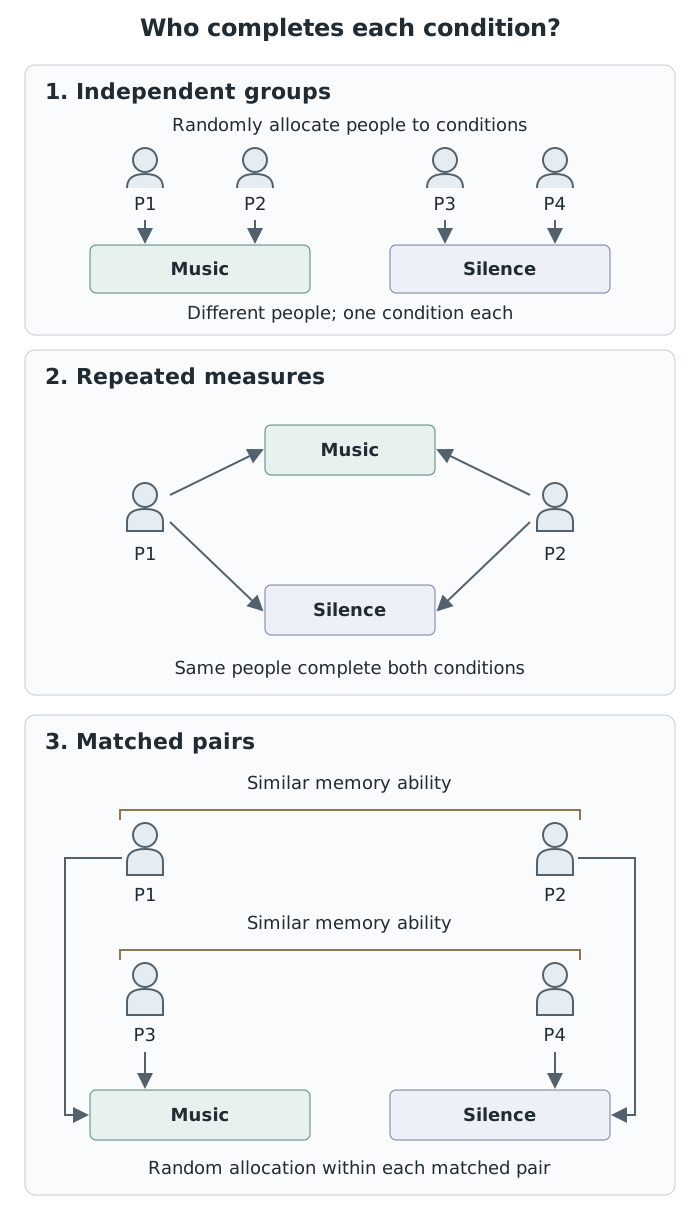
The design changes who completes each condition, not the conditions being compared.
In an independent groups design, each participant completes only one condition. One group learns the poem with music playing; a separate group learns the same poem in silence. The researcher compares the groups' recall scores. These are unrelated data because the scores come from separate groups.
Participants should be randomly allocated to conditions: assignment is decided by chance rather than the researcher's preferences. This reduces researcher bias in allocation, although it cannot guarantee equally able groups.
A strength is that there are no order effects between conditions. Participants do not complete both conditions, so their performance cannot be affected by having already completed the other one. They are also less likely to work out the aim by comparing conditions, reducing the risk of demand characteristics. These are clues that reveal the study's aim and may lead participants to change their behaviour.
The main weakness is participant variables: characteristics that differ between people and may influence results. One group might naturally have better memory, so higher recall could reflect ability rather than the effect of music. This design also needs more participants than repeated measures to obtain the same number of scores in each condition.
Independent groups is useful when completing one condition would change performance in the other, but differences between the groups remain an important limitation.
In a repeated measures design, every participant completes all conditions. Each person learns a poem with music and a different poem in silence. The poems should be comparable in difficulty so that poem difficulty does not provide an alternative explanation for the results.
The researcher compares each participant's performance across conditions. These are related data because the scores come from the same people. Each participant acts as their own control: their underlying memory ability is the same person-level characteristic in both conditions. This controls differences between participants and requires fewer participants than independent groups for the same number of scores per condition.
The main weakness is order effects. Participants might improve in the second condition through practice, or perform worse because of fatigue or boredom. They may also notice what differs between conditions, making demand characteristics more likely.
Repeated measures is useful when participant differences could strongly affect the outcome, provided the influence of completing multiple conditions can be managed.
Counterbalancing varies the order of conditions across participants. For two conditions, half complete music followed by silence, while the other half complete silence followed by music.
Both conditions therefore occur first for some participants and second for others. If practice improves second-task performance, that advantage is spread across both conditions rather than consistently favouring one. Counterbalancing controls the influence of order effects; it does not remove practice or fatigue itself.
In a matched pairs design, researchers first pair participants on characteristics relevant to the study. For the memory experiment, they could match people with similar memory ability. One member of each pair is then randomly allocated to music and the other to silence.
Each participant completes only one condition, but their score is linked to their matched partner's score. The data are therefore related through the matching.
Matching reduces the influence of the selected participant variables. Because each person completes only one condition, there are no order effects between conditions, and participants are less likely to infer the aim by comparing conditions.
However, matching is time-consuming and suitable partners may be difficult to find. People cannot be matched perfectly: two people with similar memory ability might still differ in concentration or motivation. More participants are also needed than for repeated measures to obtain the same number of scores per condition.
Matched pairs is useful when researchers want to reduce relevant differences between people without asking anyone to complete both conditions. Its value depends on choosing appropriate matching characteristics and being able to find suitable pairs.
No design is always best. If repeating the task is likely to cause strong practice effects, independent groups or matched pairs may be preferable. If differences in memory ability are the main concern and participants are limited, repeated measures with counterbalancing may be more practical. Matched pairs offers a compromise, but takes additional time and cannot control every difference between participants.
A justified choice connects the design's strengths and weaknesses to the particular task, rather than simply naming a design as the best.
| Design | Participants | Main strengths | Main weaknesses |
|---|---|---|---|
| Independent groups | Different people in each condition | No order effects; less likely to reveal the aim through comparison | Participant differences; more participants needed |
| Repeated measures | Same people in every condition | Controls participant differences; fewer participants needed | Order effects; greater risk of demand characteristics |
| Matched pairs | Matched partners complete different conditions | Reduces selected participant differences; no order effects | Matching takes time and is imperfect; more participants than repeated measures |
Identify a design by who completes each condition, not by where the experiment takes place.
Link each strength or weakness to the study: explain how memory ability, practice or fatigue could affect its results.
Random allocation assigns participants to conditions; random sampling selects participants from a population.
Counterbalancing spreads order effects across conditions; it does not stop participants becoming practised or tired.
Numerical data is not automatically reliable. Consistent instructions, measurement and scoring help make findings reliable.
Matched participants are similar on selected characteristics, not identical in every respect.
It can see this note and what your specification asks for.
Answers are free with an account.
1 free note left this week
Get more free notesYour answer sets when this note comes back for review, or marks it complete.
Was this note helpful?
Log in to tell us whether it helped, or to report a problem.
Last updated
Quantitative research
Research that collects numerical measurements or counts to investigate behaviour.
Qualitative research
Research that collects descriptive material, such as words or images, to explore experiences and meanings.
Experimental method
A research method that investigates the effect of an independent variable on a dependent variable while controlling other relevant variables.
Independent variable
The variable changed by the researcher in an experiment to investigate its effect.
Dependent variable
The outcome measured in an experiment to investigate the effect of the independent variable.
Experimental design
The way participants are organised in relation to the conditions of an experiment.
Independent groups design
An experimental design in which different participants complete each condition.
Repeated measures design
An experimental design in which the same participants complete every condition.
Matched pairs design
An experimental design in which participants are paired on relevant characteristics, with one member of each pair completing each condition.
Random allocation
Assigning participants to experimental conditions by chance to reduce researcher bias in allocation.
Participant variable
A characteristic that differs between participants, such as memory ability, and could affect an experiment's results.
Order effect
A change in performance caused by the sequence in which conditions are completed, such as practice, fatigue or boredom.
Counterbalancing
Varying the order of conditions across participants to balance the influence of order effects.
Demand characteristics
Clues in a study that suggest its aim to participants and may lead them to change their behaviour.
Reliability
The consistency of a measurement or finding.
Put your knowledge into practice — try past paper questions for Psychology
Quantitative research
Research that collects numerical measurements or counts to investigate behaviour.
Qualitative research
Research that collects descriptive material, such as words or images, to explore experiences and meanings.
Experimental method
A research method that investigates the effect of an independent variable on a dependent variable while controlling other relevant variables.
Independent variable
The variable changed by the researcher in an experiment to investigate its effect.
Dependent variable
The outcome measured in an experiment to investigate the effect of the independent variable.
Experimental design
The way participants are organised in relation to the conditions of an experiment.
Independent groups design
An experimental design in which different participants complete each condition.
Repeated measures design
An experimental design in which the same participants complete every condition.
Matched pairs design
An experimental design in which participants are paired on relevant characteristics, with one member of each pair completing each condition.
Random allocation
Assigning participants to experimental conditions by chance to reduce researcher bias in allocation.
Participant variable
A characteristic that differs between participants, such as memory ability, and could affect an experiment's results.
Order effect
A change in performance caused by the sequence in which conditions are completed, such as practice, fatigue or boredom.
Counterbalancing
Varying the order of conditions across participants to balance the influence of order effects.
Demand characteristics
Clues in a study that suggest its aim to participants and may lead them to change their behaviour.
Reliability
The consistency of a measurement or finding.