

Loading…
Loading…
Loading…
AQA Level 2 Certificate Further Mathematics · 8365
AQA 8365 · 6.1 Geometric Measurements and Properties Check the specification (PDF) (opens in a new tab)
Perimeter is the total distance around a shape’s outside boundary. Area is the amount of space inside that boundary. To picture the difference, imagine a rectangular garden: fencing follows its perimeter, while turf covers its area.
Perimeter is measured in length units, such as cm or m. Area is measured in square units, such as or . One square centimetre is the area of a square measuring 1 cm by 1 cm.
Lengths must be in the same unit before you combine them. For example, a rectangle measuring 2 m by 50 cm should be treated as 2 m by 0.5 m, or as 200 cm by 50 cm.
A rectangle has equal opposite sides. If its length is and its width is , its perimeter is
Its area is
The area formula comes from counting rows of unit squares: the number of squares in each row is multiplied by the number of rows.
For example, a rectangle measuring 8 cm by 3 cm has perimeter and area . These answers measure different things, so they have different units.
A square is a rectangle with all four sides equal. For side length , its perimeter is and its area is .
Every point on a circle is the same distance from its centre. That distance is the radius, . The diameter, , crosses the circle through its centre, so .
The perimeter of a circle is called its circumference, . For every circle, circumference divided by diameter gives the same number, . Therefore,
The area of a circle is
Notice how the radius is used differently: circumference involves , whereas area involves . Doubling the radius doubles the circumference but makes the area four times as large.
Suppose a circle has diameter 10 cm. Its radius is . Its circumference is , and its area is .
These are exact answers. If decimal answers are required, they are approximately 31.4 cm and , respectively, to one decimal place.
For triangles, parallelograms and trapezia, the height must be measured at right angles to the base. A sloping side is not generally the height. The chosen base and its height must belong together.
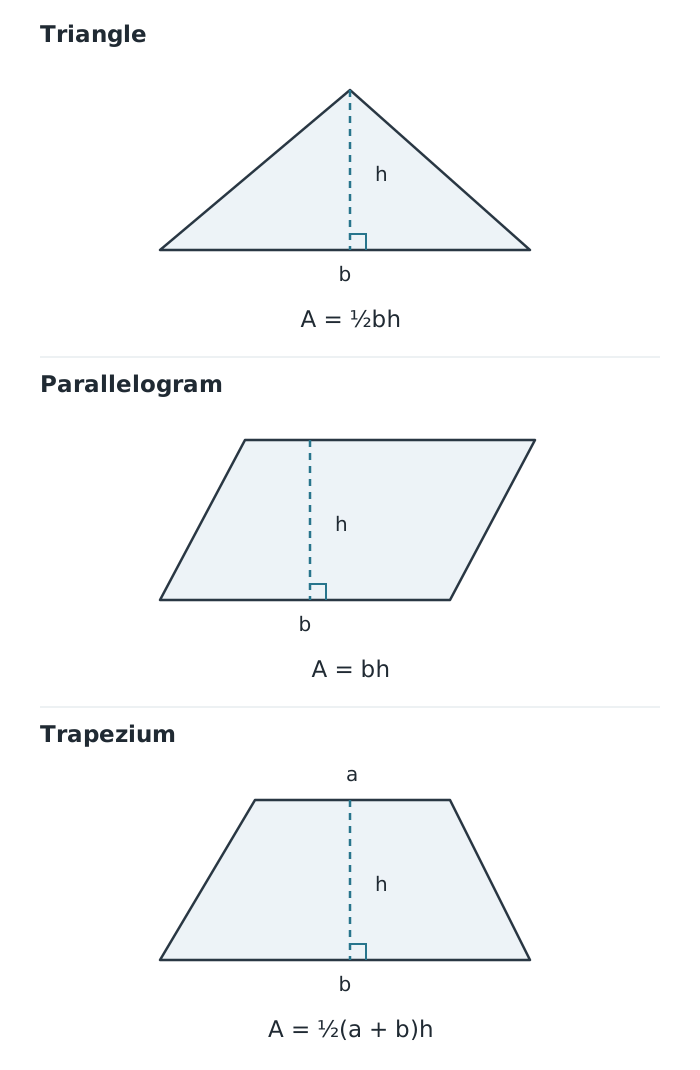
The height in each area formula is perpendicular to the chosen base.
A parallelogram has two pairs of parallel opposite sides. Cutting a triangular piece from one end and moving it to the other makes a rectangle with the same base and perpendicular height. No area is gained or lost, so
A triangle occupies half the area of a parallelogram with the same base and perpendicular height:
For example, with base 9 cm and perpendicular height 4 cm, a parallelogram has area , while a triangle has area .
In a right-angled triangle, the two sides meeting at the right angle can be used as the base and perpendicular height. The side opposite the right angle is not the height for either of those bases.
A trapezium has one pair of parallel sides. Call their lengths and , and let be the perpendicular distance between them. Its area is
You can understand this as the average length of the parallel sides multiplied by the height. Alternatively, two identical trapezia can fit together to make a parallelogram with base and height ; one trapezium has half its area.
For parallel sides of 30 cm and 15 cm, separated by a perpendicular height of 20 cm, the area is .
A more complicated shape can often be split into rectangles, triangles, parallelograms or trapezia. Calculate each part’s area and add the results, ensuring that the parts neither overlap nor leave gaps. If a piece has been removed from a larger shape, subtract its area instead.
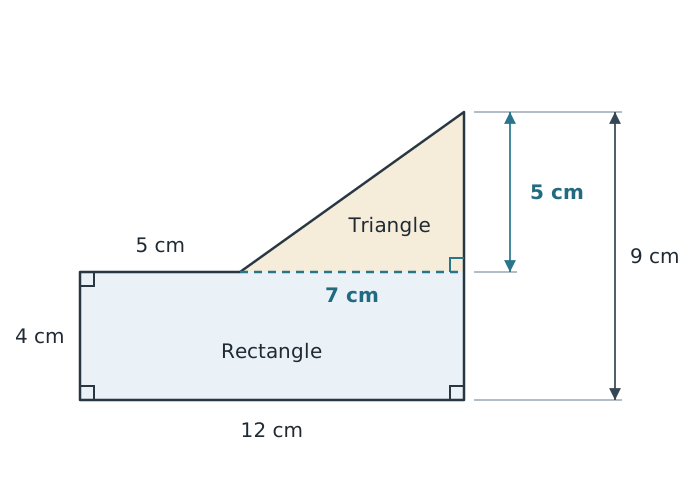
Split the pentagon into a rectangle and a triangle: the missing lengths are and .
For the pentagon shown, a horizontal dividing line separates a rectangle from a right-angled triangle. The rectangle measures 12 cm by 4 cm. The triangle’s base is the remaining horizontal distance, , and its height is the extra vertical distance, .
The total area is therefore
The dividing line helps calculate area, but it is not part of the outside boundary. When calculating a perimeter, trace only the outside edges and add their lengths.
For length and width :
Learn the trapezium area, circle area and circumference formulae: AQA Further Mathematics will not provide them in the exam.
For triangle, parallelogram and trapezium areas, use the perpendicular height, not a sloping side.
If a circle’s diameter is given, halve it before using .
Convert lengths to the same unit before calculating. Give perimeter in length units and area in square units.
Keep in exact answers. For decimal answers, use your calculator’s key and round only at the end.
It can see this note and what your specification asks for.
Answers are free with an account.
1 free note left this week
Get more free notesYour answer sets when this note comes back for review, or marks it complete.
Was this note helpful?
Log in to tell us whether it helped, or to report a problem.
Last updated
Perimeter
The total distance around the outside boundary of a two-dimensional shape.
Area
The amount of two-dimensional space inside a shape, measured in square units.
Circumference
The perimeter of a circle.
Radius
A line segment from the centre of a circle to its circumference, or the length of that segment.
Diameter
A straight line segment joining two points on a circle and passing through its centre. Its length is twice the radius: .
Perpendicular height
The distance measured at right angles from a chosen base to the opposite vertex or parallel side.
Trapezium
A quadrilateral with one pair of parallel sides.
Compound shape
A shape formed by joining two or more simpler shapes.
π
The constant ratio of a circle’s circumference to its diameter: .
Put your knowledge into practice — try past paper questions for Further Mathematics
Perimeter
The total distance around the outside boundary of a two-dimensional shape.
Area
The amount of two-dimensional space inside a shape, measured in square units.
Circumference
The perimeter of a circle.
Radius
A line segment from the centre of a circle to its circumference, or the length of that segment.
Diameter
A straight line segment joining two points on a circle and passing through its centre. Its length is twice the radius: .
Perpendicular height
The distance measured at right angles from a chosen base to the opposite vertex or parallel side.
Trapezium
A quadrilateral with one pair of parallel sides.
Compound shape
A shape formed by joining two or more simpler shapes.
π
The constant ratio of a circle’s circumference to its diameter: .
Leave in an exact answer; use the calculator’s key for a decimal answer.
In every formula, is the perpendicular height.
Split into familiar shapes and add their areas, or subtract a removed area from a larger shape. Find missing lengths using the given dimensions.
Perimeter counts only the outside boundary. Use consistent length units; area answers need square units.