Loading…


Loading…
Loading…
Loading…
AQA GCSE Design and Technology · 8552
AQA 8552 · Commercial processes Check the specification (PDF) (opens in a new tab)
Metal components can be made by removing material from solid stock or by shaping metal while it is molten. Milling uses a rotating cutter to remove metal from a solid workpiece. Casting forms metal inside a mould, where it cools and becomes solid.
This difference helps a manufacturer choose a suitable process. A bracket needing precise flat faces and slots may be milled. A complex engine part or housing may be cast. The processes can also work together: a casting may need machining afterwards to bring particular surfaces or dimensions to the required standard.
A milling cutter has several cutting edges. As it rotates, these edges remove metal where the cutter meets the workpiece. The workpiece is held securely in a machine vice or fixture, so cutting forces do not move it out of position.
The operator selects a suitable cutter and cutting speed. Controlled movement between the cutter and workpiece then produces features such as flat faces, steps, slots and pockets. A pocket is a recessed area cut into a surface rather than all the way through the metal.
Movement is controlled in three directions, called the X, Y and Z axes. X and Y describe movement across the workpiece in two perpendicular directions; Z controls the vertical relationship between the cutter and workpiece, including cutting depth. Combining these movements lets the machine cut a feature to a planned position, size and depth.
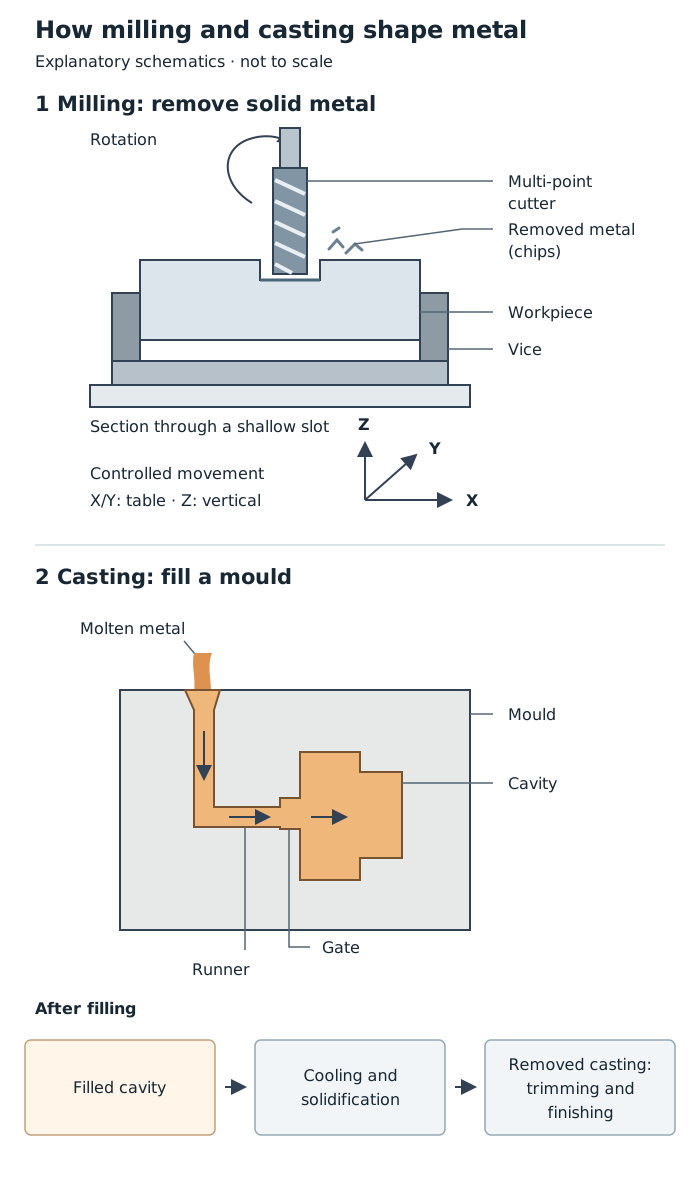
Milling removes metal from solid stock; casting forms metal as it solidifies inside a mould. These are explanatory diagrams, not machine operating instructions.
A component’s dimensions usually have a permitted range of variation, called a tolerance. Milling can achieve close tolerances and a high-quality surface finish, making it useful for machine parts, brackets, moulds and precision prototypes.
Accuracy depends on control, not just on using a milling machine. Secure clamping keeps the workpiece in position. A depth stop limits movement to a set cutting depth, helping repeated features reach the same measurement. A digital readout helps the operator monitor position and movement.
With computer numerical control (CNC), a program controls the machine’s movements. Repeating the same programmed X, Y and Z tool paths helps produce consistent parts across a batch. For example, brackets intended to fit the same assembly need their slots in matching positions and at matching dimensions. A slot that is too small or too large may prevent the bracket from fitting correctly.
Casting begins with a mould cavity corresponding to the shape of the component. A pattern can be used to create this cavity, or the cavity can be formed in a die. The metal is heated above its melting point so that it becomes liquid.
The molten metal is poured or forced into the mould. Runners carry it towards the cavity, and gates provide the openings through which it enters. The metal fills the cavity, cools and solidifies. Once solid, the casting is removed, excess metal is trimmed away and the component is finished as needed.
Casting is useful for engine parts, handles, housings and cookware. Its main advantage is that a mould can form a complex shape with relatively little subsequent machining. Rather than cutting every feature out of a solid block, the manufacturer forms much of the component’s shape in one casting operation.
The shape of the cavity alone does not guarantee a successful casting. Good mould design and suitable process settings must help the molten metal fill the cavity properly and solidify successfully.
Incomplete filling leaves part of the intended shape missing. Air pockets leave unwanted voids within the casting. Shrinkage as the metal cools must also be controlled so that the finished component has acceptable dimensions. Quality checks can identify these problems, as well as cracks, excessive flash or incorrect dimensions. Flash is unwanted thin metal formed where molten metal escapes into a gap at a mould joint.
The central distinction is therefore simple: milling controls the removal of solid metal, whereas casting controls the filling and solidification of molten metal. Both can make commercial components, but they achieve the shape in different ways.
Get unlimited access to all revision notes, key terms, and exam tips.
Milling removes solid material; casting forms molten material in a mould. A cast component may also be milled where precise finished dimensions are needed.
Get unlimited access to all revision notes, key terms, and exam tips.
Link a process to the component being made: milling can produce an accurately dimensioned slot; casting can form a complex housing.
Explain how accuracy is achieved rather than simply calling milling ‘accurate’: secure clamping prevents movement, and a depth stop limits cutting depth.
For repeated CNC milling, explain that the program repeats the same controlled tool paths on each workpiece.
When discussing casting quality, name a specific defect, such as an air pocket or incomplete filling, and explain its effect on the component.
Milling
A machining process that removes material from a workpiece using a rotating cutter with several cutting edges.
Workpiece
The piece of material being shaped or processed.
Tolerance
The permitted variation from a specified dimension. A close tolerance allows only a small variation.
CNC
Computer numerical control: the use of a computer program to control a machine’s movements.
Depth stop
A device that limits movement to a set depth, helping a machine produce features of consistent depth.
Casting
A forming process in which molten metal enters a mould cavity, then cools and solidifies into its shape.
Runner
A channel that carries molten metal towards a mould cavity.
Gate
The opening through which molten metal enters a mould cavity from a runner.
Put your knowledge into practice — try past paper questions for Design and Technology
Milling
A machining process that removes material from a workpiece using a rotating cutter with several cutting edges.
Workpiece
The piece of material being shaped or processed.
Tolerance
The permitted variation from a specified dimension. A close tolerance allows only a small variation.
CNC
Computer numerical control: the use of a computer program to control a machine’s movements.
Depth stop
A device that limits movement to a set depth, helping a machine produce features of consistent depth.
Casting
A forming process in which molten metal enters a mould cavity, then cools and solidifies into its shape.
Runner
A channel that carries molten metal towards a mould cavity.
Gate
The opening through which molten metal enters a mould cavity from a runner.