Loading…


Loading…
Loading…
Loading…
AQA GCSE Design and Technology · 8552
AQA 8552 · Commercial processes Check the specification (PDF) (opens in a new tab)
Routing and turning both shape timber by removing material. Their different movements make them suitable for different products. Routing uses a rotating cutter to shape a secured workpiece; turning rotates the workpiece itself on a lathe.
In commercial production, making one correct component is not enough. Manufacturers need to repeat its shape and dimensions across many components, so guides, templates and computer-controlled machinery are useful.
Routing removes timber or manufactured board using a high-speed rotating cutter called a router bit. The bit's shape determines the feature it cuts. Different bits can produce grooves, rebates, decorative edge profiles or cut-outs.
The workpiece is secured with clamps, or guided against a straight guide called a fence, depending on the machine arrangement. A guide, template or jig controls the cutting path. A template is especially useful for a repeated shaped outline: it guides each cut so the manufacturer does not have to shape every component by eye.
The cutter is moved relative to the workpiece along the required path. Several shallow passes may be used to reach the final depth safely and accurately rather than removing all the material in one deep cut. Correct feed direction and dust extraction help maintain safe working conditions and surface quality.
Routing is used for cabinet joints, slots, signs, decorative edges and flat-pack furniture parts. For example, a routed groove in a cabinet panel can provide a location for another panel, while a shaped router bit can create a decorative edge around a tabletop.
Commercial manufacturers commonly use computer numerical control (CNC) routing. A program controls the cutter's path using coordinates, allowing the machine to repeat the same design across successive workpieces.
This improves repeatability and can increase output while reducing the labour needed for each component. It is particularly useful when many furniture parts need matching grooves or outlines. However, CNC equipment has a high initial cost, and the cutting program must be prepared correctly. Automation repeats the programmed instructions; it does not make an incorrect design correct.
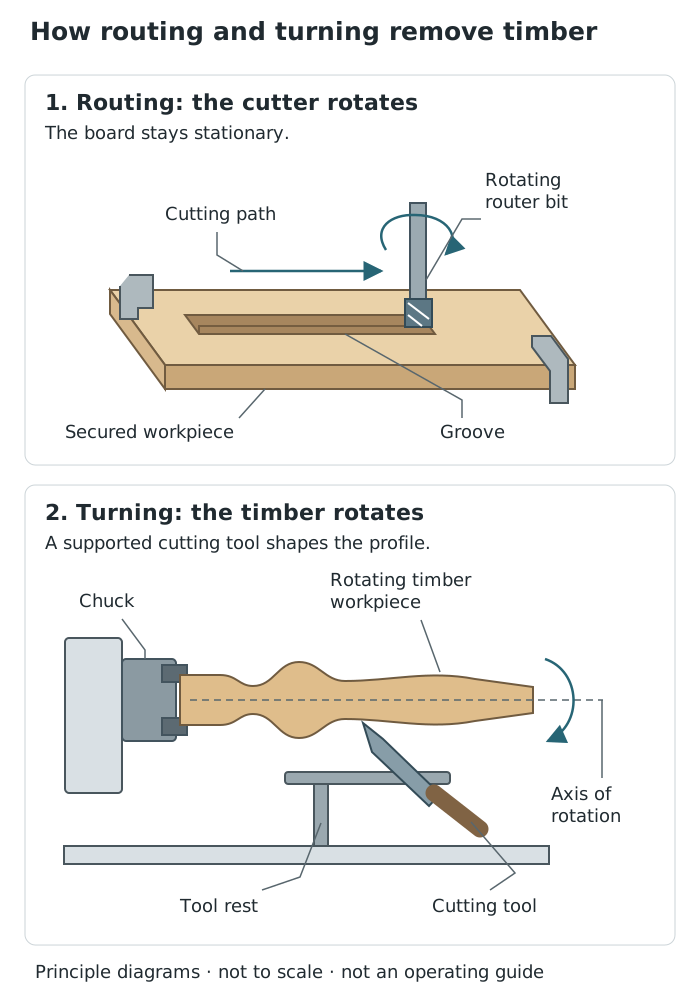
Routing rotates a cutter to shape a secured board; turning rotates the timber while a cutting tool shapes its profile.
Turning shapes a timber blank—a piece of timber prepared for machining—on a lathe. The blank is securely mounted, for example in a chuck whose jaws grip the timber. The lathe rotates it about an axis.
In manual turning, a tool rest is positioned close to the workpiece to support the cutting tool. Gouges and chisels remove material as the timber rotates, creating cylindrical sections, curves, raised rounded features called beads, and tapers that gradually narrow. The part can then be sanded and finished on the lathe.
Turning is suitable for chair legs, handles, staircase spindles and bowls. A rounded table leg is a useful example: its diameter can change along its length, but its rounded sections are centred on the same axis. Rotating the timber allows material to be removed around that axis to create the required profile.
A set of chair legs needs matching dimensions and profiles. Callipers can check dimensions, while a profile gauge or sample component helps compare the developing shape with the intended result.
Commercial turning can also use template-controlled or CNC-controlled lathes to reproduce a profile consistently. This reduces reliance on individually shaping each part by eye. The central distinction remains the same: routing rotates the cutter; turning rotates the timber workpiece.
Get unlimited access to all revision notes, key terms, and exam tips.
Routing: cutter rotates. Turning: workpiece rotates.
Get unlimited access to all revision notes, key terms, and exam tips.
When describing a process, explain what rotates, how the material is held and how material is removed—not just the machine's name.
Link the process to the required shape: routing suits grooves and edge profiles; turning suits rounded components with rotational symmetry.
Explain repeatability rather than simply saying 'accurate': a template or CNC program guides production so components have the same shape and dimensions.
Routing
Removing timber or manufactured board with a high-speed rotating cutter to produce grooves, shaped edges or cut-outs.
Turning
Shaping a rotating timber workpiece on a lathe by removing material with cutting tools.
Lathe
A machine that holds and rotates a workpiece while cutting tools shape it.
Chuck
A holding device with jaws that grip a workpiece in a machine.
Template
A guide used to reproduce a particular shape consistently.
CNC
Computer numerical control: using programmed instructions to control a machine's movements.
Rebate
A step-shaped recess cut along the edge of a material, often to accommodate another component.
Repeatability
The ability of a manufacturing process to produce the same result consistently across repeated components.
Put your knowledge into practice — try past paper questions for Design and Technology
Routing
Removing timber or manufactured board with a high-speed rotating cutter to produce grooves, shaped edges or cut-outs.
Turning
Shaping a rotating timber workpiece on a lathe by removing material with cutting tools.
Lathe
A machine that holds and rotates a workpiece while cutting tools shape it.
Chuck
A holding device with jaws that grip a workpiece in a machine.
Template
A guide used to reproduce a particular shape consistently.
CNC
Computer numerical control: using programmed instructions to control a machine's movements.
Rebate
A step-shaped recess cut along the edge of a material, often to accommodate another component.
Repeatability
The ability of a manufacturing process to produce the same result consistently across repeated components.