Loading…


Loading…
Loading…
Loading…
AQA GCSE Design and Technology · 8552
AQA 8552 · Commercial processes Check the specification (PDF) (opens in a new tab)
Many polymer products are manufactured by heating the material, shaping it and then cooling it so that it keeps its new form. A thermoplastic is a polymer that softens when heated and hardens when cooled. This makes it suitable for processes such as injection moulding and extrusion.
Both processes feed polymer granules into a heated barrel and use a screw to move the softened material forwards. Their important difference is what happens next: injection moulding fills a closed mould to make a separate component, whereas extrusion pushes material continuously through a shaped opening to make a long section.
Injection moulding forces molten thermoplastic into a closed metal mould under pressure. The shaped space inside the mould is called the mould cavity. It determines the form of the component, allowing products such as bottle caps, clips, toys and electrical casings to be made repeatedly.
The process follows a repeating cycle:
Ejector pins release the moulding without an operator having to pull it out by hand. Notice that the mould stays closed while the polymer is injected and cooled: it opens only when the component is ready to be removed.
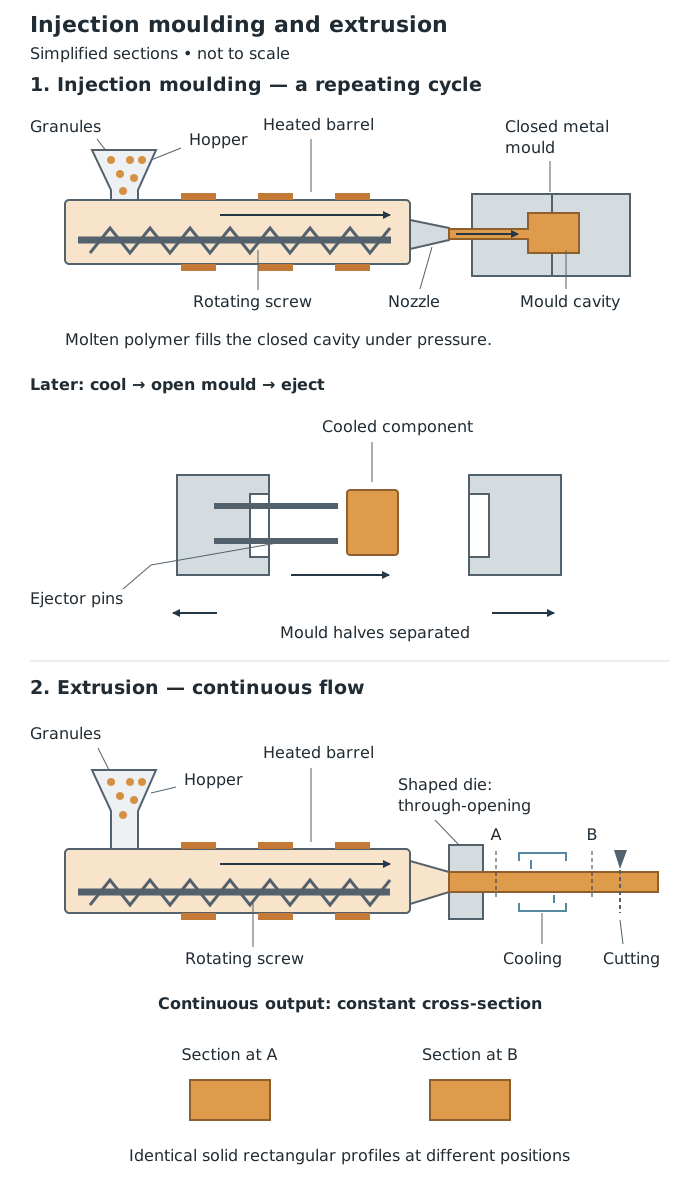
Both processes use a heated barrel and screw. Injection moulding fills a closed cavity; extrusion produces a continuous section through a die.
The metal mould is expensive tooling: it must be made for the required component. Injection moulding therefore suits mass production, where large numbers of the same product are needed. The cost of the mould can be spread across many components rather than being carried by just a few.
A bottle cap is a useful example. Each cap is a separate three-dimensional component, so a mould cavity can form its shape and the machine can repeat the cycle to produce many matching caps. Other applications include chairs and electrical fittings.
Consistent quality depends on controlling temperature, pressure and cooling time. These settings help the cavity fill properly and the component harden into the intended shape. Poor control can produce defects such as a short shot, where the cavity is not completely filled; sink marks, which are unwanted depressions in the surface; or warping, where the component becomes distorted.
Extrusion continuously forces softened polymer through a shaped die. Unlike a mould cavity, a die is an opening that the material passes through. Its profile determines the product’s cross-section — the shape seen if the product is cut across its length.
A pipe illustrates the result: it can be cut into different lengths, but its hollow cross-section remains the same along each length. Extrusion is also used for window-frame profiles, rails, sheet, film and cable insulation.
The process is efficient for long, continuous products. Its central limitation is that the cross-section must remain constant along the length; extrusion alone cannot produce a shape that becomes wider, narrower or otherwise changes profile from one point to another.
The die shape, temperature, screw speed and cooling must be controlled to achieve the required dimensions and surface finish.
Start with the product’s geometry. A separate shaped component, such as a clip or casing, suits injection moulding. A long product with an unchanged profile, such as a pipe or window-frame section, suits extrusion.
Then consider production. Injection moulding repeats a filling, cooling and ejection cycle, and its expensive mould is best justified by making many identical components. Extrusion produces material continuously through the die and is efficient when long lengths of the same profile are required. Both need controlled processing conditions to produce consistent results.
Get unlimited access to all revision notes, key terms, and exam tips.
Injection moulding: closed cavity, separate mouldings, repeating cycle.
Extrusion: shaped opening, continuous profile, constant cross-section.
Get unlimited access to all revision notes, key terms, and exam tips.
When explaining a process, link each named component to its job: the hopper feeds granules, the screw moves the polymer, and the mould or die determines the shape.
Distinguish a closed mould cavity from a die opening. Injection moulding produces separate mouldings; extrusion produces a continuous section.
Justify a process choice using the product’s shape and production quantity, rather than simply saying it is quick or cheap.
A constant cross-section does not have to be solid: an extruded pipe has the same hollow profile along its length.
Thermoplastic
A polymer that softens when heated and hardens when cooled, allowing it to be shaped using heat.
Injection moulding
A manufacturing process that forces molten thermoplastic under pressure into a closed mould, where it cools into a separate component.
Extrusion
A manufacturing process that continuously forces softened polymer through a shaped die to produce a length with a constant cross-section.
Mould cavity
The shaped space inside a mould that fills with polymer and determines the form of the moulded component.
Die
A shaping tool with an opening through which material is forced; in extrusion, its profile determines the product’s cross-section.
Cross-section
The shape seen when an object is sliced across its length. A constant cross-section stays the same along the length.
Ejector pin
A pin that pushes a cooled injection-moulded component out of its mould after the mould opens.
Put your knowledge into practice — try past paper questions for Design and Technology
Thermoplastic
A polymer that softens when heated and hardens when cooled, allowing it to be shaped using heat.
Injection moulding
A manufacturing process that forces molten thermoplastic under pressure into a closed mould, where it cools into a separate component.
Extrusion
A manufacturing process that continuously forces softened polymer through a shaped die to produce a length with a constant cross-section.
Mould cavity
The shaped space inside a mould that fills with polymer and determines the form of the moulded component.
Die
A shaping tool with an opening through which material is forced; in extrusion, its profile determines the product’s cross-section.
Cross-section
The shape seen when an object is sliced across its length. A constant cross-section stays the same along the length.
Ejector pin
A pin that pushes a cooled injection-moulded component out of its mould after the mould opens.