

Loading…
Loading…
Loading…
AQA GCSE Combined Science: Synergy · 8465
AQA 8465 · 4.4.1.8 Sources of Potable Water Check the specification (PDF) (opens in a new tab)
Describe the principal methods used to increase the availability of potable water, focusing on separation techniques and the treatment of waste, ground, and salt water.
Describe, explain, and provide examples of the simple distillation process.
Define potable water as water that is safe to drink, and distinguish it from chemically pure water by noting the presence of dissolved substances.
Explain how the methods for producing potable water depend on available water supplies and local environmental conditions.
Outline the primary steps for producing potable water from fresh water, including source selection, filtration, and sterilization.
Identify common sterilizing agents used in water treatment, such as chlorine, ozone, or ultraviolet light.
Explain the processes of desalination (including distillation and reverse osmosis) used when fresh water supplies are limited, noting the significant energy resources required.
Understand the necessity of treating large volumes of urban and industrial waste water before environmental release.
Detail the requirements for treating sewage and agricultural waste water versus industrial waste water.
Outline the stages of sewage treatment, including screening, grit removal, sedimentation, anaerobic digestion of sludge, and aerobic biological treatment of effluent.
Evaluate the personal, social, economic, and environmental implications associated with sourcing potable water and treating waste water.
Conduct practical analysis and purification of water samples from different sources, testing for pH and dissolved solids, and utilizing distillation techniques.
Water leaving a kitchen, bathroom, farm or factory can contain much more than water molecules. Urban lifestyles and industrial processes produce large volumes of waste water, which must be treated before being released into the environment. Without treatment, pollutants can damage ecosystems, harm plants and animals, and contaminate water supplies.
The treatment needed depends on what the water contains. Sewage contains human waste and other waste from homes and buildings. Sewage and agricultural waste water, such as water contaminated with animal waste, require the removal of organic matter and harmful microbes. Organic matter is material originating from living organisms, such as faeces and food waste. Harmful microbes can cause disease.
Industrial waste water may require the removal of organic matter and harmful chemicals. For example, some industrial processes produce waste water containing toxic metal compounds. Removing visible solids alone would not remove these dissolved pollutants, so treatment must be suited to the contaminants present.
Sewage treatment begins with screening and grit removal. Screens catch large insoluble objects, such as pieces of plastic and twigs. Grit removal separates small, heavy particles such as sand.
These processes remove physical debris, but they do not make the water clean enough to release. Smaller suspended particles, organic matter and harmful microbes can remain, so further stages are needed.
The sewage enters a settlement tank, where suspended solids are given time to settle under gravity. This process is called sedimentation.
The solid-rich material collecting at the bottom is sewage sludge. The liquid above it is effluent. Effluent is not clean drinking water: it still contains organic matter that needs treatment.
Sedimentation creates two separate treatment routes. Sludge and effluent are treated differently because one is concentrated solid-rich material and the other is mainly liquid.
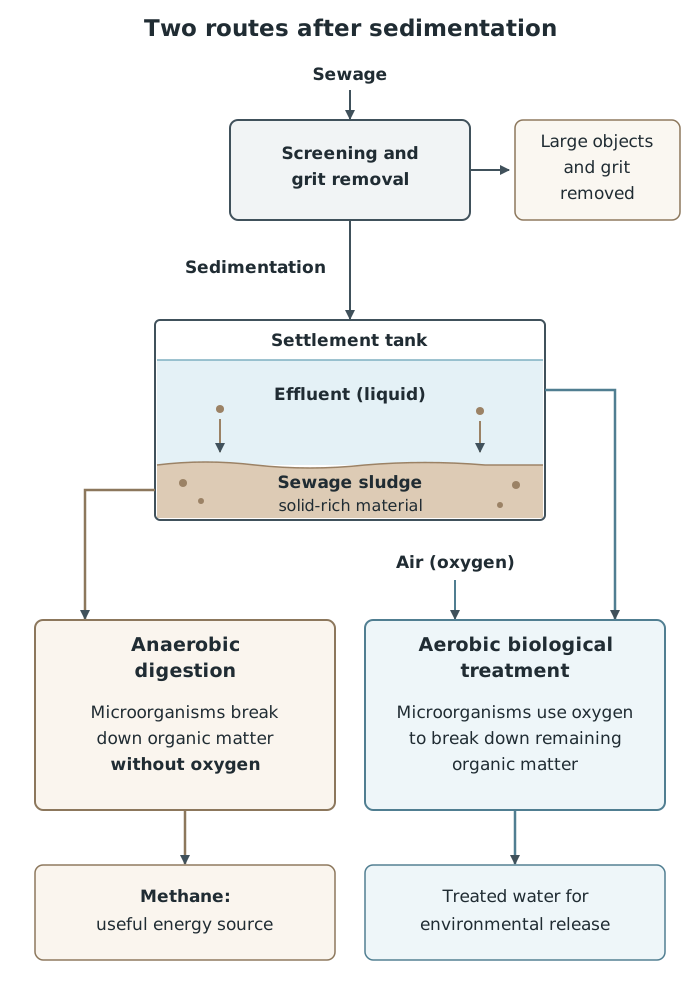
Sedimentation separates sewage into two fractions: sludge is treated without oxygen, while effluent is treated with oxygen.
Sewage sludge undergoes anaerobic digestion. Microorganisms break down its organic matter without oxygen: anaerobic means that oxygen is not used.
This digestion produces methane, which can be used as an energy source. Recovering energy from the sludge is a useful benefit of treatment, rather than simply disposing of all the waste.
Effluent undergoes aerobic biological treatment. Air is pumped into the liquid to supply oxygen, allowing aerobic microorganisms to break down the remaining organic matter. Here, aerobic means that oxygen is used, and biological means that living organisms carry out the treatment.
The contrast is important: sludge is digested without oxygen, while effluent is treated with oxygen. Both routes use microorganisms, but under different conditions.
The purpose of waste water treatment is to make the water suitable for release into the environment. That is a different standard from making water potable. Water that has passed through sewage treatment must not automatically be regarded as safe to drink.
Water treatment has implications for individuals, communities, the economy and the environment. These are connected rather than four unrelated lists.
For an individual, safe drinking water and effective sewage treatment reduce exposure to harmful microbes. For society, treating large volumes of waste water protects shared water supplies and the rivers and seas used by whole communities. These benefits matter even to people who live far from the treatment works because water moves through the environment.
However, treatment works require equipment, energy and continued operation, all of which cost money. Pumping air into effluent is one example of an energy demand. These costs must be weighed against the benefits of preventing pollution and protecting health. Methane recovered from sludge can provide useful energy, but this does not mean the entire treatment process has no costs.
Environmentally, removing pollutants protects organisms and their habitats. There is also an environmental cost to supplying energy for treatment, particularly where that energy comes from burning fuels. An evaluation should consider both the pollution prevented and the resources used, rather than describing treatment as either completely beneficial or completely harmful.
The same balancing approach applies when deciding where drinking water should come from. Potable water is water that is safe to drink, not necessarily chemically pure water.
A suitable fresh-water source, including ground water, usually has relatively low levels of dissolved substances. Filtration and sterilisation can make such water potable, so an available, suitable fresh-water supply is generally easier to treat than heavily contaminated waste water. Waste water requires additional stages to deal with organic matter, harmful microbes and, where present, harmful chemicals. Treating it protects the quality of water sources downstream, even when the treated water is not supplied directly for drinking.
Where fresh water is scarce, desalination can provide water from salty water or sea water. Distillation and reverse osmosis require energy, which adds economic and environmental costs. Nevertheless, those costs may be justified where there is no adequate fresh-water supply: a community still needs reliable drinking water.
A justified conclusion therefore depends on local conditions. Where suitable fresh water is available, using it may reduce treatment demands. Where it is limited, more demanding methods may be necessary. In either situation, waste water must be treated appropriately before release; avoiding the treatment cost would leave the health and environmental risks unresolved.
After sedimentation, describe two separate treatment routes: sludge undergoes anaerobic digestion; effluent undergoes aerobic biological treatment.
State what each stage does, rather than simply listing the stage names.
Do not assume that water treated for release into the environment is safe to drink.
For an evaluation, connect benefits and drawbacks to the local situation, then give a justified conclusion. Avoid claiming that one water source is always best.
It can see this note and what your specification asks for.
Answers are free with an account.
1 free note left this week
Get more free notesYour answer sets when this note comes back for review, or marks it complete.
Was this note helpful?
Log in to tell us whether it helped, or to report a problem.
Last updated
Waste water
Water that has been used or contaminated by activities in homes, agriculture or industry and requires treatment before release into the environment.
Sewage
Waste water containing human waste and other waste from homes and buildings.
Organic matter
Material originating from living organisms, such as faeces and food waste, which microorganisms can break down.
Sedimentation
The separation of suspended solids from a liquid by allowing the solids to settle under gravity.
Sewage sludge
The solid-rich material that settles to the bottom of a tank during sewage treatment.
Effluent
The liquid separated from sewage sludge during sedimentation, which still requires further treatment.
Anaerobic digestion
The breakdown of organic matter by microorganisms without oxygen.
Aerobic biological treatment
Treatment in which microorganisms use oxygen to break down organic matter in waste water.
Potable water
Water that is safe to drink; it may contain dissolved substances and is not necessarily chemically pure.
Put your knowledge into practice — try past paper questions for Combined Science: Synergy
Waste water
Water that has been used or contaminated by activities in homes, agriculture or industry and requires treatment before release into the environment.
Sewage
Waste water containing human waste and other waste from homes and buildings.
Organic matter
Material originating from living organisms, such as faeces and food waste, which microorganisms can break down.
Sedimentation
The separation of suspended solids from a liquid by allowing the solids to settle under gravity.
Sewage sludge
The solid-rich material that settles to the bottom of a tank during sewage treatment.
Effluent
The liquid separated from sewage sludge during sedimentation, which still requires further treatment.
Anaerobic digestion
The breakdown of organic matter by microorganisms without oxygen.
Aerobic biological treatment
Treatment in which microorganisms use oxygen to break down organic matter in waste water.
Potable water
Water that is safe to drink; it may contain dissolved substances and is not necessarily chemically pure.
The final two stages are separate routes, not successive treatments of the same material. Treated waste water is not automatically potable.
Reach a conclusion based on water availability, contaminants, costs and the consequences for health and the environment.