

Loading…
Loading…
Loading…
AQA GCSE Combined Science: Synergy · 8465
AQA 8465 · 4.4.1.8 Sources of Potable Water Check the specification (PDF) (opens in a new tab)
Describe the principal methods used to increase the availability of potable water, focusing on separation techniques and the treatment of waste, ground, and salt water.
Describe, explain, and provide examples of the simple distillation process.
Define potable water as water that is safe to drink, and distinguish it from chemically pure water by noting the presence of dissolved substances.
Explain how the methods for producing potable water depend on available water supplies and local environmental conditions.
Outline the primary steps for producing potable water from fresh water, including source selection, filtration, and sterilization.
Identify common sterilizing agents used in water treatment, such as chlorine, ozone, or ultraviolet light.
Explain the processes of desalination (including distillation and reverse osmosis) used when fresh water supplies are limited, noting the significant energy resources required.
Understand the necessity of treating large volumes of urban and industrial waste water before environmental release.
Detail the requirements for treating sewage and agricultural waste water versus industrial waste water.
Outline the stages of sewage treatment, including screening, grit removal, sedimentation, anaerobic digestion of sludge, and aerobic biological treatment of effluent.
Evaluate the personal, social, economic, and environmental implications associated with sourcing potable water and treating waste water.
Conduct practical analysis and purification of water samples from different sources, testing for pH and dissolved solids, and utilizing distillation techniques.
Potable water is water that is safe to drink. It must not contain harmful levels of dissolved substances or harmful microorganisms. However, it can contain small amounts of dissolved substances, such as mineral salts.
Chemically pure water contains only water molecules. This makes purity different from safety: drinking water does not need to be chemically pure to be potable. A clear glass of water may contain dissolved salts that cannot be seen, and its appearance alone cannot show whether it is safe.
The best treatment method depends on the available water supplies and local conditions. In the UK, rainfall supplies fresh water with low levels of dissolved substances. This water collects in rivers, lakes and the ground.
Most UK potable water is produced in three main stages:
Filtration and sterilisation therefore have different jobs. Removing visible dirt does not necessarily remove microorganisms, while killing microorganisms does not remove dissolved salts.
Where rainfall and groundwater supplies are limited, salty water or sea water may provide an alternative supply. Removing its dissolved salts is called desalination. Two methods are distillation and reverse osmosis.
In reverse osmosis, pressure forces water through a membrane that allows water to pass while retaining dissolved salts. Energy is needed to generate this pressure.
Distillation instead separates water from dissolved salts using changes of state. It needs energy to heat the water. Both methods can increase drinking-water availability, but their energy requirements add to their cost.
Suppose salt water is heated. Water changes from liquid to vapour, but the dissolved salt remains in the heated container. The water vapour travels into a cooler part of the apparatus, loses energy and condenses back into liquid water. This collected liquid is the distillate.
The sequence is:
Heat the water → form water vapour → cool the vapour → collect liquid water.
Evaporating salt water without collecting and condensing the vapour would leave the salt behind, but would not recover the water. Distillation does both: it leaves the dissolved solid behind and collects the separated water. Desalinating sea water and purifying a school laboratory salt solution are examples of this process.
Groundwater may need relatively little treatment if it contains few contaminants. However, some groundwater contains harmful dissolved substances, so the source must be assessed. Boiling can kill harmful microorganisms, but it does not remove dissolved minerals.
Waste water can contain organic matter, harmful microorganisms and harmful chemicals. Producing potable water from it requires several treatment stages to remove these contaminants. Reusing it can increase water availability, particularly where fresh water is scarce, but ordinary sewage treatment for environmental release does not automatically make it safe to drink.
Salt water contains substantial amounts of dissolved salts, which ordinary filtration and sterilisation cannot remove. Desalination is therefore necessary and requires energy. Waste-water treatment is more complex than treating a suitable fresh-water source, but can use less energy than desalination.
There is no single best source everywhere. A suitable fresh-water source is usually easier to treat, whereas desalination or waste-water reuse can be valuable where that supply is insufficient. The decision depends on the contaminants present, available supplies and the resources needed for treatment.
Required practical activity 11 involves analysing water samples from different sources and purifying water by distillation. The tests investigate different properties: pH indicates how acidic or alkaline a sample is, while evaporation reveals the solid material dissolved in it.
Measure each sample’s pH using universal indicator paper and compare its colour with the supplied pH chart. Use a separate portion for this test so that indicator does not contaminate the portion used to measure dissolved solids.
To investigate dissolved solids, use a measuring cylinder, balance, evaporating basin, tripod, gauze, Bunsen burner and heatproof mat:
Record the sample identity, pH and mass of solids in 10 cm³, with the mass in grams. If comparing residues from different sources, repeat using equal volumes and clean apparatus. A greater residue mass then indicates more dissolved solid per equal volume.
Wear eye protection, work on a heatproof mat and avoid splashes from boiling water. Handle hot apparatus with suitable tongs and allow it to cool before weighing. Remaining water would add to the measured mass, so the residue must be dry for a valid comparison.
These measurements give useful information about water quality, but do not test for every harmful chemical or microorganism. They cannot, by themselves, establish that water is potable.
A simple school setup uses a conical flask containing 10 cm³ of a water sample. A bung and delivery tube carry vapour from the flask into an open boiling tube held by a clamp in an ice-and-water bath. The flask is heated over a Bunsen burner on a tripod and gauze, with a heatproof mat underneath.
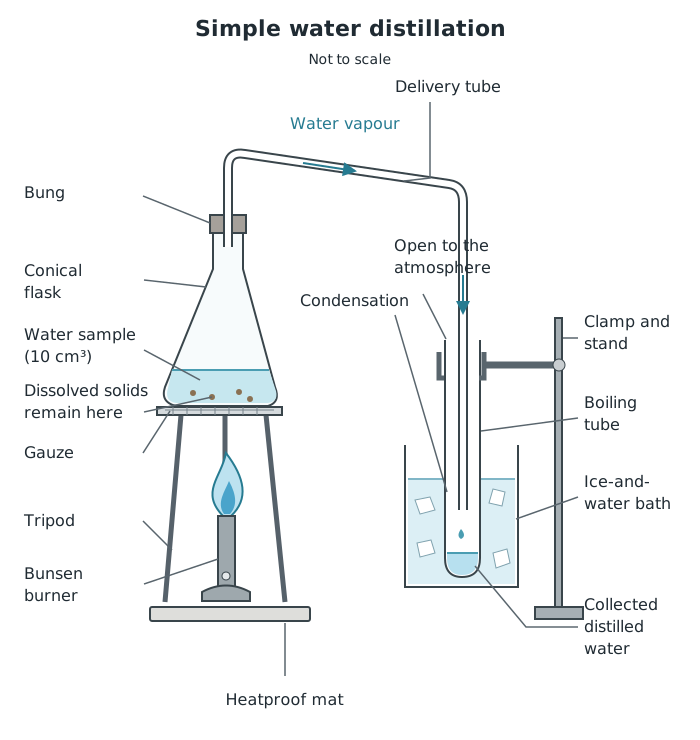
Heating separates water from dissolved solids; cooling the vapour collects the water as a liquid.
Heat the sample until it boils, then reduce the heat so that it boils gently. Vapour travels along the delivery tube and condenses in the cooled receiver. Drops of liquid collecting in the boiling tube show that distillation is working. Collect about 1 cm depth of water, then stop heating rather than boiling the flask dry.
Wear eye protection, secure the receiving tube and keep the apparatus open to the atmosphere: heating a completely sealed system could cause a dangerous pressure build-up. Let hot glassware cool before dismantling it. Do not drink laboratory samples or the collected distillate.
Analyse the distillate by determining its boiling point. Heat a separate portion carefully and use a thermometer with its bulb in the liquid, not touching the container. Record the temperature while it boils steadily. Pure water boils at about 100°C at normal atmospheric pressure; a boiling point close to this supports the conclusion that water has been collected, although it is not a complete drinking-water safety test.
Distinguish filtration from sterilisation: filters remove suspended particles; sterilisation kills harmful microorganisms. Neither normally removes dissolved salts.
For simple distillation, explain both changes of state: water evaporates, then the vapour condenses and is collected.
Calculate dissolved-solid mass by subtracting the empty basin’s mass from the mass of the basin plus dry residue.
Compare dissolved solids using equal volumes of water. A larger residue from a larger sample is not necessarily evidence of a higher concentration.
A neutral pH, clear appearance or small residue does not prove that water is safe to drink.
This is Synergy required practical activity 11; do not confuse its number with the Trilogy practical number.
It can see this note and what your specification asks for.
Answers are free with an account.
1 free note left this week
Get more free notesYour answer sets when this note comes back for review, or marks it complete.
Was this note helpful?
Log in to tell us whether it helped, or to report a problem.
Last updated
Potable water
Water that is safe to drink. It can contain dissolved substances and need not be chemically pure.
Pure water
Water containing only water molecules, with no other substances mixed or dissolved in it.
Fresh water
Water with low levels of dissolved salts, found in sources such as rivers, lakes and underground stores.
Filtration
Separation of insoluble solid particles from a liquid by passing the mixture through a filter.
Sterilisation
Treatment that kills microorganisms; in drinking-water treatment it prevents harmful microorganisms from causing disease.
Desalination
Removal of dissolved salts from salty water or sea water.
Simple distillation
A separation process in which a liquid is vaporised, then its vapour is cooled and condensed so that the liquid can be collected separately.
Distillate
The liquid collected when vapour condenses during distillation.
Reverse osmosis
A process that uses pressure to force water through a membrane while dissolved salts are retained.
Residue
Solid material left behind after a liquid has evaporated.
Put your knowledge into practice — try past paper questions for Combined Science: Synergy
Potable water
Water that is safe to drink. It can contain dissolved substances and need not be chemically pure.
Pure water
Water containing only water molecules, with no other substances mixed or dissolved in it.
Fresh water
Water with low levels of dissolved salts, found in sources such as rivers, lakes and underground stores.
Filtration
Separation of insoluble solid particles from a liquid by passing the mixture through a filter.
Sterilisation
Treatment that kills microorganisms; in drinking-water treatment it prevents harmful microorganisms from causing disease.
Desalination
Removal of dissolved salts from salty water or sea water.
Simple distillation
A separation process in which a liquid is vaporised, then its vapour is cooled and condensed so that the liquid can be collected separately.
Distillate
The liquid collected when vapour condenses during distillation.
Reverse osmosis
A process that uses pressure to force water through a membrane while dissolved salts are retained.
Residue
Solid material left behind after a liquid has evaporated.
Heat → vaporise water → cool vapour → condense → collect distillate. Dissolved salts remain behind.
Reverse osmosis uses pressure to push water through a membrane that retains dissolved salts.