Loading…


Loading…
Loading…
Loading…
AQA GCSE Combined Science Trilogy · 8464
AQA 8464 · Nervous System Structure and Function Check the specification (PDF) (opens in a new tab)
The nervous system allows you to react to your surroundings and coordinate your behaviour. Detecting a sharp object beneath your foot is only the beginning: information must reach a coordination centre, and an instruction must then reach the muscles that move your foot away.
A stimulus is a change that can be detected, such as pressure from a sharp object, a sound or a change in light intensity. A receptor is a cell or group of cells that detects a stimulus. Different receptors detect different changes.
Information from receptors travels along specialised nerve cells called neurones as electrical impulses. These impulses carry information to the central nervous system (CNS), which consists of the brain and spinal cord. The CNS coordinates the response by sending impulses to an effector. Effectors are muscles, which contract, or glands, which secrete substances such as hormones.
The general sequence is:
Stimulus → receptor → coordinator → effector → response
The coordinator connects the incoming information to an appropriate outgoing instruction. This allows detection of a change in one part of the body to produce a response elsewhere.
Neurones form pathways connecting receptors, the CNS and effectors. A nerve is a bundle of neurones, rather than a single nerve cell.
A neurone has a cell body and a long fibre called an axon, which carries electrical impulses away from the cell body. Long axons allow impulses to travel over considerable distances within one cell. This reduces the number of junctions that the signal must cross along that distance.
Branched extensions called dendrites receive signals and allow connections with other neurones. These connections help information pass through networks of cells rather than along isolated pathways.
Many axons are covered by a fatty myelin sheath. This insulates the axon and increases the speed at which electrical impulses travel. Together, long fibres, branching connections and rapid impulse transmission allow the nervous system to coordinate responses throughout the body.
A reflex action is a rapid, automatic response that does not involve the conscious part of the brain. You do not have to decide to carry it out. Many reflexes protect the body by reducing the time spent in contact with something harmful.
The pathway involved is called a reflex arc. In a withdrawal reflex coordinated by the spinal cord, three types of neurone have different roles:
The spinal cord is therefore not simply a route to the brain: it can coordinate a response itself. In this reflex, withdrawal does not wait for a conscious decision, although you become aware of what has happened.
Imagine stepping on a sharp pin. Receptors in the skin detect the stimulus and electrical impulses travel along a sensory neurone to the spinal cord. The signal passes across a synapse to a relay neurone, then across another synapse to a motor neurone.
The motor neurone carries electrical impulses to a muscle in the leg. The muscle contracts, pulling the foot away from the pin. Here, the muscle is the effector, while withdrawing the foot is the response.
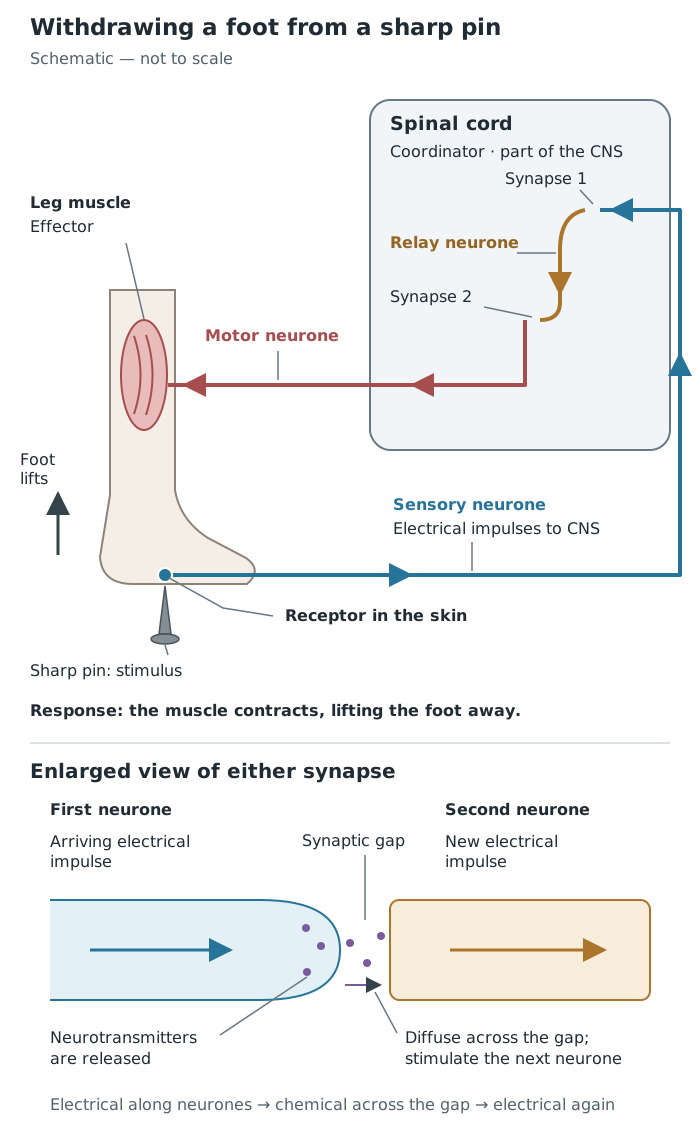
A withdrawal reflex is coordinated by the spinal cord. Signals travel electrically along neurones and chemically across the synapses between them.
Follow the arrows from the receptor towards the spinal cord and then back towards the muscle. The sensory neurone carries information into the CNS; the motor neurone carries instructions out. The relay neurone links them inside the spinal cord.
Because the response is automatic and rapid, the foot is withdrawn without waiting for conscious thought. This helps to minimise injury.
Neurones do not form one continuous cell. At a synapse, there is a tiny gap between neighbouring neurones. An electrical impulse cannot travel directly across this gap, so the signal changes from electrical to chemical and then back to electrical.
Synapses allow separate neurones to communicate and transmit signals in one direction. Crossing them takes time, so pathways that avoid unnecessary connections and conscious decision-making can produce especially rapid responses.
Get unlimited access to all revision notes, key terms, and exam tips.
The CNS = brain + spinal cord. Information travels along neurones as electrical impulses.
Stimulus → receptor → coordinator → effector → response
Effectors: muscles contract; glands secrete, including secreting hormones.
Receptor → sensory neurone → relay neurone in CNS → motor neurone → effector
Synapses occur between the neurones. In a foot-withdrawal reflex, the spinal cord coordinates the response and a leg muscle contracts to withdraw the foot.
Reflexes are rapid and automatic, do not involve the conscious part of the brain and help protect against injury.
Electrical impulse arrives → neurotransmitter released → diffuses across gap → stimulates an electrical impulse in the next neurone.
Transmission is electrical along neurones, but chemical across synapses.
Get unlimited access to all revision notes, key terms, and exam tips.
Describe information travelling along neurones as electrical impulses. Across a synapse, the signal is carried by chemicals called neurotransmitters.
For a reflex pathway, give the neurones in order: sensory → relay → motor. Include the receptor and effector when describing the whole response.
Distinguish the effector from the response: the muscle is the effector; its contraction and the resulting movement produce the response.
Say that reflex actions do not involve the conscious part of the brain, rather than claiming that all reflexes avoid the brain completely.
Link each structural adaptation to its function: for example, a myelin sheath insulates the axon and increases the speed of impulse transmission.
Stimulus
A change in the internal or external environment that can be detected by a receptor.
Receptor
A cell or group of cells that detects a stimulus.
Neurone
A specialised nerve cell that carries electrical impulses.
Central nervous system (CNS)
The brain and spinal cord, which coordinate nervous responses.
Effector
A muscle or gland that carries out a response: a muscle contracts, while a gland secretes a substance such as a hormone.
Sensory neurone
A neurone that carries electrical impulses from a receptor to the central nervous system.
Relay neurone
A neurone within the central nervous system that connects sensory and motor neurones.
Motor neurone
A neurone that carries electrical impulses from the central nervous system to an effector.
Synapse
A junction between neurones containing a tiny gap across which neurotransmitters carry the signal.
Neurotransmitter
A chemical released by a neurone that diffuses across a synaptic gap and stimulates another neurone.
Reflex action
A rapid, automatic response to a stimulus that does not involve the conscious part of the brain.
Reflex arc
The pathway taken by nervous signals during a reflex action, from a receptor through the central nervous system to an effector.
Put your knowledge into practice — try past paper questions for Combined Science Trilogy
Stimulus
A change in the internal or external environment that can be detected by a receptor.
Receptor
A cell or group of cells that detects a stimulus.
Neurone
A specialised nerve cell that carries electrical impulses.
Central nervous system (CNS)
The brain and spinal cord, which coordinate nervous responses.
Effector
A muscle or gland that carries out a response: a muscle contracts, while a gland secretes a substance such as a hormone.
Sensory neurone
A neurone that carries electrical impulses from a receptor to the central nervous system.
Relay neurone
A neurone within the central nervous system that connects sensory and motor neurones.
Motor neurone
A neurone that carries electrical impulses from the central nervous system to an effector.
Synapse
A junction between neurones containing a tiny gap across which neurotransmitters carry the signal.
Neurotransmitter
A chemical released by a neurone that diffuses across a synaptic gap and stimulates another neurone.
Reflex action
A rapid, automatic response to a stimulus that does not involve the conscious part of the brain.
Reflex arc
The pathway taken by nervous signals during a reflex action, from a receptor through the central nervous system to an effector.