

Loading…
Loading…
Loading…
OCR GCSE Geography A · J383
OCR J383 · 2.1.5 Threats to Biodiverse Ecosystems Check the specification (PDF) (opens in a new tab)
Biodiversity is the variety of living organisms in an area. Tropical rainforests and coral reefs support exceptionally varied communities, but their survival depends on connections between living organisms and their physical surroundings. Humans are part of these connections: they use ecosystems for income and resources, while their decisions can either protect or damage them.
Our rainforest case study is Malaysia, in South-East Asia. Malaysia is an emerging and developing country where demands for agricultural land, electricity and income create pressures on forests. Our coral reef case study is the Great Barrier Reef, off Queensland on Australia’s north-eastern coast. This is the world’s largest coral reef system, extending for more than 2,300 km and containing about 3,000 individual reefs.
Sustainable management does not necessarily mean stopping all use. It means finding ways to meet human needs without destroying the ecosystem on which those uses depend.
Malaysia’s warm, humid climate and abundant rainfall support dense vegetation. Water reaches the soil and is taken up by roots, while trees intercept rainfall and return water to the atmosphere. Climate and vegetation therefore influence the movement of water, rather than acting as separate parts of the ecosystem.
Warm conditions also encourage rapid decomposition of fallen plant material. This returns nutrients to the soil, where roots absorb them for further growth. Plants provide animals with food and habitats. Animals, in turn, depend on the continued growth and survival of vegetation. Malaysian rainforest animals include tapirs and leopards.
People depend on this forest too. Timber and tourism can provide income, while forest clearance creates space for farming and infrastructure. However, removing trees also removes animal habitats and reduces the supply of fallen vegetation entering the nutrient cycle. A decision about land use can therefore affect plants, animals, soil and water together.
The rainforest’s value extends beyond the price of timber or the land beneath it. Its vegetation supports diverse habitats, while nutrient recycling sustains plant growth and the forest participates in water cycling. Protecting the ecosystem preserves these connected functions as well as individual species.
For people, the forest can support employment and income through timber production and ecotourism. Visitors can bring earnings to local communities, giving people an economic reason to retain forest rather than clear it.
These values can conflict. Converting forest into farmland may produce income relatively quickly, but removes the original habitat. Sustainable use attempts to retain longer-term ecological benefits while allowing people to earn a living.
Subsistence farming is small-scale farming mainly intended to support the farmer’s household. Slash-and-burn clearance removes vegetation to create farmland. If fires spread beyond the intended area, additional forest and habitats can be lost. The need to produce food explains the activity, but does not remove its environmental consequences.
Palm-oil plantations replace diverse rainforest vegetation with a monoculture. A plantation dominated by one crop cannot provide the same range of habitats as a forest containing many plant species. Biodiversity declines even though the cleared land still has vegetation growing on it.
Hydroelectric development creates another conflict between development and conservation. The Bakun Dam, which began operating in 2011, supplies electricity for industry in Malaysia. Its reservoir flooded forest, removing terrestrial habitats. Electricity supports economic activity, but this benefit must be weighed against the loss of forest ecosystems.
These pressures are connected to human needs for food, income and energy. Effective management must address those needs rather than assuming that simply prohibiting forest use will solve every problem.
Selective logging removes chosen trees instead of clearing an entire area. Leaving other trees standing retains more habitat and allows smaller trees space to grow. It offers a compromise between obtaining timber and maintaining forest cover. However, it still removes trees, and weak monitoring can undermine restrictions. It is less damaging than complete clearance, not impact-free.
Ecotourism aims to combine conservation with local income. If communities benefit from visitors coming to see an intact rainforest, keeping the forest can become more attractive than clearing it. However, hotels and transport infrastructure can themselves damage habitats. Its success depends on controlling development and ensuring that local people receive benefits.
The Forest Stewardship Council (FSC) provides a further approach through forest-management certification intended to encourage responsible timber production. Certification can support conservation only when standards are genuinely followed and checked; a label alone is not proof that every environmental impact has been avoided.
Overall, combining controlled timber harvesting with carefully managed tourism offers a more balanced approach than unrestricted clearance. Its effectiveness depends on monitoring and on whether local people have realistic ways to earn income while retaining the forest.
Corals are small animals that build hard skeletons. These structures create habitats used by many other organisms, including fish, turtles and sharks. The Great Barrier Reef supports over 9,000 known species, so damage to the coral can affect a much wider community.
Coral animals have a close relationship with algae living in their tissues. In warm, shallow water, sunlight allows the algae to photosynthesise. They supply the coral with food and oxygen; the coral provides protection and nutrients for the algae. Neither partner should be understood in isolation.
Unlike rainforest trees, reef-building corals do not obtain their resources through roots in soil. Nevertheless, the reef is connected to land: chemical runoff and pollution from coastal areas can enter its waters and harm coral. Human activities on land can therefore affect an ecosystem offshore.
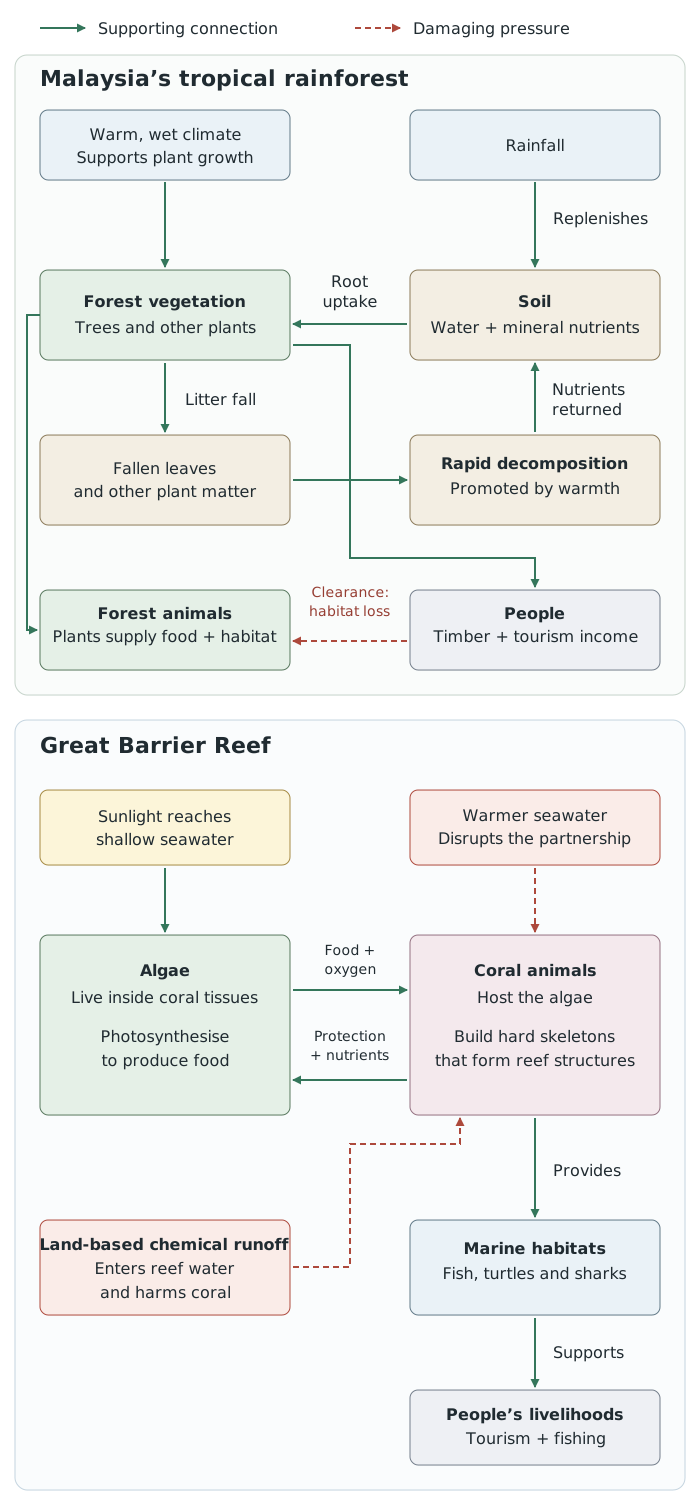
Changes to climate, water or human activity can affect several connected parts of an ecosystem.
The connections explain why protecting just one species is insufficient. Rainforest animals need functioning forest habitats, while reef animals need healthy coral structures and suitable water conditions.
The reef supports tourism and the Australian economy, attracting at least 1.6 million visitors annually. Its biodiversity is also valuable beyond tourism earnings: the reef provides habitats for a remarkable range of marine organisms.
Coral reefs more widely provide food and livelihoods, help protect shorelines from erosion, and contain compounds useful in medical research and treatment. The Great Barrier Reef is also important for scientific research, including understanding how marine ecosystems respond to warming.
These benefits create a strong argument for conservation. However, using the reef can also create pressures. Tourism brings income, but must be managed to avoid damaging the environment visitors come to experience. Medical potential is a benefit; collecting reef organisms becomes a threat if it damages habitats or removes organisms unsustainably.
Climate change warms seawater and can disrupt the coral–algae relationship. Under heat stress, coral can expel its algae and become white: this is bleaching. Losing algae removes an important food supply, increasing the risk of coral death. A 2018 study found that about one-third of the Great Barrier Reef had experienced substantial bleaching damage. Some coral also died directly in unusually warm water, showing that warming can cause harm even before bleaching occurs.
Overfishing removes organisms faster than populations can replace them. It reduces fish populations and changes relationships within the ecosystem. Fishing machinery can also physically damage reef structures.
Pollution, chemical runoff and coastal development harm coral and reduce biodiversity. Tourism adds pressure where boats, visitors and associated development damage reef habitats.
Not every threat comes directly from people. Cyclones can damage reefs, and outbreaks of crown-of-thorns starfish, which eat coral, can cause extensive losses. Management must consider these pressures alongside human activity.
Fishing restrictions, including catch limits, aim to reduce pressure on fish populations. Restrictions on destructive fishing methods help protect the coral structures on which other organisms depend. Their effectiveness depends on enforcement and on limits being suitable for the populations being protected. Restricting fishing can also reduce income in the short term, so conservation decisions affect livelihoods as well as wildlife.
Coral farming grows small pieces of coral under managed conditions as an approach to rebuilding coral populations. It can help address local losses, but growing coral does not remove the warming or pollution that damaged the ecosystem. Restoration cannot substitute for tackling the causes of decline.
Scientific monitoring helps identify damage and guide decisions. Researchers have used three-dimensional reef models to measure changes over time and share detailed information about reef structures. Monitoring improves understanding, but information must lead to protective action if it is to reduce threats.
The strongest conclusion is that no single measure is sufficient. Local controls on fishing and pollution can reduce avoidable damage, while restoration may help recovery. However, continued ocean warming can undermine these gains. Long-term protection needs both effective local management and action on climate change.
Judgement: combine strategies that protect ecosystems and livelihoods. Local management alone cannot eliminate global climate threats.
Use named places and dated evidence: Malaysia’s Bakun Dam began operating in 2011; a 2018 study found substantial bleaching damage across about one-third of the Great Barrier Reef.
Explain interdependence through a chain of consequences, rather than listing climate, water, plants and animals separately.
For management, explain how the strategy reduces a threat, then judge its limitations and the conditions needed for success.
Distinguish medicinal potential from proven treatments, and coral bleaching from immediate coral death.
Do not describe coral as a plant: coral animals depend on photosynthesising algae.
It can see this note and what your specification asks for.
Answers are free with an account.
1 free note left this week
Get more free notesYour answer sets when this note comes back for review, or marks it complete.
Was this note helpful?
Log in to tell us whether it helped, or to report a problem.
Last updated
Biodiversity
The variety of living organisms in an area.
Interdependence
The reliance of different parts of an ecosystem on one another, so that changing one component can affect others.
Sustainable management
Using and managing resources in ways that meet present needs while maintaining their availability and environmental benefits for the future.
Deforestation
The removal of forest, usually to obtain timber or change how the land is used.
Monoculture
Growing a single crop across an area, rather than maintaining a mixture of plant species.
Selective logging
Removing selected trees rather than clearing an entire forest area.
Ecotourism
Tourism intended to conserve the environment and benefit local communities.
Coral bleaching
The loss of a coral’s photosynthesising algae, causing the coral to become pale or white.
Fishing quota
A limit on the amount of fish that may be caught.
Put your knowledge into practice — try past paper questions for Geography A
Biodiversity
The variety of living organisms in an area.
Interdependence
The reliance of different parts of an ecosystem on one another, so that changing one component can affect others.
Sustainable management
Using and managing resources in ways that meet present needs while maintaining their availability and environmental benefits for the future.
Deforestation
The removal of forest, usually to obtain timber or change how the land is used.
Monoculture
Growing a single crop across an area, rather than maintaining a mixture of plant species.
Selective logging
Removing selected trees rather than clearing an entire forest area.
Ecotourism
Tourism intended to conserve the environment and benefit local communities.
Coral bleaching
The loss of a coral’s photosynthesising algae, causing the coral to become pale or white.
Fishing quota
A limit on the amount of fish that may be caught.