

Loading…
Loading…
Loading…
OCR GCSE Geography A · J383
OCR J383 · 2.1.5 Threats to Biodiverse Ecosystems Check the specification (PDF) (opens in a new tab)
A tropical rainforest or coral reef contains living organisms linked to their non-living surroundings. Plants and animals need water and nutrients to grow. Nutrients are substances organisms need to build and maintain their bodies, including mineral nutrients taken up by plants.
A cycle has stores, where material is held, and transfers, which move it between stores. In a rainforest, nutrients are stored in living organisms, dead material and soil. Water is stored in vegetation, soil and rivers, and moves between these stores and the atmosphere. Following these movements helps explain how a large, productive ecosystem keeps functioning.
Tropical rainforests are hot and wet throughout the year, so plants can grow continuously. Their nutrient cycle follows three main transfers:
Animals also transfer nutrients by feeding on plants and other animals. Their waste and dead bodies return nutrients for decomposition.
Warm, moist conditions allow decomposition to happen quickly. Rapid plant growth then produces rapid nutrient uptake. A fallen leaf therefore does not remain on the forest floor for long: its nutrients can soon become available to roots and enter new growth. Most rainforest nutrients are stored in biomass, while the litter and soil stores are much smaller.
Dense vegetation does not necessarily indicate a large reserve of soil nutrients. Rainforest growth depends heavily on the continual recycling of nutrients near the surface.
Rapid decomposition leaves only a thin layer of litter and organic matter. At the same time, roots quickly take up available nutrients. Heavy rainfall causes leaching: water moving through the soil carries dissolved nutrients away. Nutrients can also leave through runoff. Weathering of rock supplies some new mineral nutrients, but this does not make the soil a large nutrient store.
Rainforest soils can be deep while their nutrient-rich surface layer is thin. If trees are removed, nutrients held in the vegetation are lost from the local cycle and less litter replaces the soil's organic matter. Heavy rain continues to remove nutrients. This explains why soil fertility can fall rapidly after clearance.
Rainfall is an input to the forest's water cycle. Before it reaches the ground, leaves and branches intercept some of it. This water may evaporate directly from the vegetation, drip from leaves or run down branches and trunks as stemflow.
Water reaching the ground can enter the soil, where some is stored and taken up by roots. Other water moves towards streams and rivers, either through the ground or as surface runoff.
Water absorbed by roots travels through plants and is released as water vapour from their leaves through transpiration. Together, evaporation and transpiration are called evapotranspiration. They return moisture to the atmosphere. Water vapour can then condense into clouds and contribute to further rainfall, linking the forest to the atmospheric water cycle.
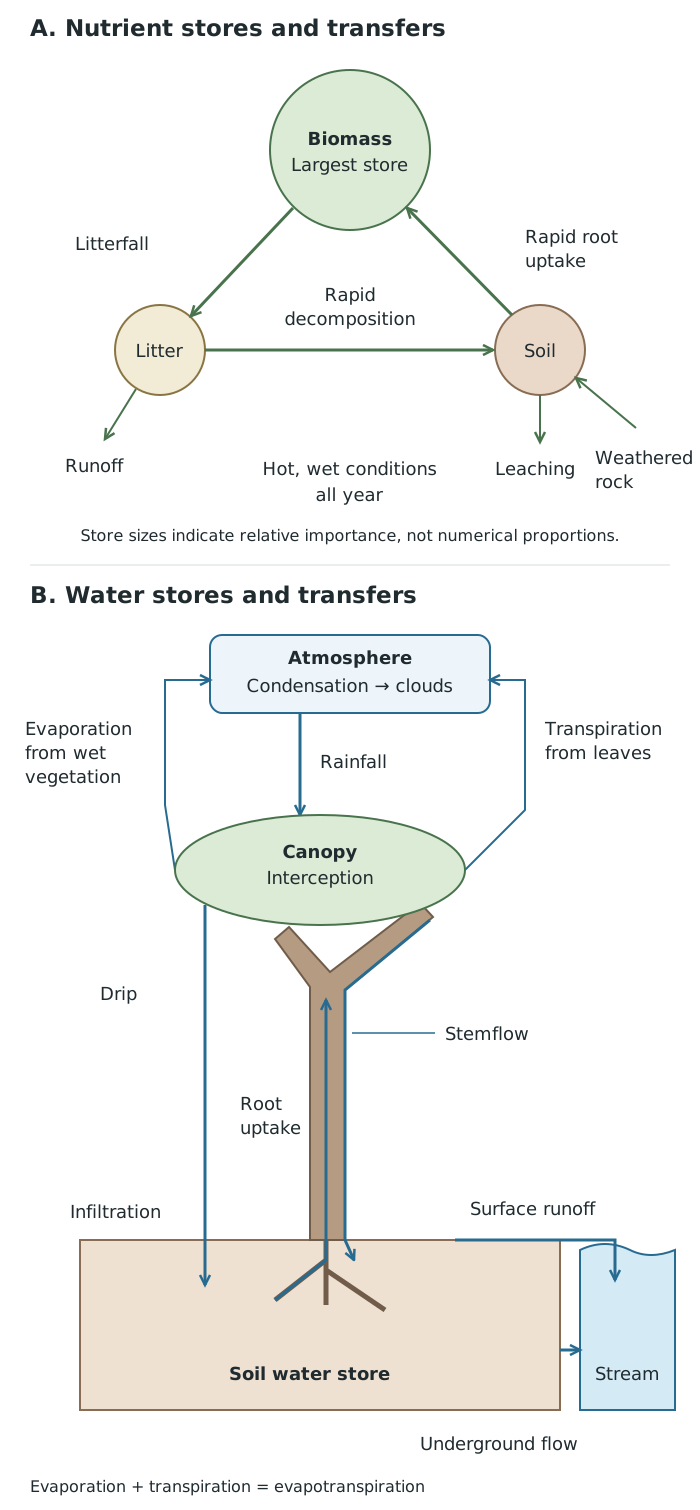
Rainforest vegetation links rapid nutrient recycling with the movement of water between the ground and atmosphere. Stemflow follows branches and trunks; drip falls from leaves.
The water and nutrient cycles are connected. Water makes dissolved nutrients available to roots, but it can also carry them away through leaching. Vegetation intercepts rain, absorbs water and returns moisture to the atmosphere. Removing it reduces interception and transpiration, while more rain reaches the exposed ground directly, increasing the risk of erosion and rapid runoff.
Coral reefs can be highly productive even though the surrounding tropical water is nutrient-poor. An important reason is the close recycling relationship between coral polyps, which are animals, and zooxanthellae, photosynthetic algae living inside their tissues.
The coral gives the algae a protected environment. The coral's cells also produce carbon dioxide and water, which the algae use for photosynthesis. Using sunlight, the algae make organic food products and release oxygen. They transfer much of this food to the coral, supporting its growth and reproduction.
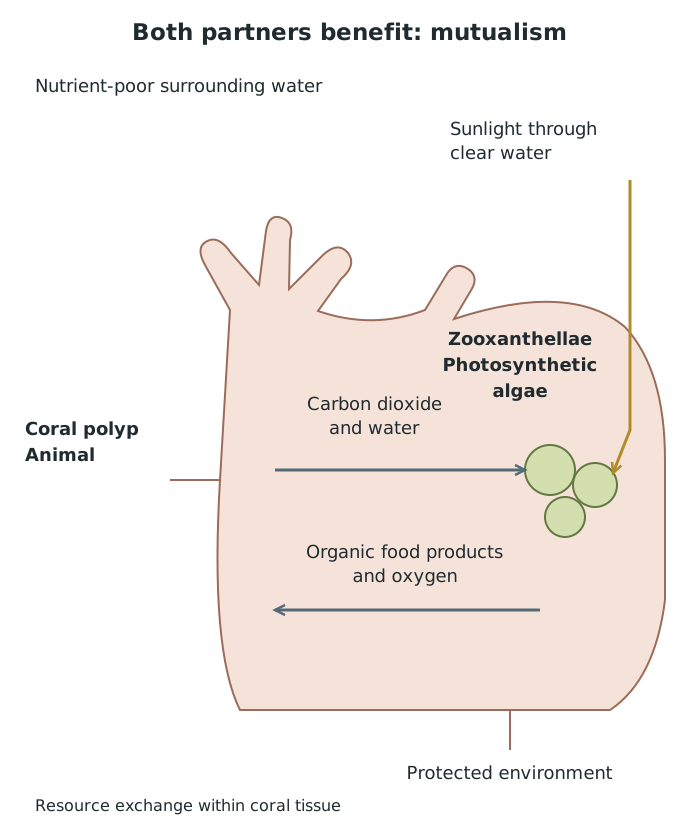
Coral polyps and their algae exchange resources, supporting growth in nutrient-poor tropical water.
This is mutualism because both partners benefit. Materials produced by one partner are used by the other, helping retain and reuse resources rather than relying entirely on supplies from the surrounding water. Up to 90% of the organic material produced by the algae through photosynthesis can be transferred to their host coral.
Clear water is important because sunlight must reach the algae. Without enough light, photosynthesis is reduced and less food is available to the coral. The reef's productivity therefore depends not simply on nutrient supply, but on the combination of light and efficient recycling.
In a rainforest, the main nutrient recycling route passes through biomass, litter and soil, with rapid decomposition and root uptake. In coral reefs, a key recycling route operates directly between coral polyps and their algae. Both show how repeated reuse of resources can sustain abundant life even when the surrounding soil or water contains relatively few available nutrients.
Biomass → litter → soil → biomass
Rainfall → interception → evaporation, dripping or stemflow.
Water reaching the ground enters soil stores or flows towards rivers. Roots take up soil water; transpiration returns it to the atmosphere.
Evapotranspiration = evaporation + transpiration. Atmospheric moisture can condense and contribute to rainfall.
Rainforest recycling mainly links biomass, litter and soil; reef recycling includes the close coral–algae partnership.
Explain a cycle using linked processes: name the transfer, say where it moves material and explain why it happens.
Distinguish a nutrient store from a transfer: biomass is a store; decomposition and plant uptake are transfers.
Do not assume that dense rainforest vegetation means fertile soil. Most nutrients are held in the biomass, with rapid recycling supporting growth.
For coral reefs, explain how both partners benefit. Coral polyps are animals; their zooxanthellae carry out photosynthesis.
Keep water transfers distinct: interception catches rainfall, evaporation changes liquid water into vapour, and transpiration releases water vapour from plants.
It can see this note and what your specification asks for.
Answers are free with an account.
1 free note left this week
Get more free notesYour answer sets when this note comes back for review, or marks it complete.
Was this note helpful?
Log in to tell us whether it helped, or to report a problem.
Last updated
Nutrient cycle
The movement and recycling of substances needed for growth between organisms and their non-living environment.
Biomass
The mass of living organisms in an area; in a tropical rainforest, trees and other vegetation form the largest nutrient store.
Litter
Dead organic material, such as fallen leaves, lying on the ground.
Decomposition
The breakdown of dead organisms and waste by decomposers, releasing nutrients that can be used again.
Leaching
The removal of dissolved nutrients from soil by water moving through it.
Interception
The capture and temporary storage of precipitation by vegetation before it reaches the ground.
Transpiration
The release of water vapour from plants, mainly through their leaves.
Evapotranspiration
The combined transfer of water to the atmosphere through evaporation and transpiration.
Coral polyp
A small coral animal. Reef-building coral polyps usually contain photosynthetic algae within their tissues.
Zooxanthellae
Photosynthetic algae living within the tissues of most reef-building corals, supplying the corals with food products.
Mutualism
A relationship between two organisms in which both benefit.
Put your knowledge into practice — try past paper questions for Geography A
Nutrient cycle
The movement and recycling of substances needed for growth between organisms and their non-living environment.
Biomass
The mass of living organisms in an area; in a tropical rainforest, trees and other vegetation form the largest nutrient store.
Litter
Dead organic material, such as fallen leaves, lying on the ground.
Decomposition
The breakdown of dead organisms and waste by decomposers, releasing nutrients that can be used again.
Leaching
The removal of dissolved nutrients from soil by water moving through it.
Interception
The capture and temporary storage of precipitation by vegetation before it reaches the ground.
Transpiration
The release of water vapour from plants, mainly through their leaves.
Evapotranspiration
The combined transfer of water to the atmosphere through evaporation and transpiration.
Coral polyp
A small coral animal. Reef-building coral polyps usually contain photosynthetic algae within their tissues.
Zooxanthellae
Photosynthetic algae living within the tissues of most reef-building corals, supplying the corals with food products.
Mutualism
A relationship between two organisms in which both benefit.