

Loading…
Loading…
Loading…
OCR GCSE Combined Science B · J260
OCR J260 · Oxidation, Reduction, and LCAs Check the specification (PDF) (opens in a new tab)
A drinks bottle has environmental impacts long before it becomes waste. Raw materials must be obtained, the bottle must be manufactured and transported, and something must happen to it after use. A life-cycle assessment (LCA) considers these impacts together, rather than judging the product only by what happens when it is thrown away.
An LCA follows four main stages: obtaining and processing raw materials, manufacturing and packaging, use, and disposal or recovery. Transport between stages is included too. At each stage, it records water use, energy consumption, raw materials consumed, and waste or pollution produced.
For a fair comparison, products must perform the same job. Comparing two containers that deliver the same quantity of drink is more useful than simply comparing equal masses of their materials. If one container can be used repeatedly, the assessment must also consider how many uses it provides.
Obtaining raw materials: metals may begin as ores extracted by mining, while conventional plastics begin with chemicals obtained from crude oil. Extraction uses energy and can disturb land and habitats. Mining can also produce dust and noise. These impacts count even though they occur far from the shop selling the finished product.
Manufacturing and packaging: processing raw materials and shaping products require energy. Water may be used for washing or cooling. The assessment includes packaging, waste materials and emissions from the manufacturing processes.
Use: some products consume substantial resources while working, such as a car burning fuel. A drinks bottle does not require energy simply to hold a drink, but washing a reusable container uses water and may require energy to heat it. Reuse can reduce the number of new containers needed, but its cleaning requirements still belong in the assessment.
Disposal or recovery: an LCA considers whether the product is buried, burned, reused or recycled. Collection and treatment also require resources. Transport throughout the life cycle uses fuel and produces emissions; heavier products or longer journeys may increase these impacts.
This whole-life approach explains why a product that is easy to dispose of is not necessarily the product with the lowest overall environmental impact.
In landfill, waste is deposited and buried. This provides a route for waste that is not recovered, but uses land and loses materials that might otherwise be useful. Non-biodegradable plastics can remain there for many years.
Incineration burns waste under controlled conditions and reduces the amount of solid waste needing disposal. However, combustion produces carbon dioxide, and some plastics can release harmful gases. Incinerators therefore need controls to remove harmful gases and particles from their exhaust. Burning also destroys the material instead of returning it to manufacturing.
An electricity generation scheme can recover some of the energy released by burning waste. The heat produces steam, which drives a turbine connected to a generator. This can reduce the need for other fuels to generate electricity, but it does not eliminate emissions or turn the waste back into usable plastic. Energy recovery and material recycling are different outcomes.
A biodegradable material can be broken down by microorganisms. Paper and some specially designed plastics are biodegradable. Most conventional plastics, including PET drinks bottles, are non-biodegradable: microorganisms do not readily break them down, so discarded material persists.
Persistence can be useful during a product’s working life. A durable plastic container should not decay while being used. The same property becomes a disadvantage when it is discarded as litter or sent to landfill.
Biodegradability is therefore one factor in an LCA, not a complete verdict. A biodegradable product still requires raw materials, water and energy to manufacture and transport. Its overall impact must be compared with the alternatives across the whole life cycle.
Start by checking what the figures describe and their units. Energy per kilogram of material is not the same as energy per finished product. To find energy per product, multiply the energy per kilogram by the product’s mass in kilograms.
Suppose two containers do the same job:
| Container | Mass of one container | Manufacturing energy per kilogram | Manufacturing energy per container |
|---|---|---|---|
| A | 20 g | 60 MJ/kg | 1.2 MJ |
| B | 40 g | 45 MJ/kg | 1.8 MJ |
For A, the calculation is . For B, it is . Although B’s material requires less energy per kilogram, its greater mass means that making one container requires more energy.
These figures favour A for manufacturing energy, but do not establish that A is best overall. Water consumption, transport, possible reuse and end-of-life treatment could change the decision. Read all relevant categories and explain which factors carry most weight in your conclusion.
Some quantities, such as water volume, energy consumption and mass of waste, can be measured. Judging the importance of landscape damage or different pollutants is less straightforward. People may assign different importance to these impacts, so an LCA is not entirely objective. An assessment that omits important stages can also give a misleading impression, particularly when used to advertise a product.
Reuse keeps an existing product in use without processing its material into a new product. For example, a used PET bottle could be repurposed as a small plant container. Recycling instead processes the PET to make something new.
Used PET drinks bottles are collected and sorted from other types of plastic. They are washed to remove contamination, then shredded into flakes. The flakes can be melted and reshaped into new products. One important route is to push molten PET through tiny holes to form fibres, which are made into yarn for fleece clothing. Recycled PET can also be used in carpets and pillow filling.
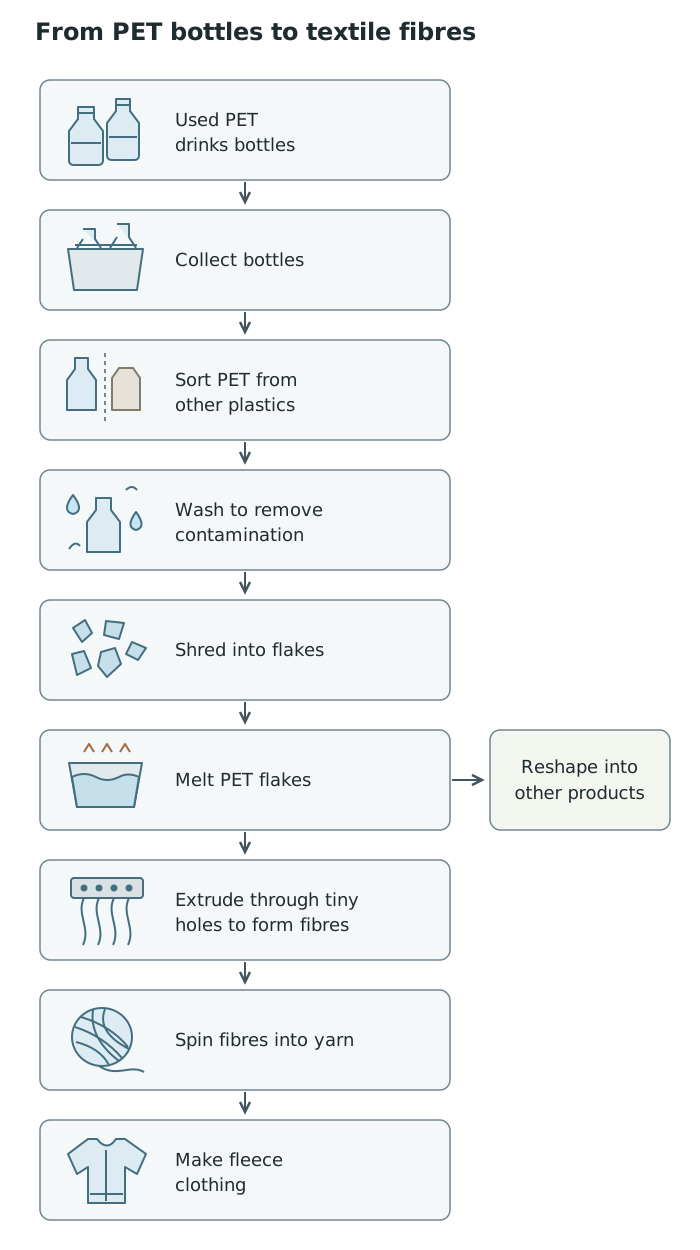
Recycling changes used PET bottles into material for new products, including textile fibres.
This route is technically possible because PET can be melted and reshaped, and its fibres have useful strength and flexibility. Clothing fibres do not require the same food-contact purity as a drinks bottle, although the material still needs suitable cleaning and processing.
It can also be economically and environmentally viable. Recycling reduces demand for new PET made from finite crude oil and can use less energy than producing new material. However, the savings must outweigh collection, transport, cleaning and processing costs, and there must be customers for the resulting products.
For products made from metal ores, recycling conserves finite resources and reduces the need for mining. Melting and reshaping scrap metal generally requires less energy than extracting new metal from ore. Aluminium is a strong example: recycling it uses about 5% of the energy needed to extract new aluminium by electrolysis.
For products made from crude oil, such as PET bottles, recycling conserves oil and reduces persistent plastic waste. However, different plastics must be separated because they have different properties. Dirty or mixed plastic waste can be difficult and costly to process into a useful material.
Both routes involve collection and transport costs, energy use, sorting and processing. The quality and selling price of the recycled material, and demand for it, also matter. Energy savings differ between materials, so a successful recycling decision for aluminium does not automatically prove that every plastic mixture is worth recycling.
A justified decision balances these factors. Clean, separately collected PET with a market for its fibres is a stronger recycling prospect than heavily contaminated mixed plastics. Aluminium’s large energy saving strongly favours recycling, while transport and processing costs still need to be considered.
Compare products that perform the same job, and check whether data are given per kilogram, per item or per use.
Use figures from the data to support an LCA conclusion. A product may have a lower impact in one category but a higher impact in another.
For a recycling evaluation, weigh benefits against collection, transport, sorting and processing costs, then give a justified conclusion for the particular material.
Distinguish recycling from energy recovery: burning plastic can generate electricity, but does not conserve the plastic for another product.
Biodegradable does not automatically mean environmentally best: consider manufacture, transport, use and disposal.
It can see this note and what your specification asks for.
Answers are free with an account.
1 free note left this week
Get more free notesYour answer sets when this note comes back for review, or marks it complete.
Was this note helpful?
Log in to tell us whether it helped, or to report a problem.
Last updated
Life-cycle assessment
An assessment of the environmental impacts of a material or product throughout its life, from obtaining raw materials to its final disposal or recovery.
Reuse
Using a product again without processing its material into a new product.
Recycling
Collecting and processing used materials to make new products.
Incineration
Burning waste under controlled conditions.
Landfill
A site where waste is deposited and buried.
Energy recovery
Obtaining useful energy from waste, for example by burning it to generate electricity.
Biodegradable
Capable of being broken down by microorganisms.
Non-biodegradable
Not readily broken down by microorganisms, so it can persist in the environment.
PET
Polyethylene terephthalate: a plastic used in drinks bottles that can be melted and reshaped, including into fibres.
Viable
Workable in practice: technically possible, affordable and able to produce something useful.
Finite resource
A resource with a limited supply that is not replaced as quickly as it is used, such as crude oil or metal ores.
Put your knowledge into practice — try past paper questions for Combined Science B
Life-cycle assessment
An assessment of the environmental impacts of a material or product throughout its life, from obtaining raw materials to its final disposal or recovery.
Reuse
Using a product again without processing its material into a new product.
Recycling
Collecting and processing used materials to make new products.
Incineration
Burning waste under controlled conditions.
Landfill
A site where waste is deposited and buried.
Energy recovery
Obtaining useful energy from waste, for example by burning it to generate electricity.
Biodegradable
Capable of being broken down by microorganisms.
Non-biodegradable
Not readily broken down by microorganisms, so it can persist in the environment.
PET
Polyethylene terephthalate: a plastic used in drinks bottles that can be melted and reshaped, including into fibres.
Viable
Workable in practice: technically possible, affordable and able to produce something useful.
Finite resource
A resource with a limited supply that is not replaced as quickly as it is used, such as crude oil or metal ores.
Compare all relevant categories. Measurements can be numerical, but weighting environmental effects involves value judgements. Omitted stages can make an LCA misleading.
Collect → sort → wash → shred → melt → reshape, including forming fibres for fleece clothing, carpets or pillow filling.
Viable because PET can be reshaped into useful products, conserving crude oil and potentially saving energy and money. Collection and processing must be affordable, with demand for the output.
Balance resource conservation, reduced mining, less landfill and energy savings against collection, transport, sorting, contamination, processing costs and product demand.