

Loading…
Loading…
Loading…
OCR GCSE Combined Science B · J260
OCR J260 · Purification and Chromatography Techniques Check the specification (PDF) (opens in a new tab)
Many useful products are mixtures rather than single substances. A mixture contains two or more substances that are not chemically combined with one another. Each substance retains its own chemical properties, although the mixture can have useful overall properties.
A formulation is a mixture designed as a useful product. Its components have particular purposes and are added in carefully measured proportions. Changing those proportions can change how well the product works. Food and drink products, medicines, sunscreens, perfumes and paints are all examples of formulations.
Mixtures are therefore not necessarily undesirable. A manufacturer may deliberately make a formulation, while also checking that each ingredient is sufficiently pure. Chemical analysis helps with this quality control and can identify substances in forensic investigations or environmental samples.
Scientifically, a pure substance is a single element or compound, with no other substance mixed into it. A pure compound can contain more than one element: what matters is that those elements are chemically combined in one compound. Pure water, for example, contains only the compound water.
Everyday language uses pure differently. It often means natural or having nothing added. Milk described as ‘pure milk’ is still a mixture of substances, so it is not chemically pure. The everyday description tells us about additions to the product, not whether it contains just one element or compound.
An impurity is an unwanted substance mixed with the substance of interest. Whether a mixture is wanted matters: the deliberately chosen ingredients of a formulation are not automatically impurities.
A pure substance has a sharp, characteristic melting point. At a given pressure, pure water melts at . Impurities generally lower a substance’s melting point and broaden its melting range: melting starts at one temperature and finishes at a higher temperature.
To use melting-point data, compare the sample with the known melting point of the pure substance. Consider both where melting occurs and how wide the range is.
Suppose a compound has a reference melting point of . A sample melting sharply at is consistent with a pure sample. Another sample melting from to is likely to contain impurities: its melting temperature is lower and melting occurs over a range.
In a melting-point test, a small solid sample is heated slowly in melting-point apparatus. Record the temperature when melting begins and when the last solid disappears. Slow heating makes these changes easier to observe. Wear eye protection and avoid touching hot apparatus. This type of analysis is useful when checking the purity of substances such as medicines.
Chromatography separates substances because they distribute differently between two phases. In paper chromatography, the stationary phase is the paper and the mobile phase is the solvent moving through it.
As the solvent rises through the paper, it carries dissolved substances with it. A substance that spends more time dissolved in the moving solvent travels further. A substance held more strongly by the stationary phase spends less time moving and travels a shorter distance. Separation therefore depends on both attraction to the stationary phase and solubility in the mobile phase, not simply on the original colour of the sample.
Different components of an ink can move at different rates and form separate spots. The resulting pattern is called a chromatogram.
Draw a pencil baseline near the bottom of chromatography paper. Place a small spot of the sample on it and let it dry. Known substances can be spotted beside the sample for comparison.
Stand the paper in a container holding a shallow layer of solvent. The solvent must touch the paper but remain below the baseline, so the samples do not dissolve directly into the solvent reservoir. Pencil is used because an ink line could dissolve and separate, adding unwanted spots.
Allow the solvent to rise. Remove the paper before the solvent reaches the top, immediately mark the solvent front in pencil, and leave the paper to dry. The solvent front is the furthest point reached by the solvent; marking it promptly preserves the position before the solvent evaporates.
Wear eye protection. When using an organic solvent, keep it away from flames and use suitable ventilation; follow the precautions for the particular solvent.
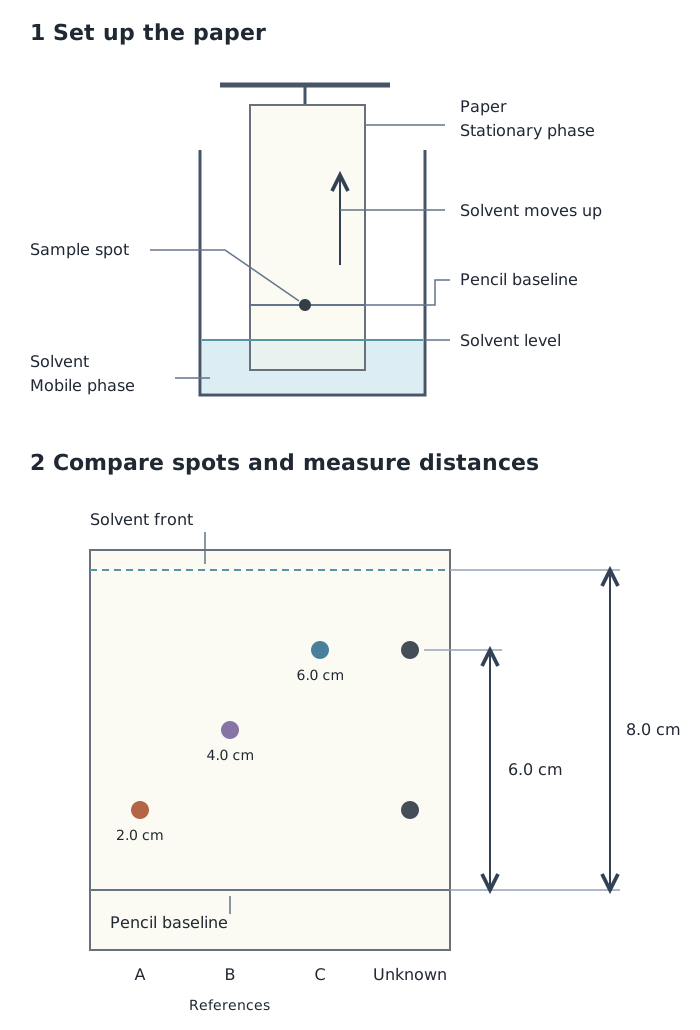
Keep the samples above the solvent level. On the finished chromatogram, compare spot positions and measure both distances from the baseline.
In the example chromatogram, the unknown sample produces two spots, so it contains at least two substances. Its lower spot lines up with reference A and its upper spot with reference C. These matches suggest that A and C are present because the samples were run together under the same conditions.
The value compares how far a substance travels with how far the solvent front travels:
Measure vertically from the baseline to the centre of the spot, and from the same baseline to the solvent front. In the constructed example, the upper unknown spot travels and the solvent front travels . Its is therefore : the substance travels three-quarters of the solvent-front distance.
An value has no unit because it is a ratio of two distances. Values lie between 0 and 1. Compare an unknown’s value with reference values obtained under the same conditions. Changing the solvent can change the value, so an is not a universal identifying number.
An aqueous solvent is water-based. A non-aqueous solvent is not water-based; ethanol is one example. Choose a solvent that dissolves the substances being tested and allows their components to separate.
A pure substance should give one spot in each suitable solvent. More than one separated spot shows that a sample is a mixture. However, two components may travel together and overlap in one solvent. Repeating the test with a different suitable solvent can separate those components and give stronger evidence about purity.
Not all substances produce coloured spots. A blank-looking chromatogram does not necessarily mean that nothing is present. Locating agents, such as ninhydrin or iodine, can make colourless spots visible. Suitable substances may also be detected under ultraviolet light. Use locating chemicals under teacher supervision, avoid inhaling vapours, and do not look directly into a UV source.
When suggesting a purity test, bring these decisions together: use paper chromatography with a suitable solvent, reveal colourless spots if necessary, and consider a second solvent if one spot could conceal overlapping substances.
For melting-point questions, compare both the temperature and the width of the melting range with the reference value.
Measure both chromatographic distances from the pencil baseline, and measure to the centre of the spot.
Use the same units for both distances in an calculation. The units cancel, so has no unit.
Compare spots or values only under the same conditions, including the same solvent.
One spot supports purity, but overlapping components can produce one spot in a particular solvent. Testing with another suitable solvent gives stronger evidence.
It can see this note and what your specification asks for.
Answers are free with an account.
1 free note left this week
Get more free notesYour answer sets when this note comes back for review, or marks it complete.
Was this note helpful?
Log in to tell us whether it helped, or to report a problem.
Last updated
Formulation
A mixture designed as a useful product, with components combined in carefully measured proportions to give the required properties.
Mixture
Two or more substances together without being chemically combined with one another.
Pure substance
A single element or compound that is not mixed with another substance.
Impurity
An unwanted substance mixed with the substance being tested or used.
Chromatography
A separation technique in which substances move at different rates because they distribute differently between a stationary phase and a mobile phase.
Stationary phase
The part of a chromatography system that stays in place; in GCSE paper chromatography, this is the paper.
Mobile phase
The part of a chromatography system that moves and carries dissolved substances; in paper chromatography, this is the solvent.
Chromatogram
The pattern of separated substances produced by chromatography.
Solvent front
The furthest position reached by the solvent as it moves through the chromatography paper.
Rᶠ value
The ratio of the distance travelled by a substance to the distance travelled by the solvent front, both measured from the baseline: .
Aqueous solvent
A water-based solvent.
Non-aqueous solvent
A solvent that is not water-based, such as ethanol.
Locating agent
A chemical used to make colourless spots on a chromatogram visible.
Put your knowledge into practice — try past paper questions for Combined Science B
Formulation
A mixture designed as a useful product, with components combined in carefully measured proportions to give the required properties.
Mixture
Two or more substances together without being chemically combined with one another.
Pure substance
A single element or compound that is not mixed with another substance.
Impurity
An unwanted substance mixed with the substance being tested or used.
Chromatography
A separation technique in which substances move at different rates because they distribute differently between a stationary phase and a mobile phase.
Stationary phase
The part of a chromatography system that stays in place; in GCSE paper chromatography, this is the paper.
Mobile phase
The part of a chromatography system that moves and carries dissolved substances; in paper chromatography, this is the solvent.
Chromatogram
The pattern of separated substances produced by chromatography.
Solvent front
The furthest position reached by the solvent as it moves through the chromatography paper.
Rᶠ value
The ratio of the distance travelled by a substance to the distance travelled by the solvent front, both measured from the baseline: .
Aqueous solvent
A water-based solvent.
Non-aqueous solvent
A solvent that is not water-based, such as ethanol.
Locating agent
A chemical used to make colourless spots on a chromatogram visible.
Measure from the baseline to the spot centre and solvent front. has no unit. Compare with known substances under the same conditions.