

Loading…
Loading…
Loading…
OCR GCSE Combined Science B · J260
OCR J260 · Chemical Bonds and Bulk Properties Check the specification (PDF) (opens in a new tab)
A covalent bond forms when atoms share a pair of electrons. In a simple molecule, only a small, fixed number of atoms are joined together. In a giant covalent structure, bonding continues through an extended network containing very many atoms. There are no separate small molecules.
Diamond and graphite are both made entirely of carbon. They are allotropes: different structural forms of the same element in the same physical state. Their carbon atoms are arranged and bonded differently, so the materials have very different properties. Hardness belongs to the whole structure—not to an individual carbon atom.
In diamond, each carbon atom forms four strong covalent bonds to four other carbon atoms. The four bonds point in different directions towards the corners of a tetrahedron, rather than lying in a flat cross. This arrangement repeats throughout the crystal, producing a continuous three-dimensional network.
Diamond is very hard because its atoms are held firmly in place by strong covalent bonds extending in all directions. There are no layers that can easily slide over one another. Its resistance to scratching makes it useful on the cutting edges of tools.
Diamond also has a very high melting point. Breaking down the giant structure requires many strong covalent bonds to be broken, which needs a large amount of energy.
It does not conduct electricity: its outer electrons are involved in covalent bonds, so there are no mobile charged particles to carry a current through the structure.
In graphite, each carbon atom forms three strong covalent bonds to three other carbon atoms. These bonds form flat sheets of joined hexagonal rings. Many sheets are stacked to make the solid.
The distinction between bonding within a sheet and forces between sheets explains graphite’s properties. Strong covalent bonds hold each sheet together, but only weak forces hold neighbouring sheets together. There are no covalent bonds joining one sheet to the next.
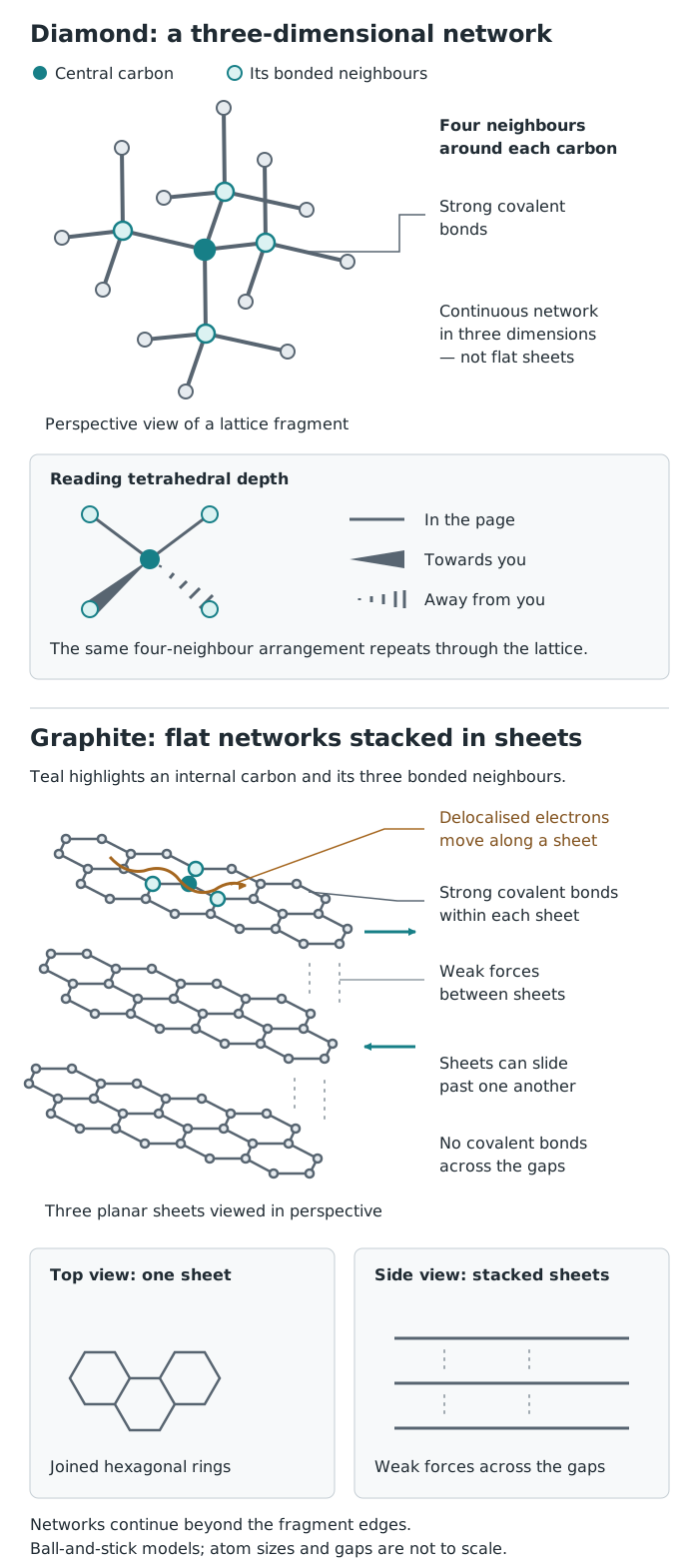
Diamond has strong covalent bonds throughout a three-dimensional network. Graphite has strong covalent bonds within sheets but weak forces between them.
Graphite has a very high melting point because breaking down its structure requires strong covalent bonds within the sheets to be broken. Simply sliding the sheets past each other does not break down those networks.
However, graphite is soft and slippery because the weak forces between sheets are easily overcome, allowing the sheets to slide over one another. This makes graphite useful as a lubricant, reducing friction between moving surfaces. Layers can also rub off onto paper, explaining its use in pencils.
Carbon has four outer electrons. In graphite, three are used to form the three covalent bonds around each atom. The fourth becomes delocalised: it is not confined to one atom or one bond and can move along the sheet. These mobile electrons carry charge, so graphite conducts electricity. This makes it useful for electrodes and electrical contacts.
A ball-and-stick model represents atoms as balls and covalent bonds as sticks. A drawing of that model must show depth on a flat page. Perspective can make some bonds appear shorter or make atoms overlap; this does not mean that the actual bonds are shorter or that overlapping atoms are bonded.
For diamond, start by identifying a carbon atom and tracing its four bonds. Imagine its neighbours surrounding it in three dimensions, not sitting together on one flat sheet. One way to draw this local arrangement uses two ordinary lines for bonds in the plane of the page, a solid wedge for a bond pointing towards you and a dashed wedge for a bond pointing away. To reconstruct the shape, place those last two neighbours in front of and behind the page. Extend the same four-neighbour arrangement to represent more of the lattice.
For graphite, a view from above shows the joined hexagonal rings within a sheet. A view from the side reveals the stack of sheets and the gaps between them. To turn the flat hexagonal drawing into a three-dimensional model, keep each sheet flat and stack several sheets above one another; do not add covalent bonds across the gaps.
When drawing from a model, preserve which atoms are connected and their spatial arrangement, even though the viewing angle changes. A small drawing represents only a fragment: the network continues beyond its edges. Ball-and-stick models make connections easy to see, but atoms are not literally hard balls joined by rods, and the drawn gaps are not an accurate picture of their relative sizes.
Both are carbon allotropes with giant covalent structures and very high melting points: many strong covalent bonds require much energy to break.
| Feature | Diamond | Graphite |
|---|---|---|
| Bonds per carbon atom | Four | Three |
| Arrangement | Tetrahedral, continuous 3D network | Flat hexagonal sheets stacked in layers |
Link each property to the relevant structure: name the bonds or forces, explain their arrangement, then explain the effect.
For graphite’s high melting point, discuss strong covalent bonds within the layers. For its softness and lubricating action, discuss weak forces between layers.
Graphite conducts because delocalised electrons can move and carry charge—not because carbon atoms move.
Count bonds to each atom, not sides of a ring: each carbon has four bonded neighbours in diamond and three in graphite.
A drawing shows only part of a giant structure. Atoms at its edges may have bonds continuing beyond the diagram.
It can see this note and what your specification asks for.
Answers are free with an account.
1 free note left this week
Get more free notesYour answer sets when this note comes back for review, or marks it complete.
Was this note helpful?
Log in to tell us whether it helped, or to report a problem.
Last updated
Covalent bond
A strong bond between atoms formed by sharing a pair of electrons.
Giant covalent structure
An extended network containing very many atoms joined by strong covalent bonds, rather than separate small molecules.
Allotrope
One of two or more different structural forms of the same element in the same physical state.
Tetrahedral arrangement
An arrangement in which an atom has four bonded neighbours directed towards the corners of a tetrahedron.
Delocalised electron
An electron that is not confined to one atom or one covalent bond and can move through part of a structure.
Lubricant
A substance that reduces friction between surfaces moving over one another.
Put your knowledge into practice — try past paper questions for Combined Science B
Covalent bond
A strong bond between atoms formed by sharing a pair of electrons.
Giant covalent structure
An extended network containing very many atoms joined by strong covalent bonds, rather than separate small molecules.
Allotrope
One of two or more different structural forms of the same element in the same physical state.
Tetrahedral arrangement
An arrangement in which an atom has four bonded neighbours directed towards the corners of a tetrahedron.
Delocalised electron
An electron that is not confined to one atom or one covalent bond and can move through part of a structure.
Lubricant
A substance that reduces friction between surfaces moving over one another.
| Hardness |
| Very hard: strong bonds in all directions prevent easy movement |
| Soft: weak forces between sheets allow sliding |
| Electrical conductivity | Does not conduct: no mobile charged particles | Conducts: delocalised electrons move along sheets |
| Linked use | Cutting tools | Lubricants, pencils and electrodes |