

Loading…
Loading…
Loading…
OCR GCSE Combined Science B · J260
OCR J260 · Chemical Bonds and Bulk Properties Check the specification (PDF) (opens in a new tab)
Carbon can form four covalent bonds. A covalent bond involves atoms sharing a pair of electrons, so these bonds hold atoms together within a molecule.
Carbon can bond to other carbon atoms as well as to atoms of other elements. Carbon atoms can therefore form the backbone of a molecule: a chain can continue from one carbon atom to the next, branch into different directions, or close into a ring. Other atoms complete the remaining bonds around each carbon atom.
Four bonds does not necessarily mean four neighbouring atoms: a double bond contains two shared pairs of electrons and counts as two covalent bonds.
This combination of four bonds and the ability to bond to itself makes an enormous variety of organic compounds possible. These are carbon-based compounds, usually containing hydrogen and sometimes other elements. Changing the length of a carbon chain, its arrangement, or the atoms attached to it produces different compounds.
Compounds can also form families of similar compounds. Members share structural features but differ, for example, in the length of their carbon chains. Carbon chemistry therefore offers both variety and recurring patterns, rather than a collection of unrelated substances.
Some organic molecules are extremely large. A polymer is a very large molecule containing many repeating units joined by strong covalent bonds. The smaller molecules used to make it are called monomers. When monomers join, they contribute repeating units to the polymer; a repeating unit is part of the finished chain, not a separate molecule trapped inside it.
Many familiar polymers are synthetic, meaning they are manufactured. Polythene is used in plastic bags, PVC in water pipes and polystyrene in packaging. Nature also produces polymers: proteins, including those found in silk and wool, and DNA are examples.
A polymer molecule can be pictured as a very long chain. A piece of solid polymer contains many such molecules together, not just one chain.
In a polymer such as polythene, strong covalent bonds join atoms along each chain, while intermolecular forces attract separate chains to one another. These must not be confused.
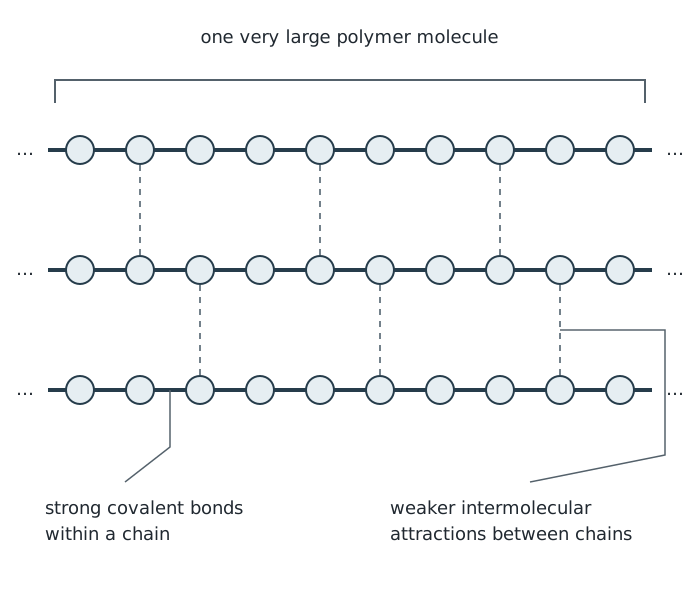
A polymer solid contains many large molecules: strong covalent bonds hold each chain together, while intermolecular attractions hold different chains near one another.
The attractions between polymer molecules are generally greater overall than those between small, simple molecules. Long chains have many places where neighbouring molecules can interact. This helps explain why polymers are usually solids at room temperature, even though the forces between chains are weaker than the covalent bonds within them.
A material's properties depend on the whole arrangement of its chains, not on an individual carbon atom. Strong covalent bonds make it difficult to break a polymer chain. However, the strength of the solid also depends on how firmly its different chains are held together: chains moving past one another can change the material's shape without every chain breaking.
A flexible polymer can bend because parts of its long chains can change position while the covalent bonds remain intact. Where the arrangement and attractions restrict chain movement more strongly, the material is stiffer: it resists bending.
Hardness concerns resistance to scratching or indentation, rather than bending or breaking. Restricting local movement of the chains helps a polymer resist being indented. For otherwise similar polymers, longer chains generally have greater overall intermolecular attraction, tending to increase strength, hardness and melting or softening temperature.
These are structural explanations, not rules that every polymer has the same properties. Polymer molecules differ, so the strength of their attractions and the freedom of their chains to move also differ.
Two forms of poly(ethene), also called polythene, show why chain arrangement matters. Low-density poly(ethene), LDPE, has branched chains that cannot pack closely together. Its weaker overall attractions between chains allow more movement, making it flexible and giving it relatively low strength and melting temperature. It is useful for plastic bags and wrappers.
High-density poly(ethene), HDPE, has largely unbranched chains that can pack more closely and regularly. The closer packing gives stronger overall attractions between chains, restricting their movement. HDPE is stronger and stiffer and has a higher melting temperature than LDPE. It is useful for rigid objects such as buckets and bottle crates.
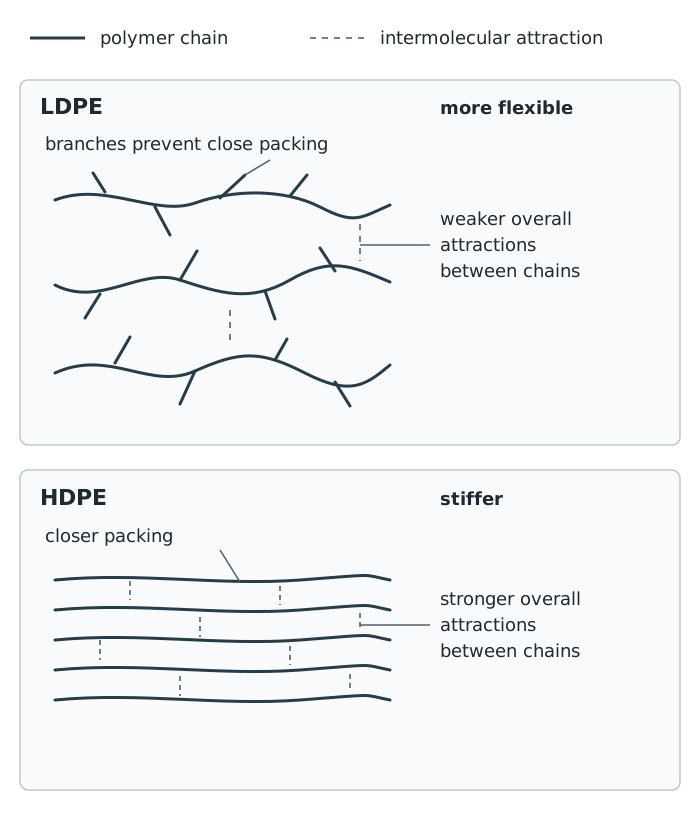
Branching reduces close packing in LDPE. Closer packing in HDPE strengthens overall interchain attractions and restricts movement.
The important difference is not that carbon atoms in one material are ‘harder’. The different arrangement of the chains changes the properties of the whole solid.
For a polymer that melts, heating supplies energy to overcome enough of the attractions between its chains for them to move past one another. The strong covalent bonds along the chains normally remain intact: melting is a physical change, not the breaking up of polymer molecules.
Stronger attractions between chains require more energy to overcome, tending to give a higher melting temperature. The arrangement of the chains also matters because it affects how effectively neighbouring chains interact. Some polymers soften over a range of temperatures rather than showing one sharp melting point.
Polymers that soften on heating and can be reshaped are called thermosoftening polymers, or thermoplastics. As they cool, attractions hold the chains in their new arrangement, so the object retains its new shape. Poly(ethene) is an example.
Some polymers have additional covalent cross-links between chains. These are strong chemical bonds, not the weaker intermolecular forces shown between separate chains in the first diagram.
In a thermosetting polymer, many cross-links hold the chains in a network. They prevent the chains from sliding freely past one another, making the material rigid and typically hard. Such materials can also be brittle: a rigid structure may fracture rather than bend.
Heating does not free the chains to flow because the covalent cross-links remain in place. Thermosetting polymers therefore do not soften or melt and cannot be reshaped by heating; sufficiently strong heating eventually decomposes them. Bakelite has been used for saucepan handles because it keeps its shape when hot.
The useful explanation is therefore always a link between bonding, chain arrangement and movement. Strong bonds within molecules alone do not explain every property of the solid.
Distinguish strong covalent bonds within a polymer chain from the weaker intermolecular forces between separate chains.
Explain a property by linking the structure to what can move, or to the forces that must be overcome. Simply saying ‘it has strong bonds’ is not enough.
Strength, stiffness and hardness are different: resistance to breaking, bending and indentation respectively.
Do not claim that ordinary melting breaks the covalent bonds along polymer chains.
Covalent cross-links are not intermolecular forces. A thermosetting polymer does not simply melt at a higher temperature: strong heating eventually causes decomposition.
It can see this note and what your specification asks for.
Answers are free with an account.
1 free note left this week
Get more free notesYour answer sets when this note comes back for review, or marks it complete.
Was this note helpful?
Log in to tell us whether it helped, or to report a problem.
Last updated
Covalent bond
A chemical bond formed when atoms share a pair of electrons.
Organic compound
A carbon-based compound. Most organic compounds contain carbon bonded to hydrogen; some simple carbon compounds, such as carbon dioxide, are classified as inorganic.
Polymer
A very large molecule made from many repeating units joined by covalent bonds.
Monomer
A small molecule that can join with other monomer molecules to form a polymer.
Intermolecular force
An attractive force between separate molecules, rather than a covalent bond within a molecule.
Strength
The ability of a material to resist breaking under an applied force.
Stiffness
The resistance of a material to bending or changing shape under an applied force.
Hardness
The resistance of a material to scratching or indentation.
Cross-link
A covalent connection between polymer chains that restricts their movement relative to one another.
Thermosoftening polymer
A polymer that softens on heating and can be reshaped because its chains can move past one another.
Thermosetting polymer
A polymer with covalent cross-links forming a network that does not soften or melt on heating.
Put your knowledge into practice — try past paper questions for Combined Science B
Covalent bond
A chemical bond formed when atoms share a pair of electrons.
Organic compound
A carbon-based compound. Most organic compounds contain carbon bonded to hydrogen; some simple carbon compounds, such as carbon dioxide, are classified as inorganic.
Polymer
A very large molecule made from many repeating units joined by covalent bonds.
Monomer
A small molecule that can join with other monomer molecules to form a polymer.
Intermolecular force
An attractive force between separate molecules, rather than a covalent bond within a molecule.
Strength
The ability of a material to resist breaking under an applied force.
Stiffness
The resistance of a material to bending or changing shape under an applied force.
Hardness
The resistance of a material to scratching or indentation.
Cross-link
A covalent connection between polymer chains that restricts their movement relative to one another.
Thermosoftening polymer
A polymer that softens on heating and can be reshaped because its chains can move past one another.
Thermosetting polymer
A polymer with covalent cross-links forming a network that does not soften or melt on heating.