

Loading…
Loading…
Loading…
OCR GCSE Combined Science B · J260
OCR J260 · Properties and Risks of Nanoparticles Check the specification (PDF) (opens in a new tab)
A nanometre, written nm, is one billionth of a metre. The prefix ‘nano’ tells us the scale of the measurement:
A nanoparticle is between 1 and 100 nm in size. Nanotechnology involves using and controlling structures within this size range. These structures are much too small to see individually with the naked eye.
Typical atomic dimensions are of the order of , or about . This is around ten times smaller than the smallest nanoparticle. A nanoparticle therefore usually contains many atoms; it is not simply another name for an individual atom.
Molecules contain atoms bonded together, so their sizes vary. Small molecules are smaller than nanoparticles, but larger molecules can have dimensions on the nanoscale. For example, the DNA molecule is about 2 nm wide, although its length is much greater. Nanoparticles can therefore be on a similar scale to individual large molecules.
Using nanometres avoids long strings of zeros. To convert a length from nanometres to metres, multiply its numerical value by . To convert from metres to nanometres, multiply by .
For example, suppose a nanoparticle is 20 nm across:
In the other direction, a particle measuring is:
Both sizes are within the nanoparticle range. The full range in metres is to .
Standard form writes a number as , where is at least 1 but less than 10, and is an integer. The power of ten sets the scale; the coefficient gives the value within that scale.
A negative power means division by a power of ten, not a negative length. For instance, means .
When ordering measurements, first put them in the same unit. Then compare their powers of ten. With negative powers, the more negative exponent represents the smaller scale:
Suppose three particle sizes are , and . In these are 8 nm, 30 nm and 60 nm, so they are already listed from smallest to largest. When two powers are equal, compare the coefficients: is smaller than .
A ratio expresses how large one quantity is compared with another. The quantities must be in matching units before you divide them.
Suppose a nanoparticle is 20 nm across and an atomic dimension is estimated as 0.1 nm. Their size ratio is:
The nanoparticle is about 200 times larger across. This compares lengths; it does not mean that the nanoparticle contains exactly 200 atoms.
You can also calculate directly with standard form. Suppose two nanoparticles measure and . Dividing the larger length by the smaller gives:
Their lengths are in the ratio . Equal powers cancel, leaving the division of the coefficients.
The surface area is the total area of an object’s outside surfaces. Its volume is the space it occupies. Cubes provide a simple model for investigating how these change with particle size; real nanoparticles need not be cubes.
For a cube of side length , each square face has area . There are six faces, so:
Volume is length multiplied by width multiplied by height. All three are equal for a cube:
Suppose a cube has a side length of 2 cm. Its surface area is , and its volume is . Using these units, its is , which simplifies to .
This means there are of surface per of volume. Area and volume are different quantities: we are comparing their numerical values in specified units, not saying they measure the same thing.
For cubes, dividing surface area by volume gives:
As the side length decreases, the surface area per unit volume increases. If the side length becomes ten times smaller, the surface area to volume ratio becomes ten times larger.
Consider two constructed cubic particles:
| Side length | Surface area | Volume | Numerical SA:V ratio, using nm |
|---|---|---|---|
| 60 nm | 21,600 nm² | 216,000 nm³ | 1:10 |
| 15 nm | 1,350 nm² | 3,375 nm³ | 2:5 |
The 15 nm cube has a smaller surface area on its own, but its volume has decreased even more. Its surface area per unit volume is four times greater, matching the fourfold decrease in side length.
Another way to understand this is to split a larger cube into smaller, separated cubes. No material is lost, so the total volume stays the same. Surfaces that were hidden inside the large cube become exposed.
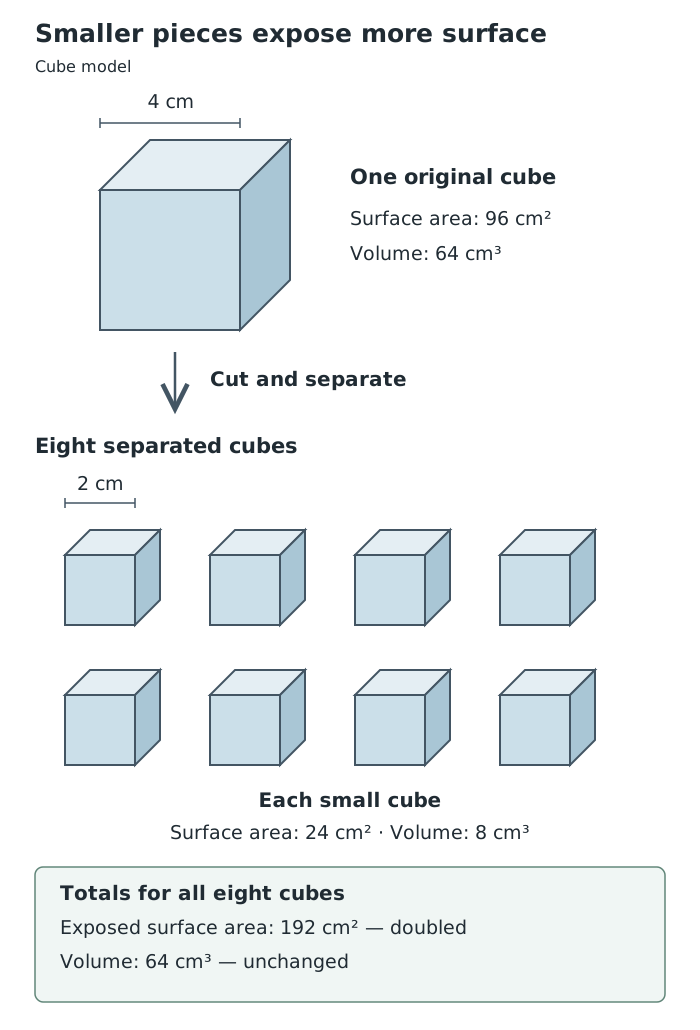
Cutting and separating a cube exposes previously internal faces: total surface area doubles, while total volume stays the same.
Separating the eight smaller cubes doubles the total exposed surface area without changing the total volume. Dividing material into still smaller particles exposes more surface for the same amount of material.
Nanoparticles have a very high surface area to volume ratio. A greater proportion of their atoms are at the surface rather than buried inside the material.
Surface atoms are accessible to other substances, so reactions can take place there. For the same amount of material, smaller particles provide more exposed surface for reaction. This can increase the rate of reaction and make nanoparticulate materials more reactive than larger pieces of the same substance.
The same relationship helps explain why nanoparticles can be effective catalysts: they provide a large surface on which reactions can occur, so a smaller quantity may be needed. Their properties therefore depend not only on what they are made of, but also on their particle size.
Convert lengths to the same unit before comparing sizes or forming a size ratio.
For negative powers, 10⁻⁷ is larger than 10⁻⁹. Compare the powers first, then the coefficients if the powers are equal.
A cube has six faces: surface area is 6l², not l². Give area in squared units and volume in cubed units.
Explain nanoparticle reactivity using a high surface area to volume ratio, not simply a ‘large surface area’.
Use the same length unit throughout surface area to volume comparisons: changing the unit changes the numerical ratio.
It can see this note and what your specification asks for.
Answers are free with an account.
1 free note left this week
Get more free notesYour answer sets when this note comes back for review, or marks it complete.
Was this note helpful?
Log in to tell us whether it helped, or to report a problem.
Last updated
Nanometre
A unit of length equal to one billionth of a metre: .
Nanoparticle
A particle between 1 and 100 nanometres in size.
Nanotechnology
The use and control of structures between 1 and 100 nanometres in size.
Standard form
A way of writing a number as , where and is an integer.
Surface area to volume ratio
The surface area of an object compared with its volume. Smaller particles of the same shape have a higher surface area to volume ratio.
Ratio
A comparison of two quantities by division, showing their relative sizes.
Put your knowledge into practice — try past paper questions for Combined Science B
Nanometre
A unit of length equal to one billionth of a metre: .
Nanoparticle
A particle between 1 and 100 nanometres in size.
Nanotechnology
The use and control of structures between 1 and 100 nanometres in size.
Standard form
A way of writing a number as , where and is an integer.
Surface area to volume ratio
The surface area of an object compared with its volume. Smaller particles of the same shape have a higher surface area to volume ratio.
Ratio
A comparison of two quantities by division, showing their relative sizes.