

Loading…
Loading…
Loading…
OCR GCSE Combined Science B · J260
OCR J260 · Measuring Rates and Enzymatic Catalysis Check the specification (PDF) (opens in a new tab)
Living organisms depend on chemical reactions: food must be broken down, useful molecules made and harmful substances removed. Many of these reactions would happen too slowly at the temperatures inside an organism without enzymes.
An enzyme is a biological catalyst, usually a protein. Like other catalysts, it increases reaction rate without being used up or permanently changed by the reaction. It can therefore act repeatedly on further reactant molecules.
Enzymes provide an alternative reaction pathway with a lower activation energy — the minimum energy needed for a reaction to occur. At the same temperature, more reacting particles have enough energy to react. This allows biological reactions to proceed rapidly without heating cells to damaging temperatures.
The reactant on which an enzyme acts is called its substrate. The enzyme has a region called the active site, where the substrate binds temporarily and the chemical reaction takes place.
The shape of the active site fits particular substrates. This helps explain why enzymes are specific: an enzyme that acts on one substance will not necessarily act on another. The lock-and-key model represents this fit, with the enzyme as the lock and the substrate as the key.
After the reaction, the products leave the active site. The enzyme is available to catalyse another reaction. Some enzymes break a large molecule into smaller molecules; others help join molecules or rearrange them.
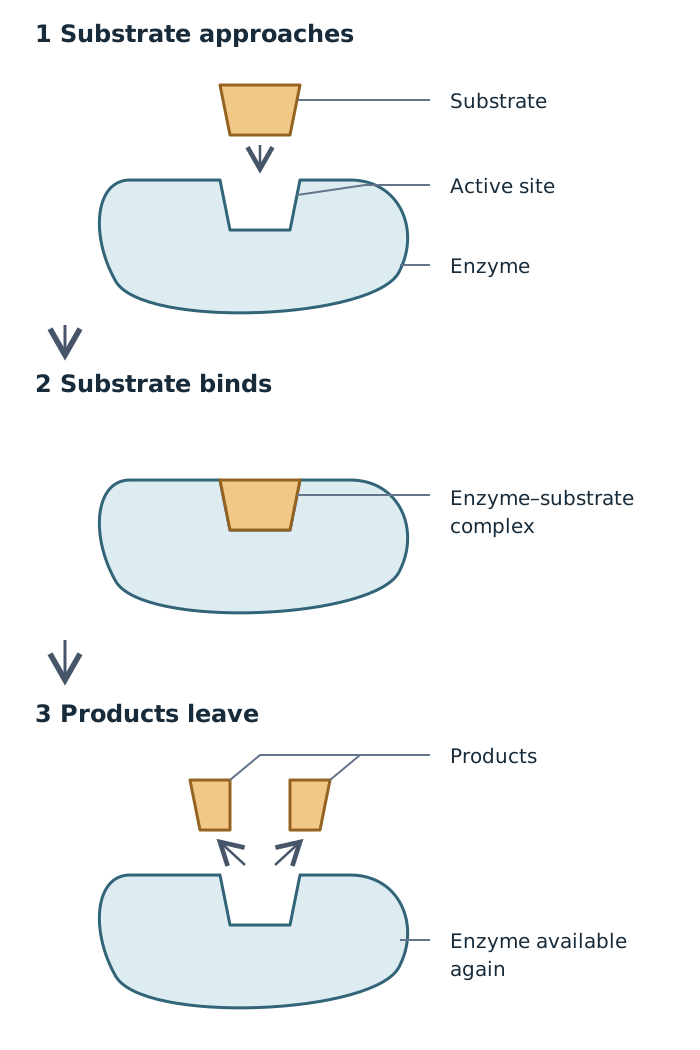
The substrate binds at the active site. After the reaction, products leave and the enzyme can act again.
Amylase is a digestive enzyme found in saliva and produced by the pancreas. It catalyses the breakdown of starch into smaller, soluble sugars. This helps convert a large food molecule into substances that can be processed further during digestion.
Catalase, found in cells including liver cells, breaks down hydrogen peroxide. Hydrogen peroxide can damage tissues, so its rapid removal protects cells. The reaction produces water and oxygen:
Catalase is shown above the arrow because it helps the reaction happen but is not an overall reactant or product.
Industry also uses enzymes to speed up useful chemical changes. Faster reactions can increase the amount of product made in a given time. Enzymes can allow processes to operate under milder conditions, reducing the energy needed for heating and therefore lowering operating costs.
In fermentation, enzymes inside yeast cells convert sugars into ethanol and carbon dioxide without oxygen:
This process is used to produce alcoholic drinks. Yeast is the microorganism; its enzymes are the catalysts that make the chemical reactions happen.
Another example is invertase, which catalyses the breakdown of sucrose into glucose and fructose. The resulting mixture is called inverted sugar syrup. Here, the enzyme helps make a useful sugar product rather than being part of the product itself.
The advantages of enzymes depend on maintaining suitable conditions. Each enzyme has an optimum temperature and pH at which it works fastest.
At low temperatures, enzyme-catalysed reactions are slow. Warming usually increases their rate at first, but excessive heat changes the enzyme’s three-dimensional shape. This is denaturation: the active site no longer fits the substrate properly, so enzyme activity falls. Unsuitable pH can also alter the active site and reduce activity.
Industrial operators therefore control temperature and pH to keep their chosen enzyme effective. Simply making a process hotter is not always a way to make it faster.
Describe an enzyme as a biological catalyst: it increases reaction rate without being used up or permanently changed by the reaction.
For an application, name the enzyme or enzyme-containing organism, describe the chemical change, and explain why it is useful.
Explain energy savings through lower operating temperatures, not by claiming that enzymes supply energy.
Denaturation changes the shape of the active site. It does not mean that the enzyme has been used up.
It can see this note and what your specification asks for.
Answers are free with an account.
1 free note left this week
Get more free notesYour answer sets when this note comes back for review, or marks it complete.
Was this note helpful?
Log in to tell us whether it helped, or to report a problem.
Last updated
Catalyst
A substance that increases the rate of a chemical reaction without being used up or permanently changed by that reaction.
Enzyme
A biological catalyst, usually a protein, that speeds up a particular chemical reaction.
Substrate
A reactant on which an enzyme acts.
Active site
The region of an enzyme where its substrate binds and the reaction takes place.
Activation energy
The minimum energy that reacting particles need for a reaction to occur.
Denaturation
A change in an enzyme’s three-dimensional structure that alters its active site and prevents it from working effectively.
Fermentation
The breakdown of sugars by enzymes in microorganisms such as yeast, producing ethanol and carbon dioxide without oxygen.
Put your knowledge into practice — try past paper questions for Combined Science B
Catalyst
A substance that increases the rate of a chemical reaction without being used up or permanently changed by that reaction.
Enzyme
A biological catalyst, usually a protein, that speeds up a particular chemical reaction.
Substrate
A reactant on which an enzyme acts.
Active site
The region of an enzyme where its substrate binds and the reaction takes place.
Activation energy
The minimum energy that reacting particles need for a reaction to occur.
Denaturation
A change in an enzyme’s three-dimensional structure that alters its active site and prevents it from working effectively.
Fermentation
The breakdown of sugars by enzymes in microorganisms such as yeast, producing ethanol and carbon dioxide without oxygen.
| Example | Chemical change and purpose |
|---|---|
| Amylase | Breaks starch into smaller sugars during digestion. |
| Catalase | Breaks harmful hydrogen peroxide into water and oxygen. |
| Yeast enzymes | Ferment sugars into ethanol and carbon dioxide; used to produce alcoholic drinks. |
| Invertase | Breaks sucrose into glucose and fructose to make inverted sugar syrup. |
Faster production and milder operating conditions can reduce energy costs. Temperature and pH must suit the enzyme: excessive heat or unsuitable pH can alter its active site and reduce activity.