

Loading…
Loading…
Loading…
OCR GCSE Combined Science B · J260
OCR J260 · Medical Treatments and Drug Development Check the specification (PDF) (opens in a new tab)
Medicines can help in different ways. Some control or eliminate the cause of a disease; others reduce the severity or duration of its symptoms. Relieving symptoms can make someone more comfortable without curing the underlying disease.
Antibiotics kill bacteria or prevent their growth. For example, penicillin interferes with processes in bacterial cells. An effective antibiotic can therefore treat the cause of a bacterial infection. Different bacteria respond to different antibiotics, so choosing an appropriate antibiotic matters.
Antibiotics do not work against viruses. Viruses reproduce inside the body’s cells, and the bacterial processes targeted by antibiotics are not present in viruses. Developing medicines against viruses is difficult because a treatment must interfere with the virus without damaging the patient’s cells.
Painkillers reduce pain but do not kill pathogens. Someone with an infection might therefore receive a painkiller to relieve symptoms as well as a medicine that treats the infection. Unnecessary antibiotic use should be avoided because it encourages the spread of antibiotic-resistant bacteria, making infections harder to treat.
Bacteria can grow on nutrient agar jelly in a Petri dish. When an antibiotic disc is placed on the agar, the antibiotic spreads into it. If the bacteria are susceptible, their growth is prevented around the disc, leaving a clear inhibition zone.
Measuring this zone gives a numerical way to compare treatments rather than judging their effects by eye. Under comparable conditions, a larger clear zone indicates that bacterial growth has been prevented over a larger area. This is evidence of effectiveness against the bacteria tested, not proof that the antibiotic will be best for every infection. A fair comparison uses the same bacteria and comparable antibiotic quantities and growth conditions.
When measuring a school culture, keep the dish closed and measure through it. Do not open an incubated culture to obtain a clearer view.
The cross-sectional area of a circular bacterial culture, or the area enclosed by a circular clear zone, is calculated using:
Here, is area and is radius: the distance from the centre to the edge. The diameter passes through the centre from one edge to the opposite edge, so the radius is half the diameter. If the radius is measured in millimetres, the area is in square millimetres, .
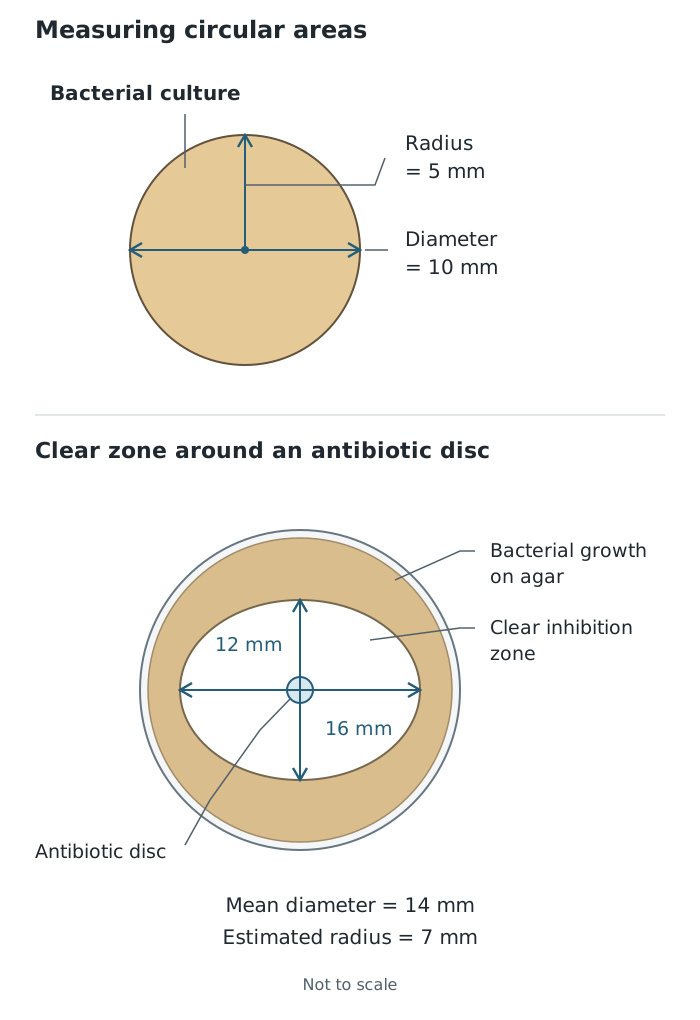
Measure across the whole circle or clear zone. Halve the diameter before calculating area; use a mean diameter for an approximately circular zone.
Suppose a circular bacterial culture has a diameter of 10 mm. Its radius is , so its cross-sectional area is . This measures the area occupied by the culture, not the number of bacterial cells.
A clear zone may not be perfectly circular. Measure its full diameter in at least two different directions and calculate the mean. For example, suppose perpendicular diameters are 12 mm and 16 mm. The mean diameter is , giving a radius of 7 mm. The estimated area is therefore . Using a mean diameter treats the zone as approximately circular, so the result is an estimate.
Cardiovascular disease affects the heart or blood vessels. One important example is coronary heart disease. The heart muscle needs its own blood supply, delivered by the coronary arteries, to obtain oxygen and glucose for respiration.
Fatty deposits called plaques can narrow these arteries. Restricted blood flow may cause chest pain called angina. If blood flow becomes completely blocked, heart muscle cells can die, causing a heart attack.
Strategies can act at different stages: lifestyle changes reduce the chance of disease developing, medicines can reduce particular risks, and procedures can restore blood flow when an artery is already narrowed or blocked.
Stopping smoking reduces exposure to chemicals that damage arteries. A balanced diet with less saturated fat and more fruit and vegetables can help reduce blood cholesterol and support a healthy body mass. Regular exercise can help control body mass, lower blood pressure and improve cardiovascular health. Avoiding excessive alcohol consumption also reduces a cardiovascular risk factor.
These changes have advantages over waiting until disease develops. They can reduce several risks together, benefit other aspects of health and avoid the risks of surgery. However, maintaining changes can be difficult, and the benefits develop over time. Lifestyle changes also cannot reliably restore blood flow through a severely blocked artery.
Prevention is therefore valuable, but it is not a substitute for necessary treatment. Someone with established disease may need lifestyle changes alongside medicines or a procedure.
Medicines: a doctor may prescribe aspirin to reduce the risk of blood clots forming in arteries. This can lower the chance of a clot blocking blood flow. Taking a medicine avoids an operation, but it may need to be taken regularly, can have side effects and does not physically remove an existing plaque. Treatment should be medically supervised.
Angioplasty and stents: a small balloon is guided into a narrowed artery and inflated to press the plaque against the artery wall. A mesh tube called a stent can then hold the artery open, improving blood flow to the heart muscle. Some stents release a medicine to help prevent further narrowing. This directly treats the narrowing, but it is still a procedure with risks and does not remove the underlying risk factors.
Coronary bypass surgery: a blood vessel taken from elsewhere in the patient’s body is used to create a new route around a blocked section of coronary artery. This allows blood to reach the heart muscle without passing through the blockage. It can help when an alternative route is needed, but it involves an operation and recovery, with risks including bleeding, infection and complications from anaesthesia.
Heart transplantation: in severe cases, a diseased heart may be replaced with a donor heart. Suitable donors are scarce, and the recipient’s immune system may reject the organ. Long-term medicines that suppress the immune system may be needed, increasing susceptibility to infection. Transplantation also carries the risks of major surgery.
There is no single strategy that is best for everyone. A useful evaluation weighs the likely improvement against side effects, procedural risks, the severity of disease and the patient’s ability to sustain treatment.
For someone without established disease, reducing risk through lifestyle changes has clear advantages over waiting for a blockage and then operating. For someone whose heart muscle already receives too little blood, lifestyle changes alone may be insufficient: a stent or bypass may provide a more immediate improvement. The strongest conclusion is often a combination of approaches—treat the existing problem while continuing to reduce the risk of further disease.
For circle-area calculations, halve the diameter before using A = πr² and give the answer in squared units, such as mm².
If a clear zone is not perfectly circular, calculate a mean diameter from measurements in different directions, then halve it.
Antibiotics act against bacteria, not viruses. Painkillers relieve symptoms but do not kill pathogens.
When evaluating cardiovascular treatments, connect each benefit or limitation to the patient’s circumstances and finish with a justified conclusion.
Lifestyle changes lower risk; they do not guarantee that cardiovascular disease will be prevented.
It can see this note and what your specification asks for.
Answers are free with an account.
1 free note left this week
Get more free notesYour answer sets when this note comes back for review, or marks it complete.
Was this note helpful?
Log in to tell us whether it helped, or to report a problem.
Last updated
Antibiotic
A medicine that kills bacteria or inhibits their growth, used to treat bacterial infections.
Painkiller
A medicine that reduces pain without removing the underlying cause of the disease.
Inhibition zone
A clear region around a disc on a bacterial culture where bacterial growth has been prevented.
Cross-sectional area
The area of a flat section through an object; for a circular section, .
Cardiovascular disease
Disease affecting the heart or blood vessels.
Coronary heart disease
Disease in which the coronary arteries become narrowed or blocked, reducing the blood supply to heart muscle.
Coronary artery
An artery that supplies the heart muscle with blood containing oxygen and nutrients.
Stent
A mesh tube placed inside an artery to help keep it open.
Coronary bypass surgery
An operation that creates an alternative route for blood around a blocked coronary artery.
Put your knowledge into practice — try past paper questions for Combined Science B
Antibiotic
A medicine that kills bacteria or inhibits their growth, used to treat bacterial infections.
Painkiller
A medicine that reduces pain without removing the underlying cause of the disease.
Inhibition zone
A clear region around a disc on a bacterial culture where bacterial growth has been prevented.
Cross-sectional area
The area of a flat section through an object; for a circular section, .
Cardiovascular disease
Disease affecting the heart or blood vessels.
Coronary heart disease
Disease in which the coronary arteries become narrowed or blocked, reducing the blood supply to heart muscle.
Coronary artery
An artery that supplies the heart muscle with blood containing oxygen and nutrients.
Stent
A mesh tube placed inside an artery to help keep it open.
Coronary bypass surgery
An operation that creates an alternative route for blood around a blocked coronary artery.
Coronary artery narrowing → reduced blood supply to heart muscle. Complete blockage can cause a heart attack.
| Strategy | Main benefit | Main limitation |
|---|---|---|
| Stop smoking, improve diet, exercise, avoid excessive alcohol | Reduces risk and benefits wider health | Requires sustained changes; cannot reliably reverse severe blockage |
| Medicines, such as prescribed aspirin | Reduce particular risks, such as clot formation | Regular treatment and possible side effects; do not remove plaque |
| Angioplasty with a stent | Widens the artery and helps keep it open | Procedural risks; underlying risk factors remain |
| Coronary bypass | Provides a route around a blockage | Operation, recovery and surgical risks |
| Heart transplant | Replaces a severely diseased heart | Donor shortage, rejection and immunosuppression |
Evaluation: prevention has advantages over later treatment, but established disease may need medicines or procedures as well as lifestyle changes. Justify the choice for the patient’s circumstances.