

Loading…
Loading…
Loading…
OCR GCSE Combined Science B · J260
OCR J260 · Medical Treatments and Drug Development Check the specification (PDF) (opens in a new tab)
A substance that affects a disease is not automatically a suitable medicine. It might work only at a dose that causes serious harm, or its effect in laboratory cells might not be useful in a patient. Drug development therefore moves through several stages, gathering evidence before a medicine becomes widely available.
Scientists look for substances that could affect the cause of a disease or a biological process involved in it. They screen possible substances to identify promising candidate drugs. Computer modelling can help identify molecules worth investigating, and chemists can synthesise them for testing.
Plants and microorganisms have provided important starting points. Digitalis, used to treat heart conditions, originates from foxgloves; aspirin developed from chemicals associated with willow. Alexander Fleming discovered penicillin after noticing that bacteria did not grow near a contaminating Penicillium mould. The mould released a substance that killed nearby bacteria. Such observations can suggest a potential medicine, but they do not replace testing.
Three questions run through drug development:
These questions are connected. A stronger effect is not necessarily better if increasing the dose also increases harm. Researchers aim to find a suitable dose, including the lowest dose that produces the required effect.
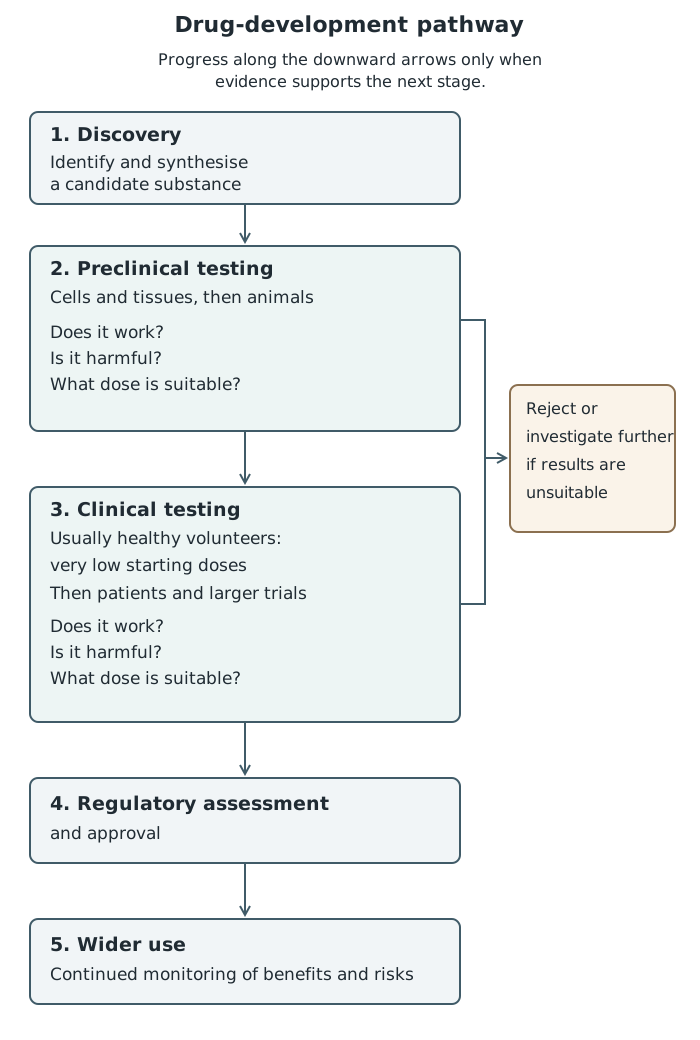
Each stage builds evidence about benefits and risks before a potential medicine moves further through development.
Preclinical testing uses cells, tissues and animals. Tests on cells and tissues in the laboratory help researchers investigate whether a candidate has the intended effect and whether it damages living material.
Animal tests then investigate its effects in a whole organism. This matters because isolated cells cannot represent all the interacting parts of a body. Researchers examine effectiveness, harmful effects and suitable doses before deciding whether human testing should begin.
A candidate that is ineffective or causes unacceptable harm may be rejected. Passing preclinical tests allows further investigation; it does not establish that the medicine will be safe and effective in humans.
Clinical trials involve humans. Testing usually begins with a small group of healthy volunteers. Very low doses are given initially to investigate safety and side effects while limiting risk. Doses can then be increased carefully as evidence is gathered.
If the results justify further testing, the medicine is tested in patients who have the condition it is intended to treat. Researchers investigate whether it actually helps them, record side effects and refine the dose. Larger trials provide further evidence about benefits and risks and can compare the medicine with an existing treatment.
The sequence is important: promising laboratory results come before human testing, and early safety checks come before wider trials in patients.
An improvement during a trial does not, by itself, show that the drug caused it. Researchers need a comparison group. Some trials compare the new medicine with an existing treatment; others use a placebo, which contains no active drug.
A placebo helps researchers distinguish the effect of the active drug from changes associated with receiving treatment and expecting to improve. The groups' outcomes are compared rather than judging the medicine from the treated group alone.
In a double-blind trial, neither the patients nor the doctors assessing them know which treatment each patient receives. Other people organise the treatment allocation. This reduces the chance that expectations influence how patients report symptoms or how doctors assess improvements. It reduces bias; it does not remove the need for careful measurements and analysis.
Trial results must be reported accurately and checked. Peer review allows other scientists to scrutinise the research. Regulators, such as the UK's Medicines and Healthcare products Regulatory Agency (MHRA), assess evidence before a medicine is approved for wider use. Monitoring continues afterwards because further side effects may become apparent during wider or longer-term use.
Testing also raises ethical questions. Animal testing can provide evidence about whole-body effects before people are exposed, but it involves potential animal harm, so its use should be reduced where possible. Human volunteers must give informed consent, and researchers must minimise risks. The possibility of helping future patients does not justify exposing participants to unreasonable danger.
Approval is therefore a judgement about whether the expected benefits outweigh the risks—not a claim that a medicine can never cause harm.
Discovery → preclinical testing → clinical trials → regulatory approval → continued monitoring.
Candidates may come from plants or microorganisms, or be synthesised by chemists. Computer modelling can help identify promising molecules.
Keep the stages in order: discovery → preclinical testing → clinical testing. Tests on animals are preclinical, not clinical.
Describe what testing investigates: toxicity, efficacy and a suitable dose. Saying only that a drug is ‘tested’ is not enough.
For a double-blind trial, state that neither the patients nor the doctors assessing them know who receives the drug or the comparison treatment, and explain how this reduces bias.
It can see this note and what your specification asks for.
Answers are free with an account.
1 free note left this week
Get more free notesYour answer sets when this note comes back for review, or marks it complete.
Was this note helpful?
Log in to tell us whether it helped, or to report a problem.
Last updated
Candidate drug
A substance identified as a possible medicine that needs further testing before it can be used widely.
Preclinical testing
Testing a potential medicine before human trials, using cells, tissues and animals.
Clinical trial
Testing a potential medicine in human volunteers and patients to investigate its safety, effectiveness and suitable dose.
Toxicity
The ability of a substance to cause harmful effects.
Efficacy
How effectively a medicine produces its intended treatment effect.
Dose
The amount of a medicine given at one time.
Placebo
A comparison treatment containing no active drug, used to help assess the effects of the medicine being tested.
Double-blind trial
A trial in which neither the participants nor the doctors assessing them know who receives the active drug and who receives the comparison treatment.
Informed consent
Voluntary agreement to take part in a study after understanding what it involves and its potential risks.
Put your knowledge into practice — try past paper questions for Combined Science B
Candidate drug
A substance identified as a possible medicine that needs further testing before it can be used widely.
Preclinical testing
Testing a potential medicine before human trials, using cells, tissues and animals.
Clinical trial
Testing a potential medicine in human volunteers and patients to investigate its safety, effectiveness and suitable dose.
Toxicity
The ability of a substance to cause harmful effects.
Efficacy
How effectively a medicine produces its intended treatment effect.
Dose
The amount of a medicine given at one time.
Placebo
A comparison treatment containing no active drug, used to help assess the effects of the medicine being tested.
Double-blind trial
A trial in which neither the participants nor the doctors assessing them know who receives the active drug and who receives the comparison treatment.
Informed consent
Voluntary agreement to take part in a study after understanding what it involves and its potential risks.