

Loading…
Loading…
Loading…
OCR GCSE Combined Science B · J260
OCR J260 · Resultant Forces and Momentum Check the specification (PDF) (opens in a new tab)
A moving object has momentum, calculated by multiplying its mass by its velocity:
Here, is momentum in kilograms metres per second (kg m/s), is mass in kilograms (kg), and is velocity in metres per second (m/s). An object at rest has zero momentum because its velocity is zero.
At the same velocity, an object with twice the mass has twice the momentum. For the same mass, doubling the velocity doubles the momentum. A light object moving quickly can therefore have the same momentum as a heavier object moving slowly.
Velocity describes both speed and direction, so momentum is also a vector. For motion along a straight line, choose one direction as positive. If right is positive, an object moving left has negative velocity and negative momentum. This lets you account for direction when adding momenta or calculating a change.
A system is the object or group of objects you are considering. When two marbles collide, you can treat both marbles together as one system. The contact forces between them act within that system; friction from the surface is an external force because it comes from outside the system.
When the resultant external force on a system is zero, its total momentum is conserved:
In a short collision on a smooth surface, external forces may be small enough to neglect. One object can lose momentum while the other gains it: conservation applies to the total, not necessarily to each object separately.
For example, when one moving marble hits an identical stationary marble head-on, the first can stop while the second moves away with the first marble's original velocity. The momentum has been transferred between the marbles, but their total momentum is unchanged.
Objects can also stick together after a collision. They then move with a common velocity, so their final momentum is their combined mass multiplied by that velocity.
Suppose a 2 kg trolley moving right at 3 m/s collides with a stationary 1 kg trolley. They stick together, and external forces are negligible during the collision. Take right as positive.
The moving trolley initially has momentum . The stationary trolley has zero momentum, so the total before the collision is .
Afterwards, the combined mass is . Conservation of momentum gives:
Therefore, the joined trolleys move at to the right. They move more slowly than the original moving trolley because the same total momentum is now shared by a greater mass.
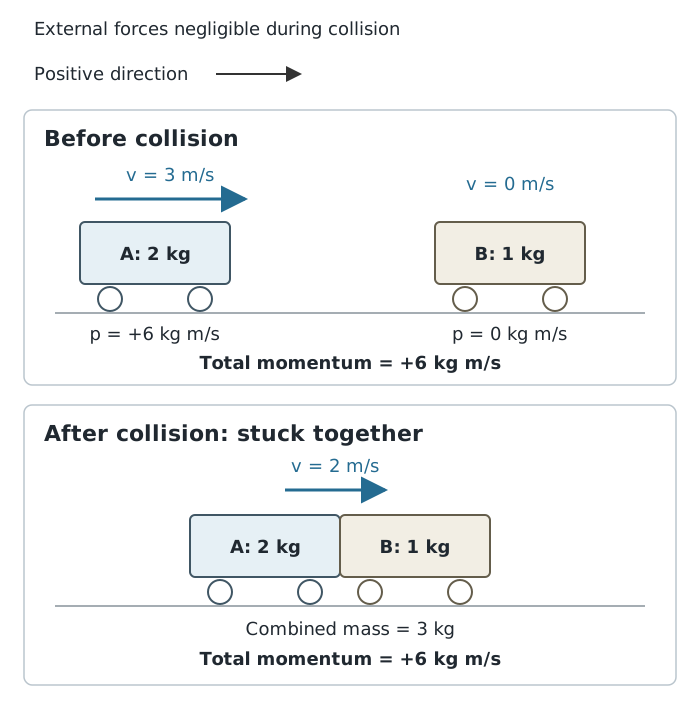
The joined trolleys move more slowly, but their total momentum remains unchanged.
For any straight-line collision, calculate each object's momentum with its signed velocity, then add the momenta. Use the same positive direction before and after the collision.
Newton's second law states that the resultant force is the rate of change of momentum. This means the change in momentum per second. In the form used to link force and time:
Here, is the change in momentum in kg m/s, is the resultant force in newtons (N), and is the time for which it acts in seconds (s). For a varying force, represents the average resultant force over that time.
A larger resultant force produces a larger momentum change in the same time. The same force acting for twice as long produces twice the momentum change. The change in momentum is in the direction of the resultant force.
To find the change, subtract initial momentum from final momentum. For an object whose mass stays constant:
Here, is initial velocity and is final velocity. Keeping their directions matters, particularly when an object rebounds.
Rearrange the equation according to the quantity needed:
Suppose a 0.20 kg ball initially travels right at 10 m/s and is brought to rest in 0.10 s. Taking right as positive, its initial momentum is and its final momentum is zero. Its change in momentum is therefore .
The average resultant force is . The negative sign means that the force acts left, opposing the ball's original motion.
If the same ball instead rebounds left at 10 m/s, its final momentum is . Its change is then : reversing direction produces a greater momentum change than merely stopping.
For a fixed change in momentum, increasing the contact time reduces the average force. Moving your hands backwards while catching a ball allows it to stop over a longer time, reducing the force needed to stop it.
: kg m/s; : kg; : m/s. Momentum is a : use signed velocities to represent opposite directions.
Choose a positive direction and use it consistently. Velocities and momenta in the opposite direction are negative.
Calculate change in momentum as final momentum minus initial momentum, not the other way round.
For a collision, add the momenta of all objects before and after. If objects stick together, use their combined mass.
In Δp = Ft, F is the resultant force. If the force varies during contact, the calculation gives its average value.
Use mass in kg, velocity in m/s and time in s. Momentum is measured in kg m/s; force is measured in N.
It can see this note and what your specification asks for.
Answers are free with an account.
1 free note left this week
Get more free notesYour answer sets when this note comes back for review, or marks it complete.
Was this note helpful?
Log in to tell us whether it helped, or to report a problem.
Last updated
Momentum
The product of an object's mass and velocity: . Momentum is a vector, measured in kg m/s.
Vector
A quantity with both magnitude and direction.
System
An object or group of objects considered together when analysing an interaction.
External force
A force exerted on a system by something outside that system.
Conservation of momentum
The principle that the total momentum of a system stays constant when the resultant external force is zero.
Resultant force
The single force equivalent to all the forces acting on an object, taking their directions into account.
Put your knowledge into practice — try past paper questions for Combined Science B
Momentum
The product of an object's mass and velocity: . Momentum is a vector, measured in kg m/s.
Vector
A quantity with both magnitude and direction.
System
An object or group of objects considered together when analysing an interaction.
External force
A force exerted on a system by something outside that system.
Conservation of momentum
The principle that the total momentum of a system stays constant when the resultant external force is zero.
Resultant force
The single force equivalent to all the forces acting on an object, taking their directions into account.
With zero resultant external force:
: resultant force in N; : time in s. For varying forces, use the average resultant force.