

Loading…
Loading…
Loading…
OCR GCSE Combined Science B · J260
OCR J260 · Newton's Laws and Reaction Times Check the specification (PDF) (opens in a new tab)
A force does not necessarily make an object speed up. Its effect depends on all the forces acting on that object and their directions. The resultant force is the single force that represents their combined effect. Forces along the same line add if they act in the same direction and subtract if they act in opposite directions.
Newton’s first law states that an object remains at rest or continues moving with constant velocity unless a non-zero resultant force acts on it. Velocity means speed in a particular direction, so constant velocity means constant speed along a straight line.
A book resting on a table has forces acting on it: its weight acts downwards and the table’s contact force acts upwards. These forces balance, giving zero resultant force, so the book remains stationary. Similarly, a car travelling along a straight, level road at constant velocity has a driving force balanced by resistive forces. The engine is needed to counter resistance, not to produce a resultant force that keeps the car moving.
If the resultant force is not zero, the object’s velocity changes: it accelerates. A force in the direction of travel can increase its speed; a force against its motion can reduce its speed. A force can also change its direction. Acceleration therefore does not always mean speeding up.
A falling skydiver shows how forces and motion are connected. Weight acts downwards and air resistance acts upwards. Early in the fall, weight is greater than air resistance, so the resultant force is downwards and the skydiver speeds up.
As the skydiver’s speed increases, air resistance increases. The downward resultant force becomes smaller, so the skydiver continues to speed up, but less quickly. Eventually, air resistance equals weight. The resultant force and acceleration are then zero, but the skydiver is still falling at a constant velocity, called terminal velocity.
The important distinction is between velocity and a change in velocity: balanced forces prevent a change in motion; they do not necessarily stop motion.
Imagine a car travelling around a roundabout at constant speed. Its speedometer reading can stay the same, but its direction changes continuously. Its velocity therefore changes, which means it is accelerating. Newton’s first law tells us that a non-zero resultant force must be acting.
The same reasoning applies to an object moving in a circular orbit. In a circular model of the Moon’s orbit around Earth, the Moon moves at constant speed but continually changes direction. Gravity provides the resultant force towards Earth that changes the direction of its motion. Constant speed is not the same as constant velocity.
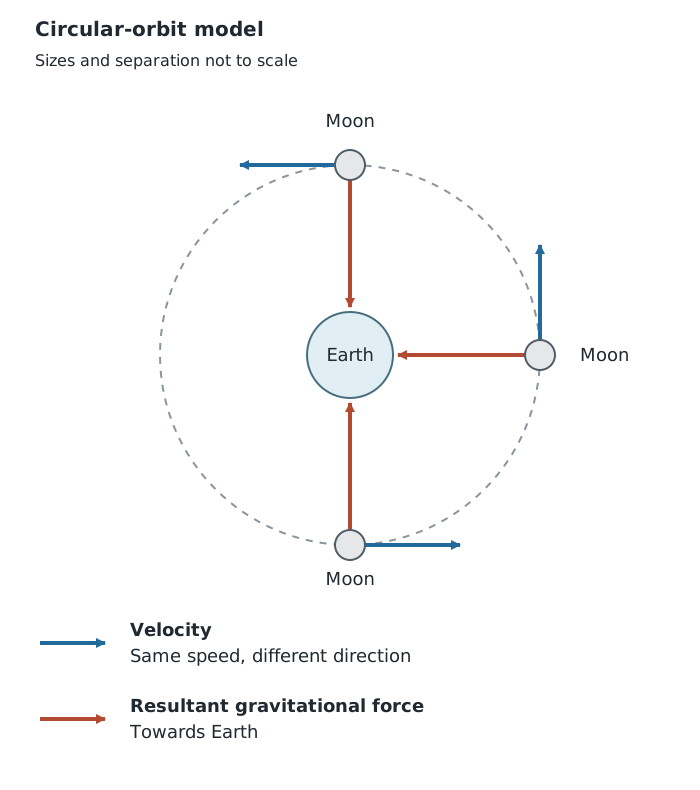
In a circular orbit, equal-length velocity arrows show constant speed, but their changing directions show changing velocity.
The velocity arrows point along the path, while the force arrows point towards the centre. Without the inward resultant force, the object would continue in a straight line rather than follow the circle.
Newton’s first law tells us whether velocity changes. Newton’s second law tells us how much acceleration a produces:
Here, is the resultant force in newtons (N), is mass in kilograms (kg), and is acceleration in metres per second squared (m/s²). Acceleration is in the direction of the resultant force.
Rearranging gives . For example, a trolley of mass 5 kg experiencing a resultant force of 20 N has an acceleration of . This means its velocity changes by 4 m/s each second while that acceleration continues.
At constant mass, acceleration is directly proportional to resultant force: doubling the force doubles the acceleration. At constant resultant force, acceleration is inversely proportional to mass: doubling the mass halves the acceleration. Equally, producing the same acceleration in an object with twice the mass requires twice the resultant force.
Inertia is the tendency of an object to remain at rest or continue moving with constant velocity. Inertial mass measures how difficult it is to change that velocity. It applies to changes in speed and changes in direction, not just to starting an object moving.
An empty shopping trolley is easier to accelerate than a heavily loaded one. For the same resultant push, the loaded trolley has a smaller acceleration because it has a greater inertial mass.
Inertial mass is defined as the ratio of resultant force to acceleration:
This is Newton’s second law rearranged. If the same force acts on several objects, the object with the smallest acceleration has the greatest inertial mass.
The force, acceleration and momentum equations describe the same change in motion in different ways. For an object of constant mass, moving along a straight line:
Here, is initial velocity, is final velocity, and is the time taken in seconds. Substituting into Newton’s second law gives:
Since momentum is , the change in momentum is . Therefore:
For a constant resultant force, a longer time produces a greater change in momentum. For the same time interval, a larger resultant force produces a greater change in momentum. The momentum change is in the direction of the resultant force. When force varies, gives the average resultant force over the interval.
Constant speed around a circle still means changing velocity because direction changes. The object accelerates, with a resultant force towards the centre. Gravity provides this force in a circular orbit.
Use the resultant force in F = ma, not just one of the forces acting on the object.
Zero resultant force means zero acceleration, not necessarily zero velocity.
When explaining circular motion, state that direction changes, so velocity changes even when speed is constant.
For proportional relationships, name what stays constant: acceleration is proportional to force at constant mass.
Use a consistent positive direction when calculating changes in velocity or momentum. Convert mass to kilograms before using F = ma.
It can see this note and what your specification asks for.
Answers are free with an account.
1 free note left this week
Get more free notesYour answer sets when this note comes back for review, or marks it complete.
Was this note helpful?
Log in to tell us whether it helped, or to report a problem.
Last updated
Resultant force
The single force representing the combined effect of all forces acting on an object, taking their directions into account.
Velocity
Speed in a specified direction. Constant velocity requires both constant speed and constant direction.
Acceleration
The rate of change of velocity. An object accelerates when its speed, direction or both change.
Newton’s first law
An object remains at rest or moves with constant velocity unless a non-zero resultant force acts on it.
Newton’s second law
The resultant force on an object equals its mass multiplied by its acceleration: .
Inertia
The tendency of an object to remain at rest or continue moving with constant velocity.
Inertial mass
A measure of how difficult it is to change an object’s velocity, defined as the ratio of resultant force to acceleration: . It is measured in kilograms.
Momentum
A vector quantity equal to mass multiplied by velocity: . Its unit is kg m/s.
Put your knowledge into practice — try past paper questions for Combined Science B
Resultant force
The single force representing the combined effect of all forces acting on an object, taking their directions into account.
Velocity
Speed in a specified direction. Constant velocity requires both constant speed and constant direction.
Acceleration
The rate of change of velocity. An object accelerates when its speed, direction or both change.
Newton’s first law
An object remains at rest or moves with constant velocity unless a non-zero resultant force acts on it.
Newton’s second law
The resultant force on an object equals its mass multiplied by its acceleration: .
Inertia
The tendency of an object to remain at rest or continue moving with constant velocity.
Inertial mass
A measure of how difficult it is to change an object’s velocity, defined as the ratio of resultant force to acceleration: . It is measured in kilograms.
Momentum
A vector quantity equal to mass multiplied by velocity: . Its unit is kg m/s.
: resultant force (N); : mass (kg); : acceleration (m/s²).
For constant mass:
A resultant force changes momentum in its own direction. Greater force or a longer acting time gives a greater momentum change.