

Loading…
Loading…
Loading…
OCR GCSE Combined Science B · J260
OCR J260 · Resultant Forces and Momentum Check the specification (PDF) (opens in a new tab)
A force is a push or pull caused by an interaction between objects. Forces are measured in newtons (N). To understand their combined effect, first choose the object you are studying and consider it separately from its surroundings. This is what it means to isolate an object for a force diagram: it does not mean that no forces act on it.
For example, a book resting on a horizontal table experiences two forces: its weight, caused by Earth's gravitational attraction, acts vertically downwards; the table's normal contact force acts upwards, perpendicular to the surface.
Sometimes it is useful to choose a whole system rather than one object. For a person sitting in a stationary boat, you can treat the boat and person together as the system. The external forces are their combined weight downwards and the water's upthrust upwards. Forces between the person and the boat are internal to this chosen system, so they are not included as external forces.
Force is a vector: both its magnitude and its direction matter. A free body diagram represents the chosen object by a simple shape or dot, with a labelled arrow for each force acting on it. An arrow points in the force's direction, and a longer arrow represents a larger force. Equal forces should have equal-length arrows.
The labels describe interactions, not movements. For a car travelling forwards along a level road, the driving force acts forwards, while air resistance and other resistive forces act backwards. Weight acts downwards and the road's normal contact force acts upwards. There is no separate force called ‘motion’.
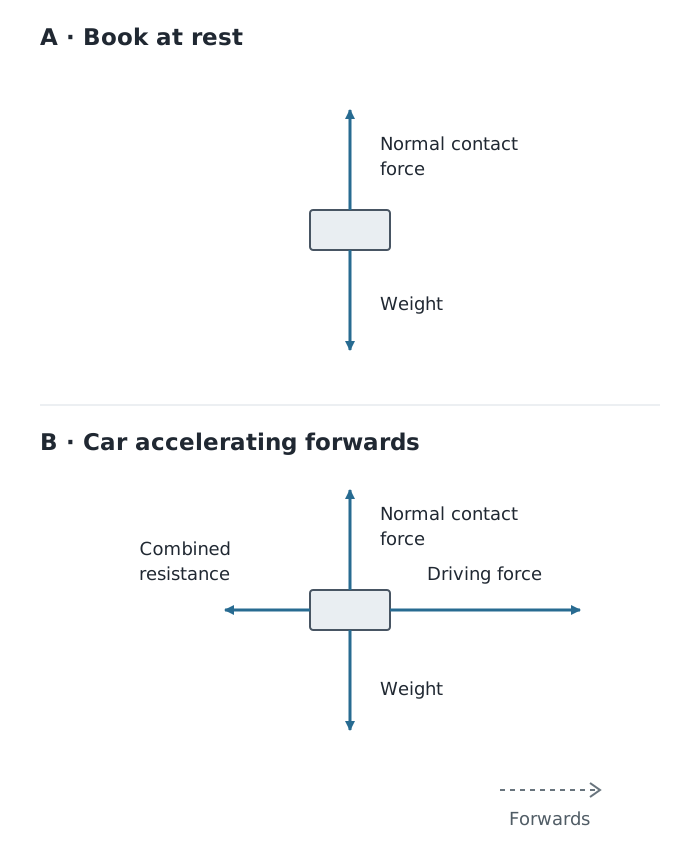
The book's forces balance. The car's vertical forces balance, but its horizontal forces give a forward resultant.
In the book diagram, equal upward and downward arrows show that the forces balance. In the accelerating-car diagram, the vertical forces balance, but the forward driving force is larger than the combined backward resistance. The car therefore has a forward resultant force.
The resultant force is the single force that represents the overall effect of all the forces acting on an object. To find it, combine forces while taking their directions into account.
Forces along the same line reinforce each other if they act in the same direction. Opposing forces partly or completely cancel. The resultant points towards the greater total force.
When the resultant is zero, the forces are balanced and the object is in equilibrium. Its velocity does not change: a stationary object remains stationary, while a moving object continues at constant speed in a straight line. Equilibrium therefore does not necessarily mean that an object is at rest.
A non-zero resultant causes acceleration in its direction. Acceleration means a change in velocity, so it can involve speeding up, slowing down or changing direction.
For an object falling through air, weight acts downwards and drag acts upwards. When weight is greater than drag, the resultant is downwards. As the object speeds up, drag increases. Eventually drag can equal weight: the resultant becomes zero and the object falls at a constant terminal velocity. Weight and drag still act; they have not disappeared.
An aircraft has four main forces: thrust forwards, drag backwards, lift upwards and weight downwards. In steady, level flight at constant velocity, thrust balances drag and lift balances weight. Balance must be considered in both directions: balanced vertical forces alone do not establish equilibrium if the horizontal forces are unbalanced.
A scale drawing makes arrow lengths represent specific force magnitudes. Suppose two forces act on an object: 60 N to the right and 20 N to the left. Choose a scale of 1 cm represents 10 N.
Draw a 6 cm arrow to the right. From its arrowhead, draw a 2 cm arrow to the left. This is the head-to-tail method: each new vector starts where the previous vector ends. Moving an arrow into this arrangement does not change its length or direction.
The resultant runs from the tail of the first arrow to the head of the last. Here it is 4 cm to the right, representing 40 N to the right. If both forces acted to the right, the arrows would instead form a total length of 8 cm, representing 80 N to the right.
For two equal opposing forces, the final arrowhead returns to the starting point. There is no remaining displacement on the vector diagram, so the resultant is zero.
Perpendicular forces act at right angles. Their magnitudes cannot simply be added to find the resultant, because they act in different directions.
Suppose one force is 40 N to the right and another is 30 N upwards. Using 1 cm represents 10 N, draw a 4 cm arrow rightwards, then a 3 cm arrow upwards from its head. Join the first tail to the final head with an arrow: this diagonal is the resultant.
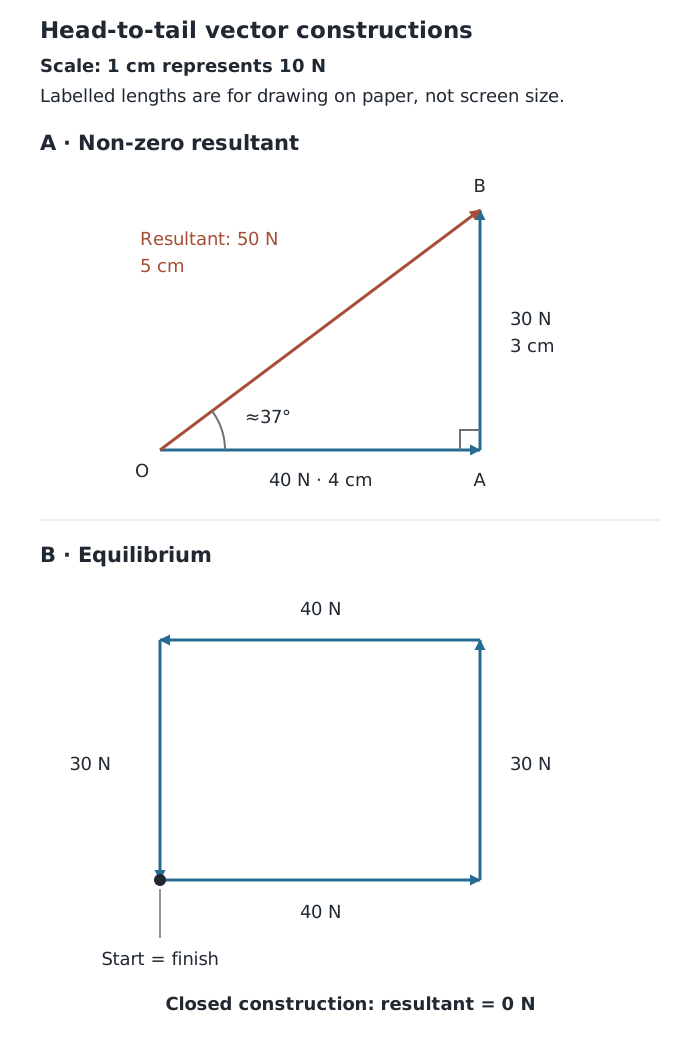
An open head-to-tail construction gives a resultant from start to finish. A closed construction shows equilibrium.
Use a ruler to measure the diagonal and convert its length using the scale. It measures 5 cm, so the resultant is 50 N. Use a protractor to measure its direction from the rightward horizontal: approximately 37° above the horizontal. The resultant's diagonal direction expresses the combined effect of the two perpendicular forces.
You can also use the parallelogram method: draw both forces from a common starting point, complete a rectangle for perpendicular vectors, and draw the diagonal from that starting point to the opposite corner.
The head-to-tail method also works for more than two forces. For example, combine 40 N rightwards, 30 N upwards, 40 N leftwards and 30 N downwards. At the same scale, the arrows form a closed rectangle. The final head meets the first tail, so the resultant is zero.
This shows the connection between a free body diagram and a vector construction. The free body diagram identifies the forces acting on the object; the head-to-tail diagram tests their combined effect. A closed construction represents equilibrium. An open construction has a non-zero resultant from its starting point to its finishing point.
For these scale-drawing tasks, the individual force vectors are limited to parallel or perpendicular directions. Recreate the stated lengths on paper when practising measurements: resizing a displayed diagram changes its physical size.
Show only forces acting on the chosen object or system, not forces it exerts on its surroundings.
Label every force arrow. Arrow direction represents force direction; arrow length represents force magnitude.
Balanced forces mean zero resultant force, not necessarily zero velocity.
When moving a vector into a head-to-tail diagram, preserve its length and direction. Draw the resultant from the first tail to the final head.
State your scale and give both the magnitude and direction of a non-zero resultant. Convert measured centimetres back into newtons.
It can see this note and what your specification asks for.
Answers are free with an account.
1 free note left this week
Get more free notesYour answer sets when this note comes back for review, or marks it complete.
Was this note helpful?
Log in to tell us whether it helped, or to report a problem.
Last updated
Vector
A quantity with both magnitude and direction. Force is a vector quantity.
Magnitude
The size of a quantity, without its direction. The magnitude of a force is measured in newtons (N).
Free body diagram
A diagram showing the forces acting on one selected object or system as labelled arrows.
Resultant force
The single force that has the same overall effect as all the forces acting on an object, taking their directions into account.
Equilibrium
A situation in which the forces acting on an object are balanced, so its resultant force is zero.
Weight
The gravitational force acting on an object. Near Earth's surface it acts vertically downwards.
Normal contact force
The support force exerted by a surface on an object, acting perpendicular to the surface.
Drag
A resistive force on an object moving through a fluid, such as air or water, acting against its motion relative to the fluid.
Scale drawing
A vector diagram in which arrow lengths represent force magnitudes using a stated conversion, such as 1 cm representing 10 N.
Put your knowledge into practice — try past paper questions for Combined Science B
Vector
A quantity with both magnitude and direction. Force is a vector quantity.
Magnitude
The size of a quantity, without its direction. The magnitude of a force is measured in newtons (N).
Free body diagram
A diagram showing the forces acting on one selected object or system as labelled arrows.
Resultant force
The single force that has the same overall effect as all the forces acting on an object, taking their directions into account.
Equilibrium
A situation in which the forces acting on an object are balanced, so its resultant force is zero.
Weight
The gravitational force acting on an object. Near Earth's surface it acts vertically downwards.
Normal contact force
The support force exerted by a surface on an object, acting perpendicular to the surface.
Drag
A resistive force on an object moving through a fluid, such as air or water, acting against its motion relative to the fluid.
Scale drawing
A vector diagram in which arrow lengths represent force magnitudes using a stated conversion, such as 1 cm representing 10 N.
Parallel forces: add magnitudes in the same direction; subtract opposing magnitudes.
Perpendicular forces: construct the right-angled diagram and measure the diagonal resultant.
Equilibrium: the head-to-tail construction closes; resultant = 0 N.