

Loading…
Loading…
Loading…
OCR GCSE Combined Science B · J260
OCR J260 · Newton's Laws and Reaction Times Check the specification (PDF) (opens in a new tab)
Seeing a hazard and responding to it are not simultaneous. Reaction time is the interval between detecting a stimulus and making a response. For a driver, this could be the time between noticing that a vehicle ahead has stopped and beginning to apply the brakes. During that interval, their own vehicle is still moving.
Human reaction times are typically about 0.2–0.9 seconds, although they vary between people, between trials and with the person's condition. Tiredness, distraction, alcohol and some drugs can lengthen reaction time. A laboratory result measures a response to one particular stimulus; it does not guarantee that a driver will respond equally quickly to an unexpected road hazard.
A ruler-drop test uses the distance a ruler falls as an indirect measure of reaction time. The longer the person takes to respond, the further the ruler falls before they catch it.
Use a ruler and a distance-to-reaction-time conversion table. The person being tested sits with their forearm supported on a table, their catching hand extending beyond its edge so the ruler can fall freely beside the table. They hold their thumb and forefinger slightly apart. A partner holds the ruler vertically between them, with the zero mark level with the point where it will be caught.
The partner releases the ruler without warning. The person closes their fingers as soon as they see it falling. Once it is caught, read the distance fallen at the catching point, looking straight at the scale to avoid a reading error. Use the conversion table to turn this distance into a time in seconds. Equal increases in falling distance do not represent equal increases in time, because the ruler accelerates as it falls.
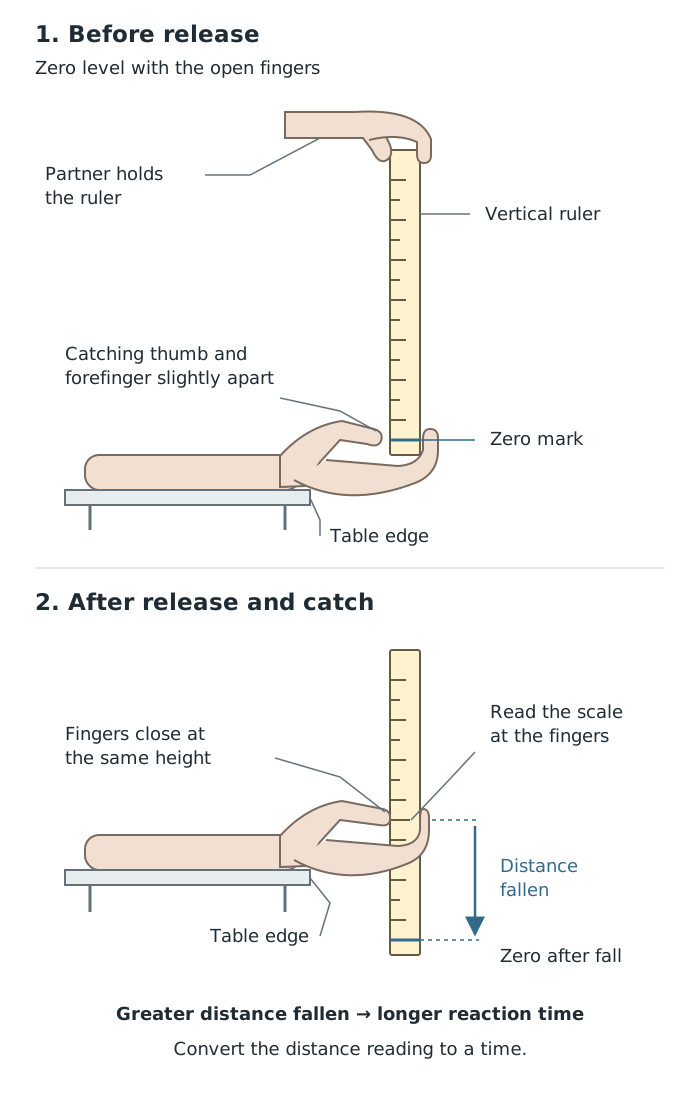
Let the ruler fall freely beside the table edge. Read how far it falls before it is caught, then convert that distance into a reaction time.
Repeat several times, convert each distance to a reaction time and calculate a mean. Repetition helps reveal variation and reduces the influence of an unusually fast or slow response. If the ruler is missed, record that the trial was unsuccessful and repeat it rather than inventing a catch reading.
For a fair comparison, keep the ruler, starting position, catching hand and release method the same. Avoid a countdown: it would allow the person to anticipate the release. To investigate distraction, compare results with and without a safe distraction such as conversation, changing only that condition. Use a light ruler, keep it away from faces and ensure the space below it is clear. Do not investigate alcohol or drug effects by giving substances to participants.
A computer test can display a signal after an unpredictable delay and measure the time until the person presses a key or clicks a mouse. It measures the interval directly, rather than converting a falling distance into a time.
Repeat trials and calculate a mean here too. Keep the same device, response button and instructions when comparing conditions. Timing the response with a handheld stopwatch is less suitable: the stopwatch operator's own reaction time would affect the measurement.
Imagine a driver noticing an obstacle ahead. First, the vehicle travels while the driver reacts. This is the thinking distance. Then it travels while the brakes slow it to rest. This is the braking distance.
If the vehicle's speed remains approximately constant while the driver reacts:
Speed is measured in metres per second, reaction time in seconds and thinking distance in metres. At a higher speed, the vehicle covers more ground during the same reaction time. At the same speed, a longer reaction time also increases thinking distance. This explains why tiredness, using a phone, alcohol and impairing drugs can increase the distance needed to stop, even when the brakes work properly.
Brakes provide a force that slows the vehicle. Friction transfers energy from the moving vehicle to the brakes and surroundings, heating them.
Higher speed increases braking distance: there is more kinetic energy to transfer before the vehicle stops. Stopping from a higher speed over the same distance would require a greater braking force.
Wet or icy roads reduce the available friction between the tyres and road. This limits the force that can slow the vehicle without it skidding, so braking distance increases. Worn tyres can reduce grip, particularly on wet roads, while worn or faulty brakes can reduce the braking force.
Greater vehicle mass, for example from passengers or a heavy load, also matters. For the same braking force, a greater mass has a smaller deceleration and needs a longer distance to stop from the same speed.
These factors explain why drivers need to leave enough clear distance ahead and increase that margin in poor conditions. Lower speed reduces both thinking and braking distance. Staying alert and avoiding distractions reduces delays before braking; maintaining tyres and brakes helps the vehicle slow safely.
Deceleration is a decrease in speed. From , a large deceleration requires a large resultant force for a given mass. Those forces can injure passengers, including causing whiplash when the head moves suddenly relative to the body.
When a car stops abruptly, an unrestrained passenger continues moving forwards until a force stops them, perhaps through a collision with the car's interior. Hard braking can also cause loss of control if the tyres lose grip. Heavy braking heats the brakes; overheating can reduce their effectiveness.
The stopping-time connection can be written as:
For the same change in momentum, stopping over a longer time reduces the average force. Seat belts restrain passengers and stretch slightly, airbags cushion their stopping, and crumple zones deform to extend the vehicle's stopping time. These features reduce the forces involved, but do not remove the need to prevent collisions.
Separate the two stages: reaction time affects thinking distance; tyre, brake and road conditions affect braking distance. Speed affects both.
In a ruler-drop test, measure the distance the ruler falls, then convert it to a reaction time. The distance itself is not a time.
When explaining the effect of vehicle mass, state the comparison: a greater mass gives less deceleration for the same braking force.
Link injury risk to a large force, not simply to a high speed. For the same change in momentum, a shorter stopping time means a larger average force.
It can see this note and what your specification asks for.
Answers are free with an account.
1 free note left this week
Get more free notesYour answer sets when this note comes back for review, or marks it complete.
Was this note helpful?
Log in to tell us whether it helped, or to report a problem.
Last updated
Reaction time
The time between detecting a stimulus and responding to it.
Thinking distance
The distance a vehicle travels during the driver's reaction time, before braking begins.
Braking distance
The distance a vehicle travels from when braking begins until it comes to rest.
Stopping distance
The total distance a vehicle travels during thinking and braking: stopping distance = thinking distance + braking distance.
Deceleration
A decrease in speed; the acceleration acts opposite to the direction of motion.
Whiplash
A neck injury caused by sudden movement of the head relative to the body.
Put your knowledge into practice — try past paper questions for Combined Science B
Reaction time
The time between detecting a stimulus and responding to it.
Thinking distance
The distance a vehicle travels during the driver's reaction time, before braking begins.
Braking distance
The distance a vehicle travels from when braking begins until it comes to rest.
Stopping distance
The total distance a vehicle travels during thinking and braking: stopping distance = thinking distance + braking distance.
Deceleration
A decrease in speed; the acceleration acts opposite to the direction of motion.
Whiplash
A neck injury caused by sudden movement of the head relative to the body.
Large deceleration means large forces and greater injury risk. Hard braking can also cause skidding, loss of control and brake overheating. Increasing stopping time reduces the average force for the same change in momentum.