

Loading…
Loading…
Loading…
OCR GCSE Combined Science B · J260
OCR J260 · Natural Selection and Evolution Evidence Check the specification (PDF) (opens in a new tab)
Evolution is a change in the inherited characteristics of a population over generations. Evidence for evolution comes both from records of organisms that lived long ago and from changes we can observe in populations today. Fossils reveal changes over millions of years, while antibiotic resistance shows evolution occurring over much shorter timescales.
A fossil is a preserved remain or trace of an organism from the past. Fossils include bones and other body parts, but also footprints, burrows and preserved faeces. Together, these discoveries form the fossil record.
Dating fossils and the rocks associated with them allows scientists to place organisms in a sequence from older to younger. Scientists can then compare their features. Differences between fossils of different ages show that the organisms living on Earth have changed over time. Fossils also reveal that past environments differed from those of today.
Similarities are important too. Shared structures between extinct organisms, and between extinct and living organisms, provide evidence of evolutionary relationships and common ancestry. The combination of an age sequence and comparisons of body structures helps scientists reconstruct how groups of organisms have changed.
For example, Ardi, a fossil found in Ethiopia dating from about 4.4 million years ago, had a mixture of features: a grasping big toe suited to climbing, but leg bones suggesting upright walking. Lucy, also found in Ethiopia and dating from about 3.2 million years ago, had features better suited to upright walking. Such comparisons provide evidence of changes in the human evolutionary group over time; they do not by themselves establish that one particular fossil individual was the direct ancestor of another.
Fossils therefore support the conclusion that evolution has occurred. Observations of living populations can also show how natural selection produces evolutionary change.
An antibiotic kills bacteria or inhibits their growth and reproduction. This makes antibiotics useful for treating bacterial infections. However, bacteria within a population can differ genetically, and a chance mutation may give some bacteria resistance to a particular antibiotic, such as penicillin.
When that antibiotic is used, susceptible bacteria are killed or inhibited, while resistant bacteria survive. The antibiotic acts as a selection pressure: resistance now gives a survival advantage.
The surviving resistant bacteria face less competition and can reproduce, passing the genetic variant for resistance to their offspring. Over many generations, resistant bacteria make up a larger proportion of the population. This is evolution because an inherited characteristic of the population has become more common.
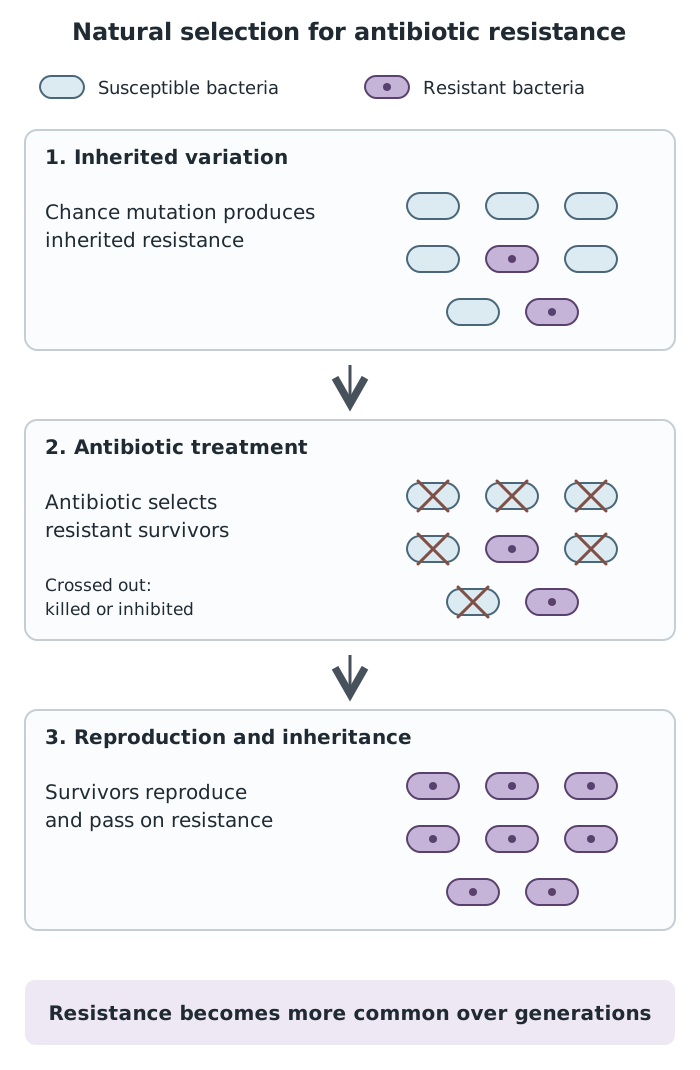
Antibiotic treatment favours resistant bacteria, which survive and pass resistance to their offspring.
Bacteria can reproduce rapidly, so many generations can occur in a short time. This allows evolutionary change to be observed much more quickly than the changes recorded by fossils.
Antibiotic resistance connects the steps of natural selection: inherited variation, a survival advantage in a particular environment, reproduction and a change in the population. The antibiotic selects bacteria that are already resistant rather than making individual bacteria adapt deliberately.
Resistance can also make infections harder to treat. An antibiotic that previously controlled a bacterial infection may no longer be effective against a resistant population.
Chance mutation → resistance → antibiotic selects resistant survivors → reproduction and inheritance → resistance becomes more common.
This is evolution: the population's inherited characteristics change over generations. Rapid bacterial reproduction makes the change observable over short timescales.
When explaining fossil evidence, link differences between older and younger fossils to changes in organisms over time. Link shared features to evolutionary relationships.
For antibiotic resistance, include mutation, survival, reproduction and inheritance, then explain how the population changes over generations.
The bacteria become resistant, not the patient. Antibiotics select resistant bacteria; they do not cause bacteria to develop resistance because they need it.
It can see this note and what your specification asks for.
Answers are free with an account.
1 free note left this week
Get more free notesYour answer sets when this note comes back for review, or marks it complete.
Was this note helpful?
Log in to tell us whether it helped, or to report a problem.
Last updated
Evolution
A change in the inherited characteristics of a population over a number of generations.
Fossil
The preserved remains or traces of an organism from the past, such as bones, footprints or burrows.
Fossil record
The collection of fossils that provides evidence of organisms living at different times in Earth's history.
Natural selection
The process in which organisms with inherited characteristics better suited to their environment are more likely to survive and reproduce, making those characteristics more common over generations.
Mutation
A change in DNA that can produce a new genetic variant.
Antibiotic
A substance that kills bacteria or inhibits their growth and reproduction.
Antibiotic resistance
An inherited characteristic that allows bacteria to survive exposure to an antibiotic that would normally kill them or inhibit their growth.
Put your knowledge into practice — try past paper questions for Combined Science B
Evolution
A change in the inherited characteristics of a population over a number of generations.
Fossil
The preserved remains or traces of an organism from the past, such as bones, footprints or burrows.
Fossil record
The collection of fossils that provides evidence of organisms living at different times in Earth's history.
Natural selection
The process in which organisms with inherited characteristics better suited to their environment are more likely to survive and reproduce, making those characteristics more common over generations.
Mutation
A change in DNA that can produce a new genetic variant.
Antibiotic
A substance that kills bacteria or inhibits their growth and reproduction.
Antibiotic resistance
An inherited characteristic that allows bacteria to survive exposure to an antibiotic that would normally kill them or inhibit their growth.
Resistance can make an antibiotic ineffective against an infection.