

Loading…
Loading…
Loading…
OCR GCSE Combined Science B · J260
OCR J260 · Natural Selection and Evolution Evidence Check the specification (PDF) (opens in a new tab)
A population is a group of organisms of the same species living in the same area. There is usually extensive genetic variation within a population: its individuals have differences in their DNA. They are not all genetically identical, even though they belong to the same species.
A gene is a section of DNA, and alternative versions of a gene are called alleles. Differences in alleles can help explain why individuals have different characteristics. The observable characteristics of an organism make up its phenotype. Phenotype depends on both genetic information and the environment: a plant’s growth, for example, depends on its inherited characteristics as well as the light and water available to it.
A mutation is a change in the DNA base sequence. Mutations create new genetic variants, some of which can be inherited by offspring.
Most genetic variants have no effect on phenotype, some influence phenotype, and a very few determine phenotype. A DNA change does not necessarily produce a noticeable difference: it may leave the resulting protein unchanged, or change the protein without affecting its function. Other changes affect protein function enough to alter a characteristic.
A variant that influences a characteristic contributes to it alongside other genetic or environmental factors. A variant that determines a characteristic has a decisive effect. These distinctions matter because natural selection acts on differences in phenotype that affect survival and reproduction, rather than automatically favouring every new DNA variant.
Organisms often produce more offspring than their environment can support. Food, water, space and other resources are limited, so individuals compete for them.
A community contains the populations of different species living in an area. Competition can occur both within a species and between species. For example, plants in a community compete for light, water and mineral ions. Animals may compete for food and territory; individuals of the same species may also compete for mates.
Individuals do not all have an equal chance of surviving and reproducing. An inherited characteristic that helps an organism obtain a limited resource can give it an advantage. Which characteristics are advantageous depends on the environment.
Natural selection occurs when individuals with inherited phenotypes better suited to their environment are more likely to survive and reproduce. They are therefore more likely to pass the alleles responsible for those characteristics to their offspring.
Suppose a population of plants contains inherited variation in drought tolerance. During a prolonged dry period, water becomes scarce. Plants whose characteristics allow them to survive with less water are more likely to live long enough to reproduce. Their offspring can inherit the alleles contributing to drought tolerance. Over many generations in these conditions, those alleles can become more common in the population.
The dry conditions do not create a mutation specifically because the plants need it. Instead, the conditions favour plants with advantageous inherited variation. If conditions change, a different phenotype may become advantageous.
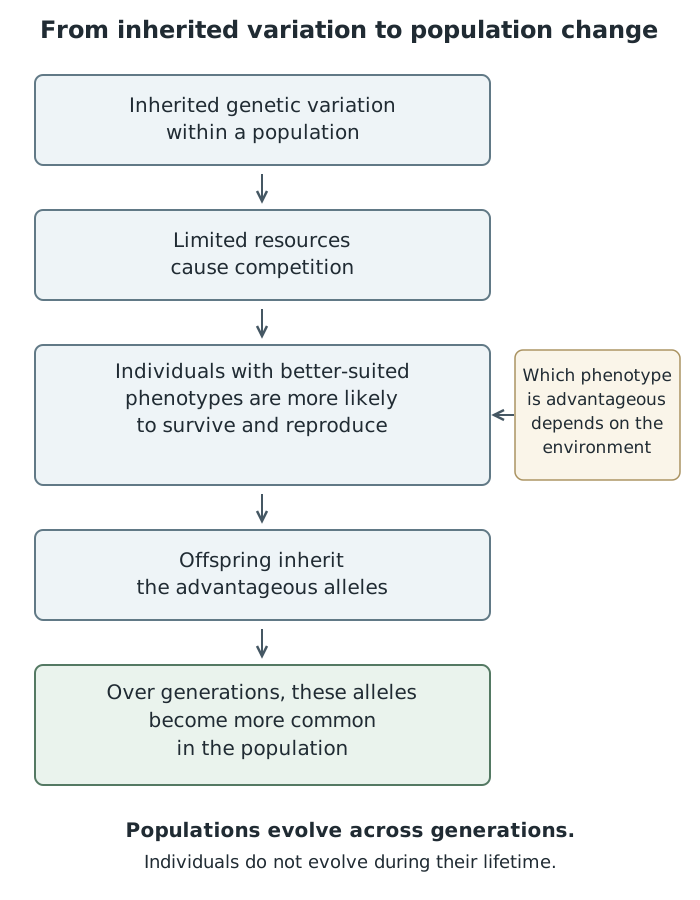
Natural selection changes the frequency of inherited variants through differences in survival and reproduction.
Survival is only part of the explanation. A characteristic spreads through natural selection when it increases an organism’s chance of leaving offspring that inherit it. This is why reproduction and inheritance are essential links in the process.
Evolution is a change in the inherited characteristics of a population over a number of generations. Through natural selection, advantageous alleles become more common, so the population’s characteristics gradually change. An individual does not evolve during its lifetime; the change occurs across generations of a population.
Over time, populations of one species may become so different that they can no longer interbreed to produce fertile offspring. They have then become separate species. The formation of new species is called speciation; it is a possible outcome of evolution, not the outcome of every evolutionary change.
Charles Darwin and Alfred Russel Wallace independently developed explanations of evolution by natural selection. Their ideas were presented together in 1858, and Darwin published On the Origin of Species in 1859. The modern explanation connects their ideas about variation and competition with our understanding of mutations, genes and inheritance.
In selective breeding, also called artificial selection, humans choose which organisms reproduce because they have desirable inherited characteristics. The basic process is to:
Not all offspring have the desired combination of characteristics, so selection must continue. Both natural selection and selective breeding change inherited characteristics over generations. The difference is what determines reproductive success: environmental conditions in natural selection, and human choices in selective breeding.
Food plants can be selectively bred for increased yield, disease resistance, drought tolerance or better-tasting fruit. Higher yields provide more food from a crop, while disease resistance and drought tolerance can reduce losses. Selective breeding of wild brassica has produced familiar vegetables including cabbage, cauliflower, broccoli and Brussels sprouts.
Domesticated animals can be bred for characteristics useful to people. Examples include cows that produce more milk, animals that produce more meat, chickens that lay larger eggs and sheep with good-quality wool. Dogs can be bred for a gentle temperament. Selective breeding has produced many different domestic dog breeds from wolf ancestors.
Repeatedly breeding only a small number of selected individuals can reduce genetic variation: fewer different alleles remain in the breeding population. It can also lead to inbreeding, where closely related organisms breed together.
Inbreeding increases the risk of offspring inheriting harmful genetic defects. Reduced genetic variation also leaves a population more vulnerable to new diseases because there is less chance that some individuals carry alleles giving resistance. Choosing several suitable, less closely related parents can help reduce the risk of inbreeding.
Selective breeding therefore brings valuable improvements, but concentrating on desirable characteristics can also reduce the genetic diversity needed to cope with future environmental changes.
Inherited variation → competition for limited resources → better-adapted individuals more likely to survive and reproduce → advantageous alleles passed on → alleles become more common over generations.
Link natural selection to reproduction and inheritance: surviving individuals must pass on the advantageous alleles for the population to change.
Describe advantageous alleles becoming more common over generations, not an individual evolving during its lifetime.
Mutations do not occur because an organism needs a particular characteristic.
In selective breeding, include selecting suitable offspring and repeating the process over many generations.
‘Fittest’ means best suited to the environment, not necessarily strongest or fastest.
It can see this note and what your specification asks for.
Answers are free with an account.
1 free note left this week
Get more free notesYour answer sets when this note comes back for review, or marks it complete.
Was this note helpful?
Log in to tell us whether it helped, or to report a problem.
Last updated
Genetic variation
Differences in DNA between individuals of the same species.
Mutation
A change in the DNA base sequence that can create a new genetic variant.
Allele
An alternative version of a gene.
Phenotype
The observable characteristics of an organism, resulting from its genetic information and its interactions with the environment.
Community
All the populations of different species living in the same area.
Natural selection
The process in which individuals with advantageous inherited characteristics are more likely to survive and reproduce, making the alleles for those characteristics more common over generations.
Evolution
A change in the inherited characteristics of a population over a number of generations.
Speciation
The formation of new species through evolution.
Selective breeding
A process in which humans choose organisms with desirable inherited characteristics to breed, then select suitable offspring for further breeding over many generations.
Inbreeding
Breeding between closely related individuals.
Put your knowledge into practice — try past paper questions for Combined Science B
Genetic variation
Differences in DNA between individuals of the same species.
Mutation
A change in the DNA base sequence that can create a new genetic variant.
Allele
An alternative version of a gene.
Phenotype
The observable characteristics of an organism, resulting from its genetic information and its interactions with the environment.
Community
All the populations of different species living in the same area.
Natural selection
The process in which individuals with advantageous inherited characteristics are more likely to survive and reproduce, making the alleles for those characteristics more common over generations.
Evolution
A change in the inherited characteristics of a population over a number of generations.
Speciation
The formation of new species through evolution.
Selective breeding
A process in which humans choose organisms with desirable inherited characteristics to breed, then select suitable offspring for further breeding over many generations.
Inbreeding
Breeding between closely related individuals.
Competition occurs within and between species in a community. The environment determines which phenotypes are advantageous.
Choose suitable parents → breed → select suitable offspring → repeat over many generations.