

Loading…
Loading…
Loading…
OCR GCSE Combined Science B · J260
OCR J260 · Magnets and Electromagnetism Check the specification (PDF) (opens in a new tab)
A bar magnet can pull another magnet towards it or push it away without touching it. These are magnetic forces: attraction pulls objects together, while repulsion pushes them apart.
Every magnet has a north pole and a south pole. Its magnetic effect is strongest at these poles. When two magnets are brought together, unlike poles attract: north attracts south. Like poles repel: north repels north, and south repels south.
For example, bring the north pole of one bar magnet towards the south pole of another and they pull together. Turn one magnet around so that the two north poles face each other, and they push apart.
A magnetic field is a region in which another magnet or a magnetic material experiences a magnetic force. The field exists around the magnet even when there is nothing nearby to reveal its effect.
We represent this field using magnetic field lines. They are a model, not physical threads surrounding the magnet. Their arrows show the direction in which the north pole of a small compass needle points. Outside a magnet, the arrows run from north to south.
Around a bar magnet, the lines curve from the north pole towards the south pole. The direction changes from point to point: just beyond the north pole it points away from the magnet, whereas just beyond the south pole it points towards the magnet. Above the middle of the bar, it runs broadly from the north-pole end towards the south-pole end.
The spacing of the lines represents field strength. Closely spaced lines show a stronger field; widely spaced lines show a weaker field. The lines are most closely packed near the poles, where the magnetic effect is strongest. As distance from the magnet increases, the field becomes weaker.
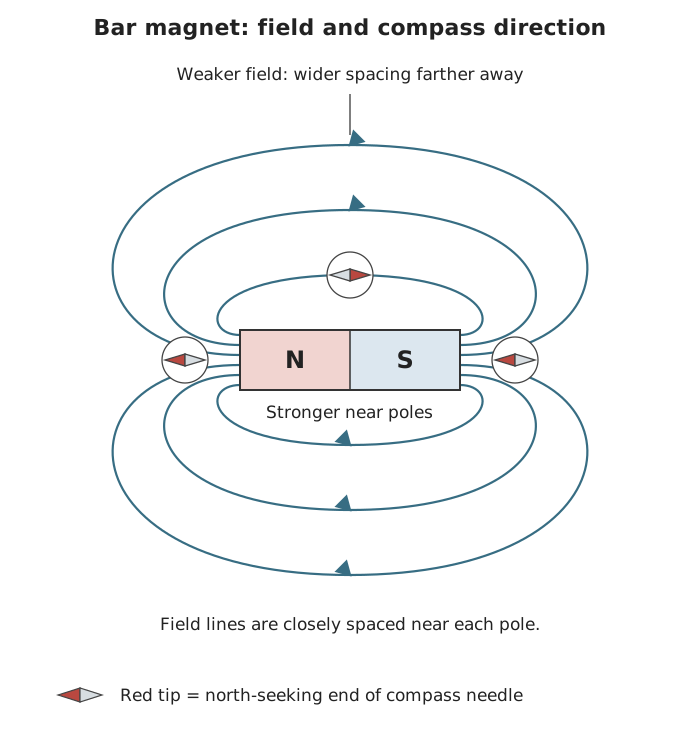
Compass needles follow the local field direction. Arrows run from north to south outside the magnet, and closer field lines represent a stronger field. Field lines never cross.
A plotting compass contains a small magnetic needle that can turn freely. The needle aligns with the magnetic field at its position, with its north-seeking end pointing in the field direction.
To trace a field line, place a bar magnet on paper and draw around it so its position stays recorded. Put a plotting compass near one pole and mark the positions of both ends of its needle. Move the compass along the direction indicated, mark the needle positions again, and repeat. Joining the marks with a smooth curve traces a field line; arrows follow the direction of the needle’s north-seeking end. Starting at different positions builds up the field pattern.
Keep other magnets and magnetic objects away so they do not alter the compass readings. Handle magnets carefully to avoid trapping fingers between them.
A permanent magnet retains its magnetism and produces its own magnetic field. Steel can be used to make permanent magnets.
An induced magnet forms when a magnetic material is placed in another magnet’s field. Iron, nickel and cobalt are magnetic materials, and steel is magnetic because it contains iron. While magnetised, an induced magnet has both a north and a south pole. It usually loses most or all of its induced magnetism when the external field is removed.
Suppose the north pole of a permanent magnet is brought near an unmagnetised iron object. The nearer end of the iron becomes a south pole and the farther end becomes a north pole. The nearer, unlike poles attract. Bringing a south pole near the iron instead reverses its induced poles, so the iron is still attracted.
This explains why an unmagnetised magnetic material is attracted to either pole of a magnet, rather than repelled.
Away from nearby magnets, a freely turning compass needle still settles in a roughly north–south direction. Since the needle is itself a magnet and responds to magnetic fields, this is evidence that Earth has a magnetic field. Earth’s field is generated by currents within its core: the core is the source of Earth’s magnetic behaviour, rather than a permanent bar magnet inside the planet.
The compass’s north-seeking end points towards the Arctic region. Because unlike poles attract, that region acts like a magnetic south pole in terms of its effect on the needle. Earth’s magnetic and geographic poles are not in exactly the same places, so a compass does not necessarily point exactly towards geographic north.
A compass aligns roughly north–south even away from other magnets → Earth has a magnetic field, generated by currents in its core. The Arctic region acts like a magnetic south pole, attracting the needle’s north-seeking end.
On a magnetic field diagram, include arrows from north to south outside the magnet. Show stronger regions with more closely spaced lines, and never let field lines cross.
Attraction alone does not prove that an object is a permanent magnet: an unmagnetised magnetic material can also be attracted.
Explain the compass evidence as a chain: the needle is a magnet, it aligns with a magnetic field, and its alignment away from other magnets shows that Earth has a magnetic field.
An induced magnet has north and south poles while magnetised; the distinction is whether it retains its magnetism when the inducing field is removed.
It can see this note and what your specification asks for.
Answers are free with an account.
1 free note left this week
Get more free notesYour answer sets when this note comes back for review, or marks it complete.
Was this note helpful?
Log in to tell us whether it helped, or to report a problem.
Last updated
Permanent magnet
A magnet that retains its magnetism and produces its own magnetic field without needing an external magnetic field.
Induced magnet
A magnetic material that becomes magnetised in an external magnetic field and usually loses most or all of this magnetism when the field is removed.
Magnetic field
A region in which another magnet or a magnetic material experiences a magnetic force.
Magnetic field line
A line used to represent a magnetic field. Its arrow shows field direction, and the spacing between neighbouring lines indicates field strength.
Magnetic pole
An end of a magnet where its magnetic effect is strongest. Every magnet has a north pole and a south pole.
Plotting compass
A small compass whose freely turning magnetic needle shows the direction of the magnetic field at its position.
Put your knowledge into practice — try past paper questions for Combined Science B
Permanent magnet
A magnet that retains its magnetism and produces its own magnetic field without needing an external magnetic field.
Induced magnet
A magnetic material that becomes magnetised in an external magnetic field and usually loses most or all of this magnetism when the field is removed.
Magnetic field
A region in which another magnet or a magnetic material experiences a magnetic force.
Magnetic field line
A line used to represent a magnetic field. Its arrow shows field direction, and the spacing between neighbouring lines indicates field strength.
Magnetic pole
An end of a magnet where its magnetic effect is strongest. Every magnet has a north pole and a south pole.
Plotting compass
A small compass whose freely turning magnetic needle shows the direction of the magnetic field at its position.