

Loading…
Loading…
Loading…
OCR GCSE Combined Science B · J260
OCR J260 · Power, Energy, and Transformers Check the specification (PDF) (opens in a new tab)
A transformer changes an alternating potential difference, often called voltage. Its primary coil receives energy from the input supply; its secondary coil transfers energy to the output circuit. The coils are electrically separate: energy passes between them through a changing magnetic field in an iron core, rather than current flowing directly from one coil into the other.
A step-up transformer produces a higher output voltage than its input voltage. A step-down transformer produces a lower output voltage. Neither creates energy. Increasing the voltage does not mean that the transformer can deliver more power than it receives.
Power is the rate of energy transfer. An ideal transformer is 100% efficient, so all the energy supplied to it is transferred electrically to the output circuit. Its input and output powers are therefore equal:
Using the electrical power relationship gives:
Here, and are the potential differences across the primary and secondary coils, measured in volts (V). and are the currents in those coils, measured in amperes (A). Each voltage–current product is a power in watts (W).
For a step-up transformer, the secondary voltage is greater. To keep the product unchanged, the secondary current must be smaller. For example, if the voltage doubles, the current halves. Conversely, a step-down transformer lowers the voltage, so its output current is greater: halving the voltage doubles the current in the ideal model.
Real transformers transfer some energy to their surroundings, so their electrical output power is slightly less than their input power. The equal-power equation uses the ideal-transformer assumption.
Keep input quantities together and output quantities together. To calculate an unknown primary current, rearrange the equation:
For example, a travel adapter steps up a 115 V alternating supply to the 230 V required by a hairdryer. The hairdryer draws an output current of 5 A. Assuming the transformer is 100% efficient:
The output voltage is twice the input voltage, while the output current is half the input current. Both sides transfer power at , so the calculation is consistent with conservation of energy.
Transmission cables have resistance. When current flows through them, energy is transferred to the thermal energy stores of the cables and their surroundings. This heating wastes some of the energy that should reach consumers.
For a given power being transmitted:
Raising the transmission voltage therefore reduces the current needed to transfer the same power. The power wasted through cable heating is:
Here, is the resistance of the transmission cables in ohms (Ω). Because the current is squared, reducing it has a large effect. If the current is halved while cable resistance stays the same, the heating power falls to one-quarter. Less energy is wasted each second, making transmission more efficient.
The National Grid uses step-up transformers before long-distance transmission and step-down transformers near consumers. The voltage is raised for efficient transmission, then reduced to safer, usable levels.
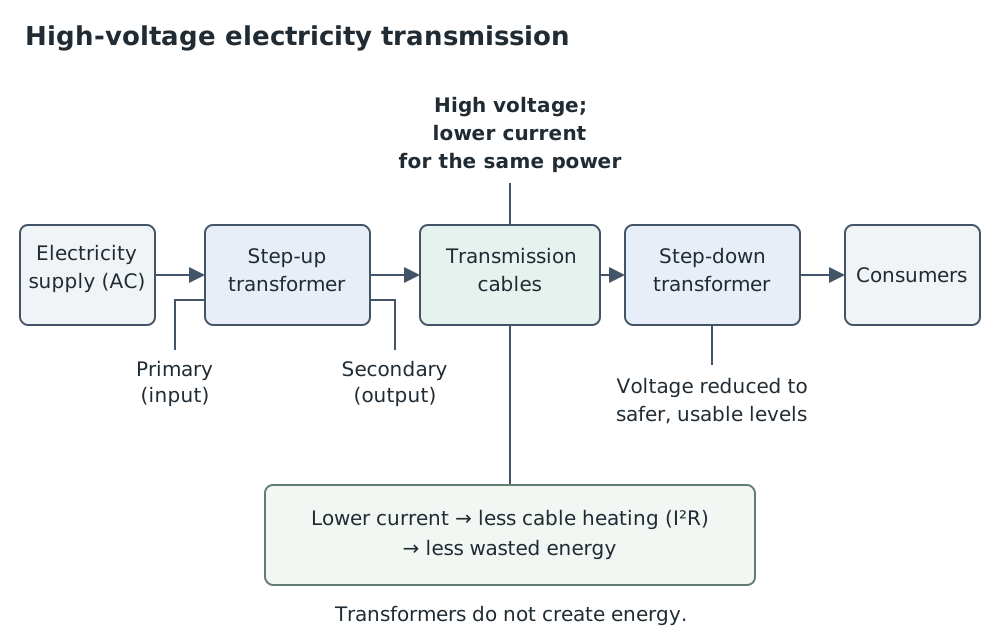
Transformers allow efficient high-voltage transmission before the voltage is reduced for consumers.
For an ideal, 100% efficient transformer:
Label quantities as primary (input) or secondary (output) before substituting into the transformer equation.
Use equal input and output powers only when the transformer is assumed to be ideal or 100% efficient.
For high-voltage transmission, give the complete explanation: the same power requires a smaller current, which causes less cable heating and less wasted energy.
In cable-heating calculations, use the resistance of the cables in P = I²R, not the resistance of the appliances.
It can see this note and what your specification asks for.
Answers are free with an account.
1 free note left this week
Get more free notesYour answer sets when this note comes back for review, or marks it complete.
Was this note helpful?
Log in to tell us whether it helped, or to report a problem.
Last updated
Transformer
A device that changes an alternating potential difference, transferring energy between separate coils through a changing magnetic field.
Primary coil
The input coil of a transformer, connected to the alternating electrical supply.
Secondary coil
The output coil of a transformer, connected to the circuit receiving electrical energy.
Step-up transformer
A transformer that increases the output potential difference compared with the input potential difference.
Step-down transformer
A transformer that decreases the output potential difference compared with the input potential difference.
Ideal transformer
A transformer that is 100% efficient, so its electrical output power equals its electrical input power.
Conservation of energy
The principle that energy cannot be created or destroyed, only transferred between stores.
Put your knowledge into practice — try past paper questions for Combined Science B
Transformer
A device that changes an alternating potential difference, transferring energy between separate coils through a changing magnetic field.
Primary coil
The input coil of a transformer, connected to the alternating electrical supply.
Secondary coil
The output coil of a transformer, connected to the circuit receiving electrical energy.
Step-up transformer
A transformer that increases the output potential difference compared with the input potential difference.
Step-down transformer
A transformer that decreases the output potential difference compared with the input potential difference.
Ideal transformer
A transformer that is 100% efficient, so its electrical output power equals its electrical input power.
Conservation of energy
The principle that energy cannot be created or destroyed, only transferred between stores.
= primary/input; = secondary/output. Potential difference is measured in V and current in A.
For the same transmitted power, : higher voltage means lower current.
Cable heating power is . Lower current means less heating, less wasted energy and greater efficiency.
Grid sequence: step up voltage → transmit at high voltage and low current → step down voltage near consumers.