

Loading…
Loading…
Loading…
OCR GCSE Combined Science B · J260
OCR J260 · Magnets and Electromagnetism Check the specification (PDF) (opens in a new tab)
A magnetic field is a region in which a magnet experiences a force. Permanent magnets are not the only things that produce magnetic fields: an electric current in a wire produces a field around the wire too.
A plotting compass provides a way to detect this effect. Its needle is a small magnet, so it turns to align with the magnetic field at its position.
Place a straight section of wire close above a plotting compass and connect the wire to a low-voltage power supply through a switch. With the switch open, note the needle's direction. Close the switch briefly: when current flows, the compass needle deflects. Open the switch again and it returns towards its original direction. This change shows that the current has created a magnetic effect.
Reverse the connections to the supply and repeat. The needle deflects in the opposite direction because reversing the current reverses the magnetic field. Keep nearby magnets away so that their fields do not confuse the observations. Use a current-limited, low-voltage supply and switch off between observations because the wire can become hot; never connect a wire directly across an unrestricted supply.
To investigate the pattern, pass a straight wire vertically through a horizontal card. With current flowing, place a plotting compass at several positions around the wire. Mark the direction of the north-seeking end of its needle at each position. Together, these directions trace circles centred on the wire.
The field lines are concentric circles, lying in planes perpendicular to the wire. At each position, the compass points along the circle, not towards or away from the wire.
Use the right-hand grip rule to find the direction: point your right thumb in the direction of conventional current, and curl your fingers around the wire. Your fingers show the direction of the magnetic field. For example, viewed from above, a current coming upwards towards you produces an anticlockwise field. A current going downwards away from you produces a clockwise field.
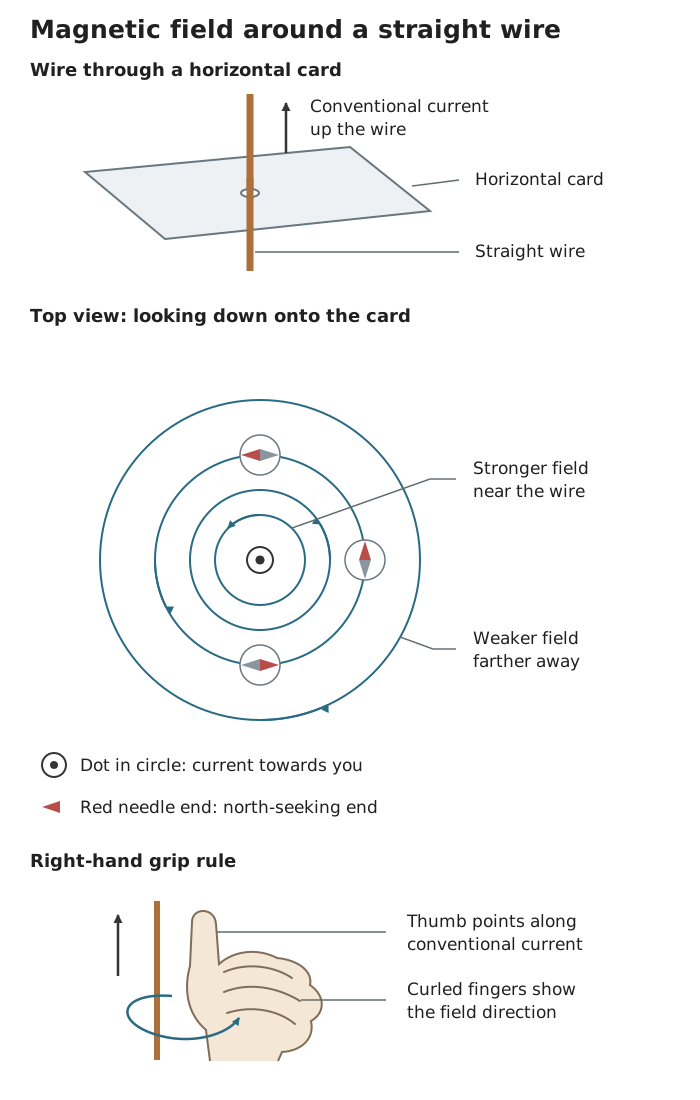
A plotting compass points along the circular field. Reversing the current reverses every field arrow.
The strength of this field depends on two things:
Field-line drawings represent stronger fields with more closely spaced lines. Around a straight wire, the circles are drawn farther apart as distance increases. These lines are a model of the field, not physical rings around the wire.
A solenoid is a wire wound into a long coil. When current flows, each turn produces a magnetic field. Inside the coil, the effects of the turns reinforce one another, producing a strong field that is approximately uniform away from the ends. A uniform field has approximately the same strength and direction throughout that region.
The overall field resembles that of a bar magnet: the solenoid has a north pole at one end and a south pole at the other. Inside it, the field lines are approximately straight, parallel and evenly spaced. Outside it, they curve from north to south.
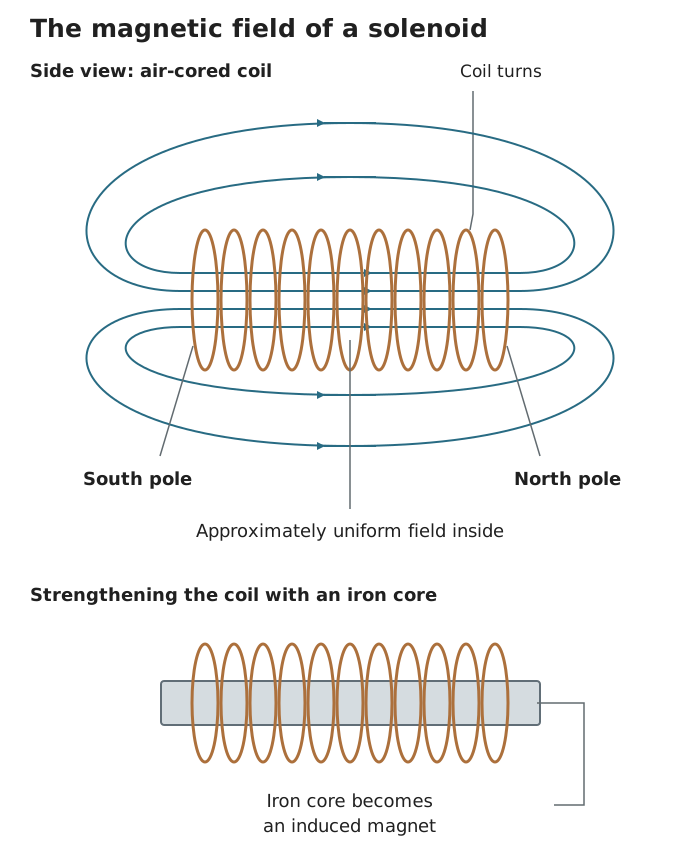
The turns reinforce one another's magnetic effects inside the solenoid. An iron core makes the electromagnet stronger.
Reversing the current swaps the poles. Viewed directly from one end, anticlockwise current makes that end a north pole; clockwise current makes it a south pole. Switching off removes the magnetic field produced by the current.
There are three main ways to strengthen a solenoid's magnetic effect:
The iron core strengthens the magnetic effect; it does not supply the current. The electrical supply provides the current that creates the coil's field.
Draw the field around a straight wire as concentric circles centred on the wire, with arrows showing direction—not as lines radiating outwards.
Use conventional current direction with the right-hand grip rule, not electron flow.
For a stronger solenoid, state a specific change: increase the current, increase the number of turns in the same length, or insert an iron core.
It can see this note and what your specification asks for.
Answers are free with an account.
1 free note left this week
Get more free notesYour answer sets when this note comes back for review, or marks it complete.
Was this note helpful?
Log in to tell us whether it helped, or to report a problem.
Last updated
Magnetic field
A region in which a magnet experiences a force. Field lines represent its direction and strength.
Plotting compass
A small compass used to find magnetic field direction; its north-seeking end points along the field.
Right-hand grip rule
A rule for finding the magnetic field direction around a straight current-carrying wire: point your right thumb along conventional current and your curled fingers show the field direction.
Solenoid
A wire wound into a long coil that produces a magnetic field when current flows through it.
Electromagnet
A magnet produced by an electric current, commonly made using a coil of wire around an iron core.
Put your knowledge into practice — try past paper questions for Combined Science B
Magnetic field
A region in which a magnet experiences a force. Field lines represent its direction and strength.
Plotting compass
A small compass used to find magnetic field direction; its north-seeking end points along the field.
Right-hand grip rule
A rule for finding the magnetic field direction around a straight current-carrying wire: point your right thumb along conventional current and your curled fingers show the field direction.
Solenoid
A wire wound into a long coil that produces a magnetic field when current flows through it.
Electromagnet
A magnet produced by an electric current, commonly made using a coil of wire around an iron core.