

Loading…
Loading…
Loading…
Eduqas GCSE History · C100
Eduqas C100 · Changes in Military Technology Check the specification (PDF) (opens in a new tab)
After the Norman Conquest of 1066, castles helped rulers control territory. Fortified towns and castles protected people, wealth, administration and supplies. Capturing them could therefore be more important than winning a battle nearby.
A siege was an attempt to capture a fortified place by attacking its defences or cutting off its supplies. Walls gave even a relatively small defending garrison protection against a larger army. Attackers needed ways to overcome that advantage, but a siege also demanded money, skilled workers, soldiers and enough food to keep their own army in place.
Early Norman castles often had timber defences. Stone walls and keeps provided stronger protection, but they were not invulnerable. Medieval siege warfare became a contest between methods of attack and improvements in defence.
Attackers could use several methods together rather than rely on a single machine.
A battering ram was a heavy timber beam, often with a metal head, swung repeatedly against a gate. A covered wooden frame protected its operators from missiles dropped from above. If attackers created a breach—an opening in the defences—a storming party could fight its way through.
Escalade meant climbing walls with ladders. Archers and siege engines could provide covering fire, but climbing soldiers remained exposed to arrows, stones and hot liquids. Defenders could also push the ladders over with long poles.
A wheeled siege tower carried soldiers on several levels. Archers on its upper platform could shoot at the battlements. Once the tower reached the wall, attackers could lower a drawbridge onto the parapet and cross into the defences.
Undermining attacked the foundations rather than the top of a wall. Miners dug a tunnel beneath the defences, excavated a cavity and supported it with timber. They then burned the supports so that the ground and masonry above collapsed. At Rochester Castle in 1215, King John used rendered pig fat to help burn a mine beneath the keep. One of its turrets fell, and John captured the castle after a siege lasting well over a month. This took place during the First Barons’ War, when rebellious barons opposed John.
Defenders could dig countermines to intercept attacking miners before they reached the foundations. The struggle therefore depended on engineering skill as well as fighting strength.
Before gunpowder artillery appeared in the mid-fourteenth century, siege engines provided ways to launch missiles against or over fortifications.
A ballista resembled a very large crossbow mounted on a frame and fired a heavy bolt. A mangonel, also called a traction trebuchet, used a pivoting wooden throwing arm. People pulled ropes attached to its short end, swinging the long end upwards and releasing a stone from a sling.
A counterweight trebuchet replaced those pulling teams with a heavy weight. When released, the weight fell and rotated the throwing arm, launching the projectile. It was a powerful means of bombarding defences. Siege engines could also throw incendiary material to start fires and spread fear inside a fortress.
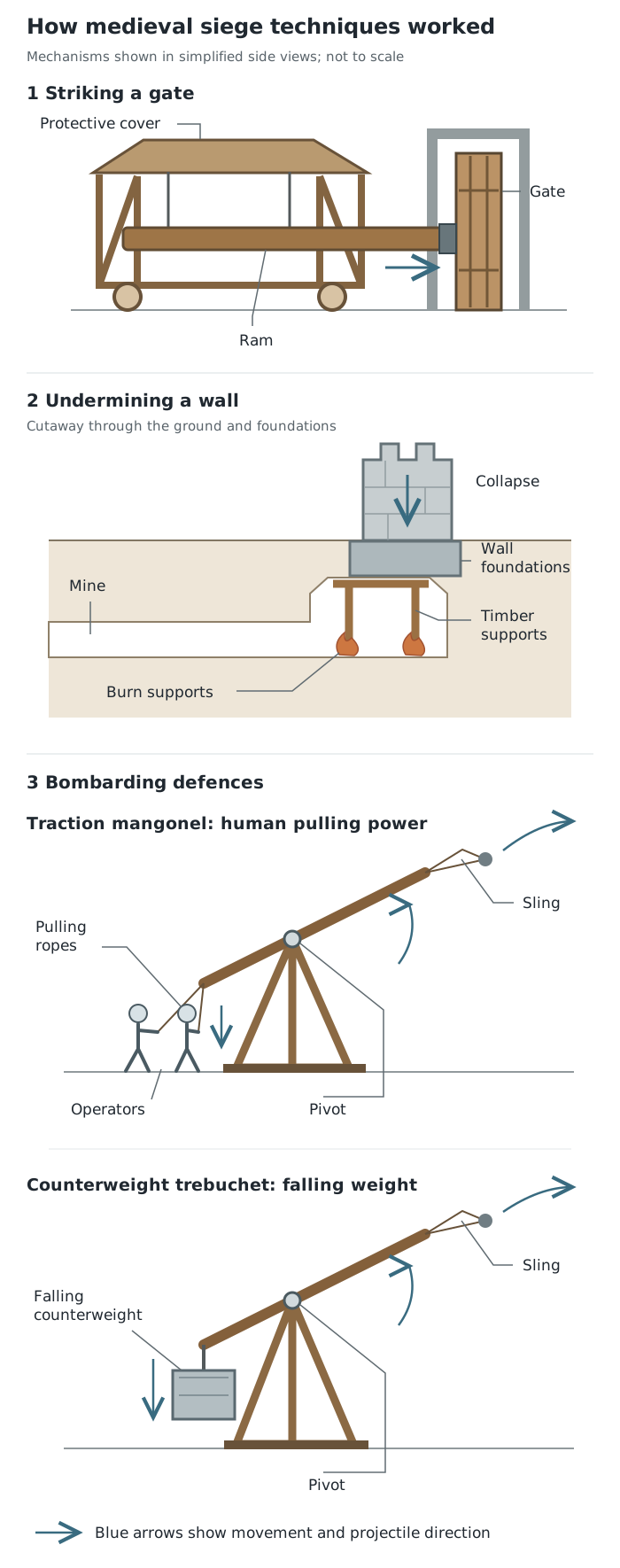
Attackers could strike gates, undermine foundations or bombard defences. Siege engines used either human pulling power or a falling counterweight.
Bombardment could damage buildings, injure defenders and weaken morale, but it did not guarantee victory. At Dover in 1216 and 1217, Prince Louis of France’s forces used siege engines and mining against the castle. The garrison resisted both sieges.
Attackers could blockade a fortress, preventing food and reinforcements from reaching it. As supplies dwindled, hunger and disease could force surrender. At Kenilworth in 1266, the defenders surrendered on honourable terms after almost six months because their food had run out.
Blockade avoided some of the risks of storming walls, but time also worked against the attackers: they had to feed and maintain their army throughout the siege. A powerful machine was of little use if the army operating it could not remain in place.
Defenders prepared by stockpiling food, water, arrows, bolts and stones. Wells and rainwater cisterns helped sustain them. Timber, earth and stone allowed repairs to breaches. Overhanging wooden galleries, called hoards, let defenders drop missiles onto attackers close to the walls.
Castle design also developed. Rectangular keeps had vulnerable corners, as Rochester demonstrated. Round and polygonal keeps offered alternative designs. By about 1250, Dover had inner and outer circuits of towered walls around its keep. In a concentric castle, successive defensive lines supported each other, making it harder for attackers to turn one breakthrough into complete victory. Edward I later used this principle in castles such as Harlech and Beaumaris to control conquered north Wales.
Bows were not a late medieval invention: Norman archers had already played an important role at Hastings in 1066. Powerful longbows, however, became increasingly important from the late twelfth century.
The crossbow was powerful but slow to shoot. Its most experienced users in medieval English armies were often foreign mercenaries. The longbow, ideally made from yew, could shoot over 200 metres. At shorter distances, suitable pointed arrows could pierce armour. This did not mean that every arrow could defeat every kind of armour at any distance.
At Falkirk in 1298, Edward I’s longbowmen played a major part in defeating William Wallace’s Scottish army. Longbows then became especially important during the Hundred Years War, 1337–1453, fought largely in France.
At Agincourt in 1415, archers formed about five-sixths of Henry V’s army and were central to the English victory. The battle demonstrated how dangerous attacks against effective archers could be. Missile weapons allowed infantry to challenge heavily armoured opponents, but their effectiveness still depended on how armies used them.
The longbow’s strength was also a limitation: producing an effective archer required substantial training and physical strength. This became important when personal firearms offered armies a different way to equip soldiers.
Gunpowder weapons introduced a new means of firing projectiles. Cannon were large guns used for bombardment; personal firearms were smaller weapons carried by individual soldiers. Their development did not proceed at the same speed.
Cannon became important in late medieval sieges while hand-held firearms were still in their infancy. Henry V used cannon against French fortresses. In 1464, Edward IV’s heavy guns quickly reduced Bamburgh Castle in Northumberland. Artillery could make previously formidable walls much less secure.
There were important limitations. Early cannon were cumbersome and difficult to transport, which made them particularly useful in fixed defensive positions. Castles adapted by adding gunports, openings through which guns could fire. At Carisbrooke, the gatehouse had gunports by the late fourteenth century. Cannon therefore changed defence as well as attack: they did not simply make every fortress useless.
Early Tudor armies remained recognisably medieval. At Flodden in 1513, English soldiers still fought mainly with longbows and bills—traditional pole weapons. Early personal firearms were more expensive, slower to shoot and less effective than a longbow used by an experienced archer. They were used mainly by foreign mercenaries.
Artillery was already much more influential. Scottish guns battered Norham Castle before Flodden, while Henry VIII used siege guns effectively in France. By 1547, English forces were gradually acquiring more personal firearms. These required less physical strength and briefer training than powerful longbows, making it easier to prepare soldiers to use them.
Later Tudor fighting accelerated the change. Matchlock muskets and calivers replaced longbows, while the long pike gradually replaced the bill. Firearms and pikes were used together rather than guns immediately removing the need for other weapons.
Defences changed too. Between 1539 and 1547, Henry VIII built more than 30 gun forts against the threat of invasion by Catholic European powers. Forts such as Pendennis, St Mawes and Deal had squat, rounded forms and arrangements that allowed powerful fire in different directions. Their purpose was to protect harbours and estuaries. Later Elizabethan fortifications, including works at Berwick-upon-Tweed and Pendennis, adopted angled bastions influenced by European designs.
During the British Civil Wars of the 1640s, musketeers typically carried matchlock muskets. These were muzzle-loading weapons: the main powder charge and bullet were loaded through the open end of the barrel. Their barrels were smooth-bore, meaning that the inside lacked spiral grooves to guide the bullet’s rotation.
The matchlock mechanism used a slow-burning cord, called a match, to ignite fine gunpowder in a small pan. The flame passed through a touch hole to ignite the main charge inside the barrel, firing the bullet. Gunpowder supplied the force, rather than the archer’s muscles drawing a bow.
Muskets were slow to reload and highly inaccurate. This shaped tactics. Musketeers could fire by ranks: one rank fired and moved back while others took their turn, allowing the first rank time to reload. Alternatively, soldiers fired a close-range volley, discharging their weapons together to concentrate their effect on an approaching enemy. Inexperienced soldiers sometimes fired too high and missed, showing why simply possessing muskets did not ensure effective shooting.
Firearms had not eliminated close combat. Musketeers could use swords or strike with their musket butts when fighting at close quarters. The continuing combination of firearms and pikes shows that infantry still needed both missile weapons and weapons for hand-to-hand fighting.
A flintlock used a different ignition system. Flint struck a metal plate, producing sparks that ignited the priming powder. It did not need a continuously burning match. Flintlocks were already used by some specialist soldiers during the Civil Wars. Soldiers guarding the artillery train received them for safety: avoiding a burning cord mattered near gunpowder supplies. Most Civil War musketeers, however, still carried matchlocks.
By the end of the seventeenth century, flintlock muskets were becoming standard infantry weapons. A National Army Museum flintlock musket dated 1689–1702, from William III’s reign, represents the kind used by most British infantry. This places widespread flintlock use later than the Civil War examples, rather than suggesting that matchlocks disappeared as soon as flintlocks appeared.
The plug bayonet, a seventeenth-century invention, was a blade inserted into the musket’s muzzle. It effectively turned the firearm into a pike for close combat. Combining shooting and thrusting functions in one weapon reduced the need for separate pikemen, who were gradually phased out. The important development was therefore not just a different way to ignite powder, but a change in the range of tasks one infantryman could perform.
Technology altered how soldiers could attack, defend and fight. Mining and siege engines offered ways past castle walls; longbows made archers a major battlefield force; cannon threatened masonry; and personal firearms gradually changed infantry equipment and training needs. By the late seventeenth century, flintlocks and bayonets were helping reshape infantry weapons again.
However, change was neither immediate nor determined by weapons alone. Dover’s resistance shows that siege technology could fail. Kenilworth shows that supplies could decide an outcome. Early Tudor reliance on longbows shows that an established weapon could remain useful after a new one appeared. Civil War muskets required tactics that compensated for slow loading and poor accuracy. Technology was important, but its effects depended on training, tactics, resources and the defenders’ ability to adapt.
Technology changed warfare substantially, but replacement was gradual. Training, tactics, transport, money and supplies determined whether weapons produced victory.
Distinguish a siege from an open battle: attackers aimed to capture a fortified place, not simply defeat an army in the field.
Explain how a weapon changed warfare. For example, cannon could breach walls, while defenders adapted by adding gunports and building artillery forts.
Use dated examples to support judgements: Rochester in 1215, Agincourt in 1415 and Bamburgh in 1464 show different uses of technology.
Avoid claiming that firearms immediately replaced bows. Early Tudor armies still relied heavily on longbows, and the change was gradual.
Balance technological advantages against limitations such as transport, cost, training and supplies.
Distinguish matchlocks from flintlocks: a matchlock used a burning cord, whereas a flintlock produced a spark. Flintlocks existed during the Civil Wars, but most musketeers still used matchlocks.
It can see this note and what your specification asks for.
Answers are free with an account.
1 free note left this week
Get more free notesYour answer sets when this note comes back for review, or marks it complete.
Was this note helpful?
Log in to tell us whether it helped, or to report a problem.
Last updated
Siege
An attempt to capture a fortified place by surrounding it, attacking its defences or cutting off its supplies.
Blockade
A military blockade that prevents people and supplies entering or leaving a place.
Undermining
Digging beneath a defensive wall or tower to make its foundations collapse.
Escalade
An assault in which soldiers climb defensive walls using ladders.
Mangonel
A stone-throwing siege engine whose throwing arm is moved by people pulling ropes.
Counterweight trebuchet
A siege engine that uses a falling counterweight to swing a throwing arm and launch a projectile.
Concentric castle
A castle with inner and outer defensive walls arranged so that the different lines of defence support one another.
Longbow
A powerful bow drawn by hand, used by English armies to shoot arrows over long distances.
Crossbow
A weapon with a bow mounted across a stock, which shoots a bolt rather than a conventional arrow.
Artillery
Large missile-firing weapons, including medieval siege engines and gunpowder cannon.
Mercenary
A soldier hired to fight for payment, often serving a foreign ruler or army.
Pike
A long spear used by infantry, increasingly combined with firearms in Tudor armies.
Musket
A firearm carried by an individual soldier, usually loaded through the muzzle in the sixteenth and seventeenth centuries.
Matchlock
A firearm ignition mechanism in which a slow-burning cord ignites priming gunpowder, which then ignites the main charge in the barrel.
Flintlock
A firearm ignition mechanism in which flint strikes metal to produce a spark that ignites priming gunpowder.
Plug bayonet
A blade inserted into a musket’s muzzle to turn it into a thrusting weapon for close combat.
Volley
The simultaneous firing of weapons by a group of soldiers.
Put your knowledge into practice — try past paper questions for History
Siege
An attempt to capture a fortified place by surrounding it, attacking its defences or cutting off its supplies.
Blockade
A military blockade that prevents people and supplies entering or leaving a place.
Undermining
Digging beneath a defensive wall or tower to make its foundations collapse.
Escalade
An assault in which soldiers climb defensive walls using ladders.
Mangonel
A stone-throwing siege engine whose throwing arm is moved by people pulling ropes.
Counterweight trebuchet
A siege engine that uses a falling counterweight to swing a throwing arm and launch a projectile.
Concentric castle
A castle with inner and outer defensive walls arranged so that the different lines of defence support one another.
Longbow
A powerful bow drawn by hand, used by English armies to shoot arrows over long distances.
Crossbow
A weapon with a bow mounted across a stock, which shoots a bolt rather than a conventional arrow.
Artillery
Large missile-firing weapons, including medieval siege engines and gunpowder cannon.
Mercenary
A soldier hired to fight for payment, often serving a foreign ruler or army.
Pike
A long spear used by infantry, increasingly combined with firearms in Tudor armies.
Musket
A firearm carried by an individual soldier, usually loaded through the muzzle in the sixteenth and seventeenth centuries.
Matchlock
A firearm ignition mechanism in which a slow-burning cord ignites priming gunpowder, which then ignites the main charge in the barrel.
Flintlock
A firearm ignition mechanism in which flint strikes metal to produce a spark that ignites priming gunpowder.
Plug bayonet
A blade inserted into a musket’s muzzle to turn it into a thrusting weapon for close combat.
Volley
The simultaneous firing of weapons by a group of soldiers.