

Loading…
Loading…
Loading…
Eduqas GCSE Geography A · C111
Eduqas C111 · 8.1.1 Impacts of Consumerism on the Environment Check the specification (PDF) (opens in a new tab)
Consumerism encourages people to buy increasing amounts of goods and services. Advertising and social pressure can create demand for more choice, lower prices and newer products. Meeting that demand affects environments far beyond the place where a purchase is made.
A food supply chain connects growing, processing, transporting and selling food. A supermarket offering strawberries throughout the year needs a supply even when strawberries are not being harvested locally. The UK imports strawberries from countries including Spain and Morocco. Imports also provide foods that the UK climate cannot support and can offer cheaper alternatives to UK production.
This shows global interdependence: UK consumers depend on overseas producers, while those producers depend on customers elsewhere. The environmental consequences occur along the whole supply chain, not just at the supermarket.
Agri-business is large-scale commercial farming organised as a business. Consumer demand for plentiful, inexpensive food encourages intensive production: farmers aim to obtain a high output from their land, often using machinery, fertilisers and pesticides.
Fertilisers supply nutrients that help crops grow, while pesticides control organisms that damage crops. However, excessive use can harm soil health and biodiversity—the variety of living organisms. Greater production also requires resources such as water and energy. Irrigation means supplying water to crops; demand for out-of-season produce can increase irrigation, including in greenhouses.
Lynford House Farm in eastern England provides a concrete example of agri-business. It covers 570 hectares and uses pesticides, fertilisers and machinery. The machinery is expensive but makes production efficient, allowing the farm to operate with relatively few workers. This illustrates how increased output can be achieved through investment and intensive methods rather than a large workforce.
Producing food within the UK can shorten journeys to UK customers. However, a shorter journey does not remove the environmental impacts of farming. Local production may reduce transport requirements while still using substantial water, energy and agricultural chemicals.
Food miles are the distance food travels from its place of production to the market where it is sold. Demand for out-of-season fruit and vegetables can increase food miles because retailers obtain supplies from places with different growing seasons.
Transporting food by planes and lorries uses energy. When fossil fuels are burned, carbon dioxide is released, contributing to climate change. Growing and transporting food therefore contribute to its carbon footprint: the greenhouse gas emissions associated with it.
For example, supplying imported strawberries to UK shops connects a consumer's year-round choice with farming abroad and international transport. The purchase creates demand not only for the fruit but also for the resources and journeys needed to deliver it.
Food miles are useful, but distance alone is not a complete measure of environmental impact. The method of transport and the resources used during production also matter. A balanced judgement considers the whole supply chain. Choosing locally grown, seasonal food can reduce the need for long-distance transport and additional production inputs, but “local” does not automatically mean environmentally harmless.
Buying more products also means disposing of more products and packaging. Non-biodegradable plastic packaging does not readily break down through natural processes, so discarded plastic can persist and pollute environments. Waste sent to landfill requires disposal space, while discarding useful materials means losing resources that could have been reused.
A throwaway pattern of consumption develops when replacement becomes more attractive than continued use or repair. Planned obsolescence strengthens this pattern: products are designed to become outdated or unusable after a limited period, encouraging another purchase.
The impacts extend beyond the discarded object. Its replacement requires raw materials, manufacturing and transport, creating further resource use and pollution. Recycling can recover materials, but collection and processing also require energy. Reducing unnecessary purchases and keeping products in use for longer can therefore prevent impacts that recycling alone cannot avoid.
E-waste is discarded electrical and electronic equipment, including phones, computers and large household appliances. Devices become waste when they break or are replaced by newer models. According to the World Health Organization, an estimated 62 million tonnes of e-waste were produced globally in 2022, and only 22.3% was documented as formally collected and recycled.
E-waste contains both valuable materials and hazardous substances. Recovering metals can provide income and reduce the loss of finite resources. The danger arises when disposal and recovery are poorly managed. Toxic materials contained within a working device are not normally accessible to its user, but unsafe processing can release them into the environment.
Some e-waste moves across national borders to low- and middle-income countries, frequently illegally. Where recycling infrastructure, training or enforcement are inadequate, workers may dismantle equipment, burn plastic coatings or use acid treatments to recover valuable materials. This means the place gaining the benefits of a new purchase may be far from the community experiencing the consequences of its disposal.
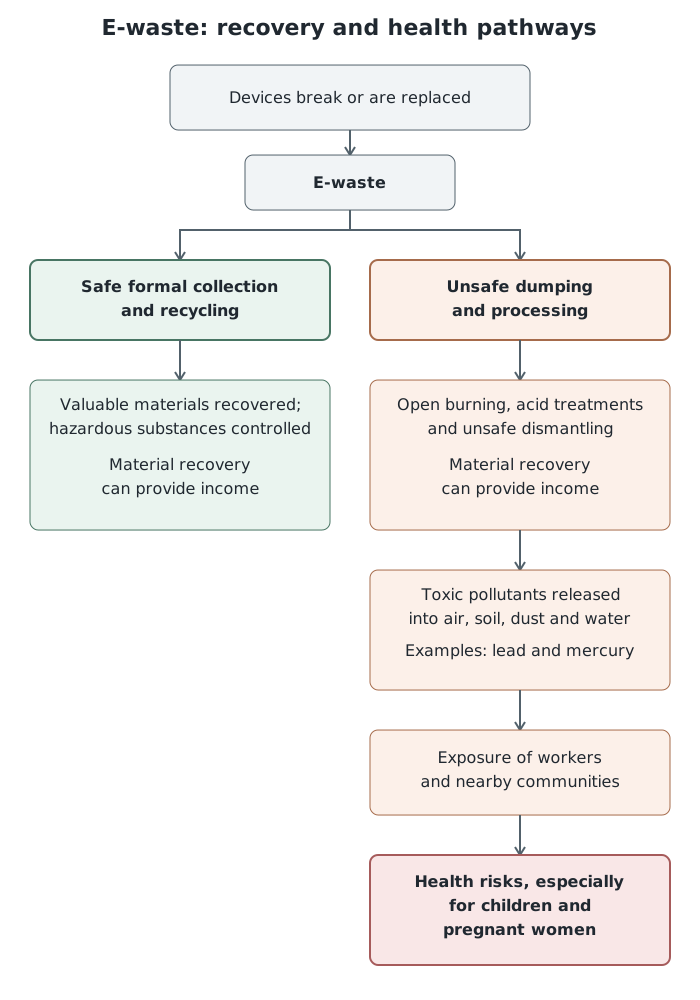
E-waste contains useful materials, but unsafe disposal and recovery can transfer the costs of consumption to workers and nearby communities.
Open burning creates toxic fumes, while unsafe dumping and processing can contaminate air, soil, dust and water with substances including lead and mercury. Pollution can affect workers and neighbouring communities, and pollutants can travel beyond the processing site.
The human consequences include injuries during dismantling and exposure to contaminated air and other materials. Unsafe e-waste recycling has been linked to reduced lung function and increased asthma, as well as harm to children's learning and development associated with lead exposure. Children and pregnant women are particularly vulnerable. Some children work in waste picking and dismantling, directly exposing them to hazardous substances while their bodies are still developing.
Greater consumer choice brings benefits: varied food supplies, access to technology and income for producers and material-recovery workers. However, these benefits can be accompanied by resource depletion, emissions and pollution. The costs are not necessarily borne by the people making the purchases.
Safer formal e-waste collection and recycling can recover valuable materials while controlling exposure to hazardous substances. Effective regulation, enforcement, training and the elimination of child labour are important. Simply removing an informal source of income without providing safer opportunities would overlook the livelihoods involved.
Overall, consumerism's impacts depend on how goods are produced, transported, used and discarded. More sustainable choices combine reduced unnecessary consumption, longer product use and properly managed recovery—not just a change at one stage of the supply chain.
Consumer choice and material recovery provide benefits and income, but environmental and health costs may fall on distant communities. Reduce unnecessary consumption, extend product life and use safe, regulated recycling.
Build a causal chain: consumer demand → change in production, transport or disposal → environmental or human impact.
Food miles measure distance, not greenhouse gas emissions. Consider how food is grown and transported as well as how far it travels.
Distinguish environmental impacts, such as contaminated water, from human impacts, such as illness caused by exposure to that contamination.
The 22.3% formal recycling figure does not mean that all remaining e-waste was dumped: some was stored or handled outside documented formal systems.
It can see this note and what your specification asks for.
Answers are free with an account.
1 free note left this week
Get more free notesYour answer sets when this note comes back for review, or marks it complete.
Was this note helpful?
Log in to tell us whether it helped, or to report a problem.
Last updated
Consumerism
A pattern of society and economic activity that encourages people to purchase goods and services in increasing amounts.
Agri-business
Large-scale commercial farming organised as a business, often using intensive production methods, machinery, fertilisers and pesticides.
Food miles
The distance food travels from where it is grown or produced to the market where it is sold.
Out-of-season produce
Fruit or vegetables sold at a time when they would not normally be harvested locally.
Carbon footprint
The total greenhouse gas emissions associated with a product, activity, person or organisation.
E-waste
Discarded electrical and electronic equipment, such as mobile phones, computers and household appliances.
Planned obsolescence
Designing products to become outdated or unusable after a limited period, encouraging consumers to replace them.
Put your knowledge into practice — try past paper questions for Geography A
Consumerism
A pattern of society and economic activity that encourages people to purchase goods and services in increasing amounts.
Agri-business
Large-scale commercial farming organised as a business, often using intensive production methods, machinery, fertilisers and pesticides.
Food miles
The distance food travels from where it is grown or produced to the market where it is sold.
Out-of-season produce
Fruit or vegetables sold at a time when they would not normally be harvested locally.
Carbon footprint
The total greenhouse gas emissions associated with a product, activity, person or organisation.
E-waste
Discarded electrical and electronic equipment, such as mobile phones, computers and household appliances.
Planned obsolescence
Designing products to become outdated or unusable after a limited period, encouraging consumers to replace them.