

Loading…
Loading…
Loading…
Eduqas GCSE Geography A · C111
Eduqas C111 · 8.1.2 Climate Change Impacts and Responses Check the specification (PDF) (opens in a new tab)
Climate change is a long-term change in average weather conditions and their patterns. Its effects involve more than a rise in temperature: rainfall, seasons, sea levels and the likelihood of extreme weather can also change. These physical changes affect people’s health and safety, economic activities such as farming, and environments such as coastal habitats.
Some effects are short-term, occurring during an event or its immediate aftermath. A flood can damage homes and interrupt journeys within hours. Others are long-term, developing or continuing over years and decades. Repeated flooding can create continuing repair costs, while rising sea levels increase the risk to coastal settlements. A short event can therefore leave long-lasting consequences.
The UK and the Arctic provide a useful contrast. The UK has a temperate maritime climate, generally mild with changeable weather. The Arctic is a cold polar environment where snow, frozen ground and seasonal ice are important to ecosystems and many people’s livelihoods. The same global warming produces different local effects because these starting conditions differ.
The UK is already experiencing longer and more frequent warm spells and shorter, less frequent cold spells. Climate change increases the likelihood of some extremes; this does not mean that every individual weather event is caused entirely by climate change.
Heatwaves threaten health. During the summer heatwave of 2003, there were over 2,000 excess deaths over a ten-day period. Older people are particularly vulnerable to heat-related illness. More frequent and severe hot spells would increase this health risk and the demands placed on health services.
Heavy rainfall increases flood risk. Intense rain can overwhelm drains or cause rivers to overflow. In built-up areas, concrete and other impermeable surfaces prevent water soaking into the ground, increasing surface runoff. Floodwater can damage homes and businesses, disrupt transport and leave people temporarily unable to use their homes. Repairs and interrupted business activity create economic losses that continue after the water has receded.
Hotter, drier summers can also increase the risk of drought. Less available water makes farming more difficult and puts pressure on water supplies. Importantly, a drier summer can still contain intense downpours: the total rainfall over a season and the intensity of an individual shower are different measures.
The UK is projected to experience warmer, wetter winters and hotter, drier summers. This changes seasonality—the pattern of conditions through the year. Less frost and a longer growing season may allow farmers to grow some crops more easily or introduce new ones.
However, these opportunities have limits. Drought can interrupt crop growth, and some crops currently grown in the UK may become less suited to higher temperatures. A longer growing season does not automatically mean a larger harvest if water is unavailable when plants need it. Changing temperatures and water availability also alter conditions for plants and wildlife, with potential losses of biodiversity.
Sea-level rise creates a further long-term threat. Seawater expands as it warms, and melting land-based glaciers and ice sheets add water to the oceans. Low-lying coastal settlements face increasing flood risk, alongside risks to coastal environments and infrastructure. Sea levels around the UK are expected to keep rising beyond 2100 even if emissions fall, so reducing warming cannot immediately remove every impact.
Overall, some economic activities may gain opportunities, but these must be weighed against health risks, flood damage and less reliable water supplies. Impacts will differ between regions and between people with different resources to cope.
The Arctic’s shrinking ice cover affects both its environment and the people who depend on it. Ice reflects sunlight; when it retreats, darker surfaces absorb more solar energy, reinforcing warming. Melting floating sea ice changes habitats and access routes, but it is melting land ice—not floating sea ice—that adds water to the oceans.
In Arctic Alaska, many Indigenous communities rely on hunting, fishing and detailed knowledge of seasonal conditions. Thinner ice and less predictable freezing and melting make traditional travel and hunting routes more dangerous. Around Shishmaref, traditional on-ice hunting routes are no longer safe. This is a direct safety impact, but it also affects access to food and cultural practices.
Sea-ice retreat can force hunters to travel farther across open water. Hunters from Savoonga on St Lawrence Island have reported travelling as far as 100 miles to reach walruses during the spring harvest. Longer journeys increase exposure to dangerous conditions and require more fuel.
Whale-hunting communities have also faced larger waves as sea ice retreats. Some villages have purchased larger boats, creating substantial up-front costs; these boats can use two or three times as much fuel. Environmental change therefore becomes an economic burden as well as a safety problem.
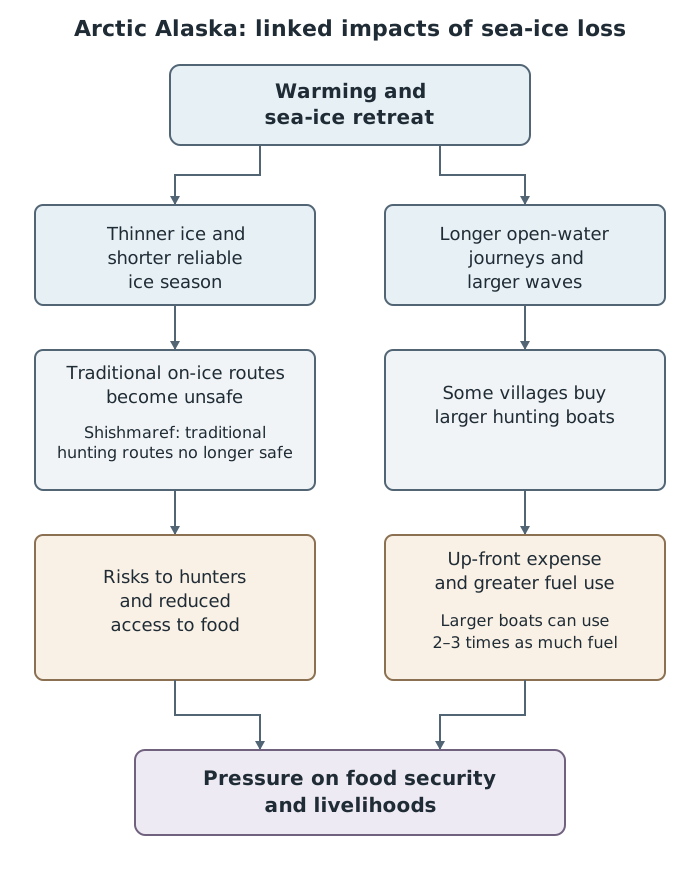
Sea-ice loss can connect environmental change to safety, food access and household costs in Arctic Alaska.
Changing seasonal patterns affect when food can be obtained. At Utqiaġvik, bowhead whales now migrate earlier in spring and later in autumn. Hunting crews must adjust their timing, including hunting earlier in spring to use more stable coastal ice. Autumn fishing that depends on snow-machine access occurs later because freeze-up is delayed.
These changes threaten food security: food may still exist in the region, but reaching it safely becomes harder. Over the longer term, repeated disruption can affect nutrition, livelihoods and the transfer of traditional knowledge between generations.
Thawing permafrost changes land surfaces and water availability. In 2022, a tundra lake near Kotzebue, which supplied freshwater to some residents, abruptly drained. This shows how an environmental change can become an immediate problem for drinking-water access.
Wildfires provide another linked set of effects. Increasingly large areas of Alaska have burned over recent decades. Fires damage landscapes, while smoke harms breathing, disrupts aviation and interferes with subsistence activities. The environmental, social and economic consequences reinforce one another.
Extreme events can compound these pressures. In September 2022, Typhoon Merbok flooded Bering Sea communities and damaged homes, boats and hunting camps, disrupting autumn subsistence harvests. In Golovin, one third of homes were damaged. The event demonstrates the consequences of a severe storm; it does not, by itself, prove that climate change caused that storm.
A geographical future is a possible future pattern of environments and human activity in a place. Climate projections explore alternatives rather than predict one certain outcome. Future emissions matter, and climate models give ranges because the climate’s response is uncertain.
For the UK in 2070, Met Office projections under a high-emissions scenario, compared with 1990, include:
Under this pathway, greater heat and more intense rainfall would increase risks to health, farming and settlements. Cold spells and wet summers would still occur: climate change alters their likelihood rather than making every year identical. Evidence for increasing heat extremes is stronger than evidence for a future increase in UK windstorms.
For the Arctic, continued high emissions would bring increasingly unfamiliar extremes in temperature, ice conditions and whether precipitation falls as rain or snow. Continued warming could produce summers with very little sea ice by the middle of this century. Shorter periods of reliable ice and altered animal migrations would further disrupt travel and harvesting seasons.
A future with lower emissions would limit some changes in both locations. It would reduce the scale of future warming, but would not restore all past conditions immediately. How well communities can cope also shapes the outcome: the same physical hazard can have different consequences depending on safe infrastructure, resources and access to reliable knowledge.
The most justified judgement is therefore not that every effect is equally harmful or certain. The UK may gain some agricultural opportunities, but water shortages and extreme weather can undermine them. In Arctic Alaska, the close dependence of food, travel and cultural life on ice makes its loss particularly disruptive. Greater warming raises the overall risks in both places, while lower warming offers a less damaging—but not impact-free—future.
Develop an impact as a chain: physical change → effect on people or the environment → economic or longer-term consequence.
Use named evidence from both the UK and Arctic Alaska, rather than treating the Arctic as an uninhabited region.
For the UK’s 2070 figures, state that they are projections under a high-emissions scenario, compared with 1990—not guaranteed outcomes.
Distinguish frequency, meaning how often an event occurs, from intensity, meaning how severe it is.
Do not claim that every type of storm will become more frequent. Evidence about future UK windstorms is less certain than evidence about increasing heat extremes.
When judging geographical futures, weigh any opportunities against their limits, and consider who benefits and who faces the greatest risks.
It can see this note and what your specification asks for.
Answers are free with an account.
1 free note left this week
Get more free notesYour answer sets when this note comes back for review, or marks it complete.
Was this note helpful?
Log in to tell us whether it helped, or to report a problem.
Last updated
Climate change
A long-term change in average weather conditions and their patterns, including temperature, rainfall and the occurrence of extremes.
Extreme weather
An unusually severe or unseasonal weather event, such as a heatwave or exceptionally heavy rainfall.
Seasonality
The timing and pattern of conditions or activities through the year, such as winter rainfall, plant growth or animal migration.
Climate projection
A modelled estimate of possible future climate conditions, based on assumptions such as future greenhouse gas emissions.
Emissions scenario
A possible pathway of future greenhouse gas emissions, used to explore how the climate might change.
Geographical future
A possible future pattern of environments and human activity in a place, shaped by physical changes and people's decisions.
Permafrost
Ground that remains frozen for at least two consecutive years.
Food security
Reliable access to enough safe, nutritious food.
Vulnerability
The degree to which people or places are susceptible to harm, influenced by their exposure to hazards and ability to cope.
Put your knowledge into practice — try past paper questions for Geography A
Climate change
A long-term change in average weather conditions and their patterns, including temperature, rainfall and the occurrence of extremes.
Extreme weather
An unusually severe or unseasonal weather event, such as a heatwave or exceptionally heavy rainfall.
Seasonality
The timing and pattern of conditions or activities through the year, such as winter rainfall, plant growth or animal migration.
Climate projection
A modelled estimate of possible future climate conditions, based on assumptions such as future greenhouse gas emissions.
Emissions scenario
A possible pathway of future greenhouse gas emissions, used to explore how the climate might change.
Geographical future
A possible future pattern of environments and human activity in a place, shaped by physical changes and people's decisions.
Permafrost
Ground that remains frozen for at least two consecutive years.
Food security
Reliable access to enough safe, nutritious food.
Vulnerability
The degree to which people or places are susceptible to harm, influenced by their exposure to hazards and ability to cope.
UK, 2070: high emissions, relative to 1990
Arctic: continued high emissions mean greater disruption to ice, precipitation and harvesting seasons; summers with very little sea ice could occur by mid-century.
Judgement: lower emissions limit future changes but do not remove every impact. Outcomes also depend on vulnerability and ability to cope. Projections are conditional ranges, not guarantees; an individual extreme event is not proof of climate causation.