

Loading…
Loading…
Loading…
Eduqas GCSE Geography A · C111
Eduqas C111 · 8.1.1 Impacts of Consumerism on the Environment Check the specification (PDF) (opens in a new tab)
A purchase uses more of nature than the space the finished product occupies. Chocolate requires land to grow its ingredients; a wooden table requires forest resources; producing goods using fossil fuels releases carbon dioxide that ecosystems would need to absorb. An ecological footprint brings these demands together. It measures the biologically productive land and sea area needed to supply what a person or population consumes and absorb its waste, especially carbon dioxide.
The footprint includes demands on cropland, grazing land, fishing grounds, forests and built-up land, as well as land needed to absorb carbon emissions. It is therefore broader than a carbon footprint, which focuses on greenhouse gas emissions. A country’s footprint can include demands on ecosystems abroad: importing a product does not remove the resource demand involved in making it.
To judge whether these demands can be sustained, the footprint is compared with biocapacity: the capacity of ecosystems to regenerate resources and absorb waste. Both are expressed in global hectares, which represent hectares with world-average biological productivity. This makes areas with different productivity comparable.
Suppose a population’s demand exceeds what its own ecosystems can regenerate. It has an ecological deficit. It may meet demand by importing resources, depleting its ecological assets through activities such as deforestation or overfishing, or allowing carbon dioxide to accumulate in the atmosphere. Imports can support a regional deficit, but the world as a whole cannot import resources from another planet. Sustainability therefore requires attention to both consumption and nature’s capacity to renew resources.
Consumerism encourages demand for goods and services. Global interdependence means that this demand can affect places thousands of kilometres from the consumer. Retailers depend on manufacturers and overseas producers for supplies, while producers depend on buyers for income.
The connection is often indirect. Someone buying shampoo may be buying palm oil without noticing it as a separate ingredient. Someone buying chicken may be supporting demand for soy used in animal feed. If rising demand encourages producers to expand farmland into natural habitats, consumer choices become linked to ecosystem destruction.
An ecosystem is a community of organisms interacting with its physical environment. Replacing it with a commercial crop does not simply change its appearance: it changes habitats, food sources and the storage of carbon. These effects occur in both forests and non-forest biomes.
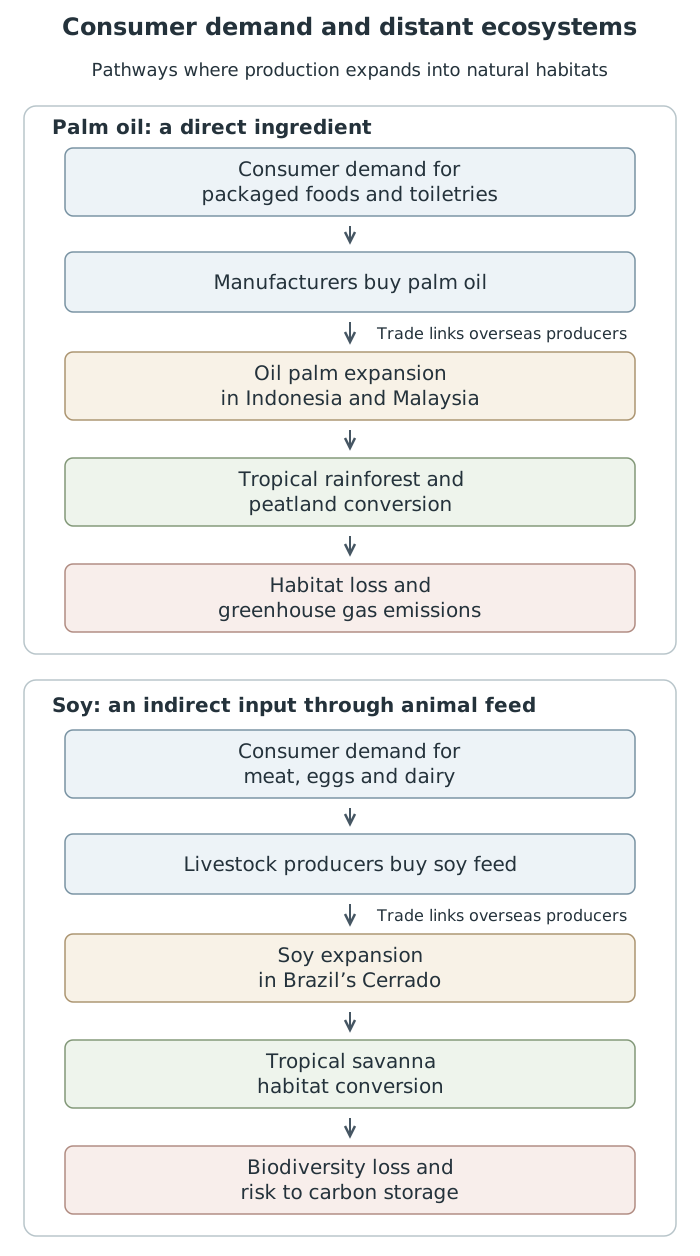
Consumer demand can reach distant ecosystems through direct ingredients and indirect inputs such as animal feed.
Palm oil is an edible vegetable oil obtained from oil palm fruit. It is widely used in foods such as chocolate and pizza, and in products such as shampoo and toothpaste. It is versatile, helps products last longer and produces large quantities of oil from a relatively small area. These properties make it attractive to manufacturers and growers.
Indonesia and Malaysia supply over 85% of the world’s palm oil. Their production connects South-East Asian landscapes to consumers and businesses around the world. Palm oil is also used as a biofuel in some parts of the world, adding another source of demand.
Where oil palm expansion replaces tropical rainforest, it destroys diverse habitats. Orangutans, pygmy elephants and Sumatran rhinos are among the threatened animals affected by palm-oil-related forest loss. A plantation producing a useful crop is not an ecological replacement for the natural forest it displaces.
Forest loss and the conversion of carbon-rich peat soils also release greenhouse gases, contributing to climate change. Peat is partly decomposed organic material that stores carbon. Its conversion, alongside forest clearance, means that agricultural expansion can affect both local wildlife and the global climate. A fuel made from a crop is therefore not automatically environmentally sustainable: the land-use change involved in producing it matters.
The Cerrado in Brazil is a tropical savanna neighbouring the Amazon. Its wooded grasslands contrast with tropical rainforest, but they are also valuable natural habitats. The Cerrado is home to about 5% of the world’s biodiversity and stores large amounts of carbon. Only about 20% of its original vegetation remains intact.
Soy production provides a clear connection between consumption and habitat conversion here. Almost 80% of the world’s soybean crops are fed to livestock. Demand for chicken, pork, eggs and dairy products can therefore drive soy demand even when consumers do not eat soybeans directly. The UK is an important market for soybeans.
As soy farming expands into the Cerrado’s natural vegetation, habitats are lost and the biome’s carbon storage is put at risk. The Cerrado also supports the water cycle that helps sustain the neighbouring Amazon. Its destruction matters beyond the fields being cleared.
The comparison is important: palm oil expansion can destroy tropical rainforest, while soy expansion can convert tropical savanna. Protecting forests alone would leave other valuable ecosystems exposed to consumer-driven destruction.
The environmental case against destructive palm oil production is strong: it can cause habitat loss, threaten species and release greenhouse gases. However, replacing all palm oil with other vegetable oils could create new pressures elsewhere.
Palm oil supplies around 40% of global vegetable oil demand using just under 6% of the land used for vegetable oil production. Producing an equivalent amount of alternative oils can require between four and ten times more land. A replacement could therefore shift habitat destruction to another region or biome. Millions of smallholder farmers also depend on palm oil for their livelihoods.
A more convincing approach is to reduce destructive production rather than assume that every substitute is better. The Roundtable on Sustainable Palm Oil, or RSPO, sets standards intended to protect habitats and people. Businesses can source certified palm oil, trace where it comes from and exclude forest and peatland conversion from their supply chains. The benefits depend on producers actually meeting the standards, not simply on companies making promises.
For soy, stronger traceability, protection of native vegetation and support for responsible producers can help. Reducing demand for meat and other animal products can also reduce pressure for livestock feed. However, mixing soy from different origins makes tracing it back to individual farms difficult.
Overall, the strongest response combines lower pressure from consumption with verified, habitat-protecting production. Consumers influence demand, but companies and governments also have responsibilities because they control sourcing decisions, production rules and enforcement.
Demand → international supply chains → agricultural expansion → habitat conversion → biodiversity loss and carbon impacts.
Explain the whole chain: consumer demand → trade and production → land-use change → environmental impact. Naming deforestation alone does not explain the link.
Use the Cerrado as a contrasting tropical savanna biome, not as another tropical rainforest.
When evaluating palm oil, weigh habitat and carbon losses against its high oil yield per hectare. Explain why replacing it with another oil may shift rather than solve the problem.
Distinguish commitments from results: a company promising sustainable sourcing does not prove that its supply chain is free of habitat destruction.
It can see this note and what your specification asks for.
Answers are free with an account.
1 free note left this week
Get more free notesYour answer sets when this note comes back for review, or marks it complete.
Was this note helpful?
Log in to tell us whether it helped, or to report a problem.
Last updated
Ecological footprint
The biologically productive land and sea area needed to provide the resources consumed by a person or population and absorb its waste, especially carbon dioxide emissions.
Biocapacity
The capacity of biologically productive land and sea to regenerate resources and absorb waste, especially carbon dioxide.
Global hectare
A hectare adjusted to represent world-average biological productivity, allowing ecological footprints and biocapacity to be compared.
Ecological deficit
A situation in which a population’s ecological footprint exceeds the biocapacity of the area being considered.
Consumerism
A pattern in which buying and using goods and services is an important part of people’s lifestyles, encouraging demand for production.
Global interdependence
The dependence of countries and people on one another through connections such as trade and supply chains.
Biome
A large-scale ecological region characterised by its climate and typical vegetation, such as tropical rainforest or tropical savanna.
Habitat conversion
The replacement of a natural habitat with another land use, such as a crop plantation.
Traceability
The ability to follow a product or ingredient through its supply chain back to where it was produced.
Put your knowledge into practice — try past paper questions for Geography A
Ecological footprint
The biologically productive land and sea area needed to provide the resources consumed by a person or population and absorb its waste, especially carbon dioxide emissions.
Biocapacity
The capacity of biologically productive land and sea to regenerate resources and absorb waste, especially carbon dioxide.
Global hectare
A hectare adjusted to represent world-average biological productivity, allowing ecological footprints and biocapacity to be compared.
Ecological deficit
A situation in which a population’s ecological footprint exceeds the biocapacity of the area being considered.
Consumerism
A pattern in which buying and using goods and services is an important part of people’s lifestyles, encouraging demand for production.
Global interdependence
The dependence of countries and people on one another through connections such as trade and supply chains.
Biome
A large-scale ecological region characterised by its climate and typical vegetation, such as tropical rainforest or tropical savanna.
Habitat conversion
The replacement of a natural habitat with another land use, such as a crop plantation.
Traceability
The ability to follow a product or ingredient through its supply chain back to where it was produced.