

Loading…
Loading…
Loading…
Eduqas GCSE Geography A · C111
Eduqas C111 · 2.3.2 Consequences of Urbanisation Check the specification (PDF) (opens in a new tab)
A global city has important connections to the wider world through business, finance, migration and culture. These connections create opportunities, but they do not give every resident the same way of life. Within one city, income and location can make a large difference to someone’s work, home, leisure and access to services.
Mumbai, on India’s west coast in Maharashtra, provides an example of a city in a newly industrialised country (NIC). It is a major financial and commercial centre, with employment in finance, technology, textiles and the Bollywood film industry. Sydney, in Australia, provides the contrasting high-income country (HIC) example. Its economy includes finance, technology, tourism and other services.
The useful comparison is not simply ‘Mumbai is poor and Sydney is rich’. Both contain wealthy and lower-income communities, and both have diverse cultural lives. The important questions are how these differences are distributed within each city and how they affect everyday life.
Social patterns describe how characteristics such as income, living conditions and access to services vary between groups and areas. Mumbai has sharp contrasts between affluent districts such as Bandra West and informal settlements such as Dharavi.
Affluent areas include gated housing and access to private healthcare and international schools. These services give higher-income households more choice. In Dharavi, many residents live in crowded accommodation without reliable clean water or sanitation. Access to services therefore depends heavily on both income and where someone lives.
These differences also affect work. Mumbai’s finance and IT industries offer opportunities for highly skilled workers, while many other residents earn a living through street vending, recycling and small workshops. However, Dharavi is not only a residential area associated with poverty: it is also a place of business, skills and enterprise.
Sydney generally has better-developed infrastructure and access to healthcare, education and leisure facilities. Nevertheless, a high national income does not mean that all neighbourhoods enjoy the same living standards.
Wealthy suburbs such as Mosman and Manly include large homes and attractive coastal settings. By contrast, outer suburbs such as Mount Druitt have lower incomes and higher unemployment. Housing affordability also affects people’s choices about where they can live.
Both cities therefore show a relationship between income and residential location. The contrast is that Mumbai includes communities where reliable basic services are limited, whereas Sydney’s inequality exists within a city with generally well-developed services. Comparing these patterns is more accurate than assuming that every Mumbai resident is disadvantaged or every Sydney resident is wealthy.
Cultural patterns concern the distribution of identities, traditions and activities within a place. They appear in everyday food, entertainment, festivals and community life, not just in famous landmarks.
Mumbai is culturally diverse. Bollywood connects the city to audiences across India and internationally, while festivals such as Diwali and Ganesh Chaturthi are important parts of its cultural calendar. Street markets, cricket and foods such as vada pav also shape daily life. These activities create opportunities for people to meet, celebrate and trade, although residents do not all follow the same traditions or participate in the same way.
Sydney’s multicultural character reflects its overseas-born population and international connections. Events such as Chinese New Year, Mardi Gras and Vivid Sydney express different aspects of the city’s cultural life. The Sydney Opera House is both a cultural venue and an internationally recognised landmark.
Both cities combine local identities with global influences. Mumbai’s film industry and Sydney’s cultural events also connect culture to employment and tourism: cultural life is part of the economy as well as something residents enjoy.
The informal economy consists of economic activity outside formal employment and government regulation or taxation. Workers often have no employment contract, regular wage or entitlement to benefits such as paid holidays. Informal work is not the same as unemployment: people are producing goods or providing services, but without the arrangements and protections associated with formal jobs.
In Mumbai, examples include street vending, recycling and small workshops, including businesses in Dharavi. A large urban population creates demand for affordable goods and services. People who cannot obtain formal employment can use their labour and skills to meet that demand and earn an income.
For example, street vendors sell goods to other residents, while recycling workers collect and process discarded materials. These activities support households and supply useful services to the wider city. They also show why an informal settlement should not be understood only as a place of poor housing.
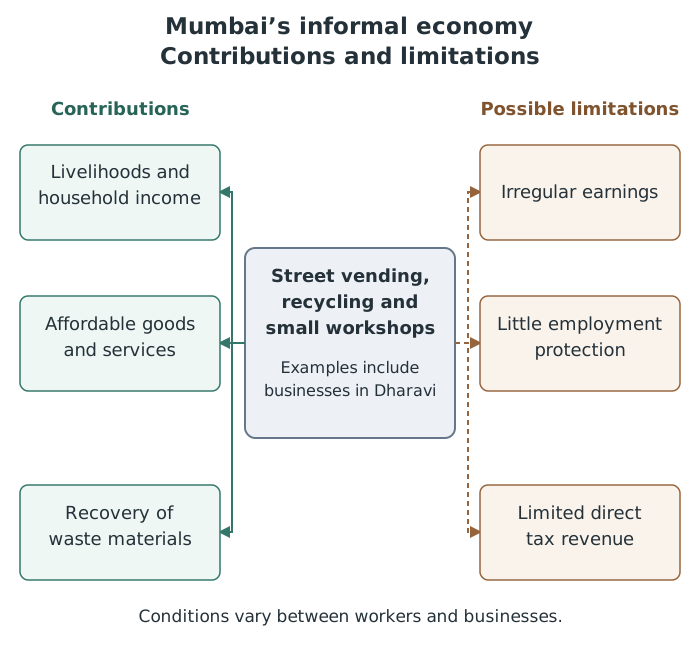
Mumbai’s informal economy supports households and the wider city, but its benefits coexist with insecure work and limited protection.
The informal economy makes several important contributions. It creates livelihoods for people who might otherwise struggle to find paid work. Small businesses provide affordable goods and services, and their earnings help support families. Dharavi’s recycling activity also recovers materials from waste, giving it an environmental as well as an economic role.
However, earning an income does not necessarily mean having secure or well-paid employment. Workers may face basic working conditions, irregular earnings and little protection if they become ill or lose work. Activity outside government taxation also limits its direct contribution to tax revenue used to fund public services.
Overall, Mumbai’s informal economy is an important source of livelihoods, enterprise and services. Its contribution should not be dismissed because the work is informal. Equally, it should not be treated as a complete solution to poverty: its benefits are limited by insecure earnings and weak worker protection.
Examples: street vending, recycling and small workshops in Dharavi.
Benefits: livelihoods, household income, enterprise, affordable goods and services, recovery of waste materials.
For a comparison, link the cities directly using words such as ‘both’ and ‘whereas’, rather than writing two unrelated descriptions.
Support social patterns with named places: Bandra West and Dharavi in Mumbai; Mosman, Manly and Mount Druitt in Sydney.
Distinguish informal employment from informal housing: one describes work, the other describes accommodation. They often overlap, but are not the same thing.
When assessing the informal economy, explain its benefits and limitations before giving a supported overall judgement.
It can see this note and what your specification asks for.
Answers are free with an account.
1 free note left this week
Get more free notesYour answer sets when this note comes back for review, or marks it complete.
Was this note helpful?
Log in to tell us whether it helped, or to report a problem.
Last updated
Global city
A city with important connections to other parts of the world through activities such as finance, business, migration and culture.
Social pattern
The distribution of social characteristics, such as income, living conditions and access to services, between groups and areas.
Cultural pattern
The ways that identities, traditions and activities, such as languages, festivals, food and entertainment, vary between groups and places.
Informal economy
Economic activity outside formal employment and government regulation or taxation, often without contracts or employment protections.
Informal settlement
An area of housing built outside the formal planning system, often with insecure land rights and limited basic services.
Inequality
Unequal access to income, resources and opportunities between people or groups.
Put your knowledge into practice — try past paper questions for Geography A
Global city
A city with important connections to other parts of the world through activities such as finance, business, migration and culture.
Social pattern
The distribution of social characteristics, such as income, living conditions and access to services, between groups and areas.
Cultural pattern
The ways that identities, traditions and activities, such as languages, festivals, food and entertainment, vary between groups and places.
Informal economy
Economic activity outside formal employment and government regulation or taxation, often without contracts or employment protections.
Informal settlement
An area of housing built outside the formal planning system, often with insecure land rights and limited basic services.
Inequality
Unequal access to income, resources and opportunities between people or groups.
Limitations: irregular earnings, basic working conditions, little employment protection and limited direct tax revenue.
Judgement: an important economic contribution, but not a complete solution to poverty or insecure employment.