

Loading…
Loading…
Loading…
Eduqas GCSE Geography A · C111
Eduqas C111 · 2.3.2 Consequences of Urbanisation Check the specification (PDF) (opens in a new tab)
Mumbai and Sydney show how cities grow through connections with their surrounding regions and with other countries. Mumbai is in Maharashtra, India, in South Asia. It provides an example of a global city in a newly industrialised country (NIC). Sydney is in New South Wales (NSW), Australia, a high-income country (HIC).
At the regional scale, each city attracts people from its surrounding settlements. At the national scale, people move there from other parts of the country. At the global scale, international migration connects the cities to places overseas. A city-region includes the city and the surrounding area linked to it through movements of people and access to jobs and services; it is wider than the city centre.
Mumbai is India's financial capital, with the Bombay Stock Exchange and many global companies. Sydney is a major centre for finance, services, technology and tourism, with international businesses and educational opportunities. These activities help explain why both cities attract migrants. Being a global city concerns international influence and connections, whereas being a megacity concerns population size: at least 10 million people. Mumbai is both; Sydney is a global city but not a megacity. Greater Sydney had about 5.1 million residents in June 2023, accounting for 61% of NSW's population.
Two processes change the number of people living in a city: natural population change and migration. Natural change is births minus deaths. When births outnumber deaths, the result is natural increase; when deaths outnumber births, it is natural decrease.
Migration is movement to live in another place. Arrivals increase the population, but departures reduce it. The difference between arrivals and departures is net migration. A city can therefore attract many newcomers while also losing residents to other places.
The relationship is:
These processes are connected. Young adults who move to a city may later have children there, contributing to natural increase as well as to migration growth.
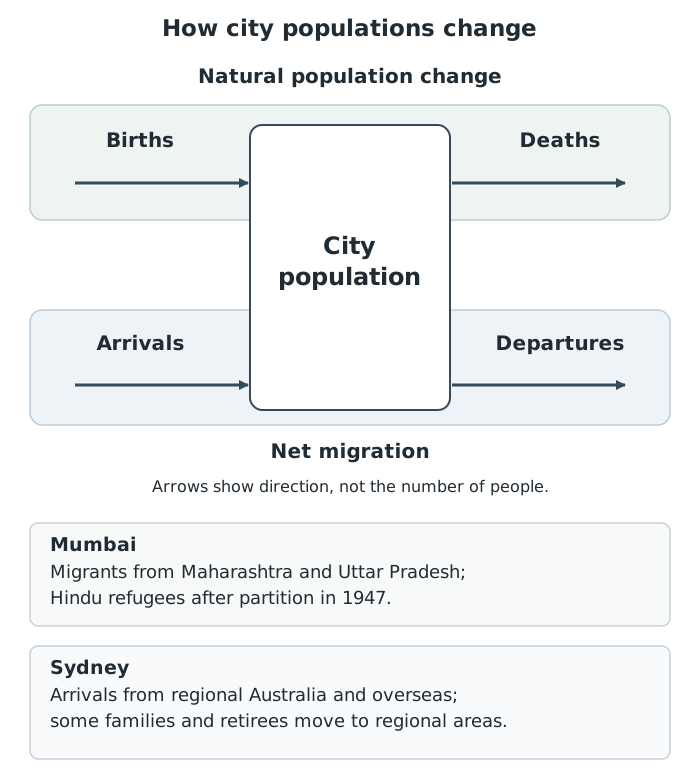
Births and arrivals add residents; deaths and departures remove them. Migration links cities to their surrounding regions and to other countries.
Mumbai attracts migrants from within Maharashtra and from more distant parts of India, including Uttar Pradesh in northern India. These movements connect the city to both its surrounding region and the wider country.
A migration decision often combines a push factor at the origin with a pull factor at the destination. In Mumbai's case, low rural incomes, limited education and poor access to healthcare encourage people to leave. Jobs in manufacturing, construction and services, together with schools and hospitals, attract them to the city. The attraction is the prospect of a better quality of life, not a guarantee that every migrant will obtain a secure job.
Changes in agriculture also help explain this movement. The Green Revolution, beginning in India in the 1960s, introduced agricultural improvements involving chemicals and machinery. Large farms were better able to afford these inputs. Mechanisation reduced demand for some farm labour, encouraging displaced workers to seek urban employment. Here the connection is clear: fewer rural employment opportunities push workers away, while Mumbai's jobs pull them towards the city.
Mumbai's growth has not depended only on rural–urban migration. Following the Second World War, the partition of British India in 1947 created India and Pakistan and triggered mass migration. Many Hindu refugees settled in Mumbai, where they received asylum. This historical international movement differed from migration for employment: people were seeking refuge during political upheaval.
Continued migration from other parts of India helped Mumbai's population rise by over four million between about 1980 and 1990. Towards the end of the twentieth century, natural increase contributed more to growth than migration. This shows why an explanation of Mumbai's growth must include births and deaths, rather than assuming that every additional resident was a migrant.
A population graph plots time along the horizontal axis and population along the vertical axis. Read the units first: Mumbai's population is shown in millions. To compare growth rates, examine how much the population rises over comparable periods. A steeper line indicates faster growth.
Mumbai's population took over 40 years to increase by one million early in the twentieth century. It then grew much more rapidly: the population was approximately eight million in 1980 and twelve and a half million in 1990. Between these dates it crossed the ten-million threshold and became a megacity. During the early 2010s, an increase of one million took only about two years.
Later, the growth rate slowed as families had fewer children. Slower growth is not the same as population decline: a line that still rises shows that the population is increasing, even if it has become less steep. The graph establishes the pattern of growth; explanations involving agricultural change, migration and family size account for that pattern.
Sydney also grows through both natural increase and migration. Births outnumber deaths in Greater Sydney. Its relatively young population is reinforced by young adults arriving from overseas and from other parts of Australia.
Within NSW, young people move from rural and regional areas towards cities for education and employment. A narrower range of local study and work opportunities can push them away, while Sydney's universities and varied jobs attract them. Movement also occurs in the opposite direction: some young families move to regional areas, and retirees move towards coastal or inland communities. The city-region is therefore connected by flows in both directions, not simply by a stream of arrivals.
International migration was important to Sydney's growth after the Second World War, particularly migration from Europe. More recently, migrants have arrived from Asia and the Pacific. Sydney attracts skilled workers and students through its strong economy, employment opportunities, educational institutions, high living standards and good transport links.
Over the past 40 years, net overseas migration has been the largest contributor to population growth in NSW. This regional trend provides context for Sydney, but should not be treated as an exact Sydney-only statistic.
Both cities attract people seeking work, education and an improved quality of life, and both experience natural increase. However, Mumbai's growth includes substantial rural–urban migration within India, agricultural changes and refugee settlement following partition. Sydney's growth includes migration within Australia and successive waves of international migration for work and study. Understanding either city requires both the local circumstances that encourage movement and the wider historical and international connections.
Locate each city at regional, national and global scales, rather than just naming its country.
Explain migration using a linked push–pull pair: fewer rural jobs push people away, while urban employment opportunities pull them towards the city.
Distinguish natural increase from net migration. Births and arrivals add people; deaths and departures remove them.
When using population figures, include the date and geographical area. Greater Sydney is not the same area as the whole of New South Wales.
A population graph shows changes in size and growth rate, but does not by itself prove whether migration or natural increase caused them.
It can see this note and what your specification asks for.
Answers are free with an account.
1 free note left this week
Get more free notesYour answer sets when this note comes back for review, or marks it complete.
Was this note helpful?
Log in to tell us whether it helped, or to report a problem.
Last updated
Global city
A city with important international connections and influence, for example through finance, business and migration.
Newly industrialised country
A country undergoing substantial industrial development and economic change.
High-income country
A country with a high average income per person.
City-region
A city and the surrounding area linked to it through flows such as migration, commuting and access to services.
Natural population change
The difference between the number of births and deaths in a population over a period. It is positive when births exceed deaths and negative when deaths exceed births.
Natural increase
Population growth that occurs when births outnumber deaths.
Net migration
The number of people moving into an area minus the number moving out over a period.
Rural–urban migration
The movement of people from countryside settlements to towns and cities to live.
Push factor
A condition that encourages people to leave a place, such as low incomes or limited employment.
Pull factor
A feature that attracts people to a place, such as employment or education opportunities.
Megacity
An urban area with a population of at least 10 million.
Put your knowledge into practice — try past paper questions for Geography A
Global city
A city with important international connections and influence, for example through finance, business and migration.
Newly industrialised country
A country undergoing substantial industrial development and economic change.
High-income country
A country with a high average income per person.
City-region
A city and the surrounding area linked to it through flows such as migration, commuting and access to services.
Natural population change
The difference between the number of births and deaths in a population over a period. It is positive when births exceed deaths and negative when deaths exceed births.
Natural increase
Population growth that occurs when births outnumber deaths.
Net migration
The number of people moving into an area minus the number moving out over a period.
Rural–urban migration
The movement of people from countryside settlements to towns and cities to live.
Push factor
A condition that encourages people to leave a place, such as low incomes or limited employment.
Pull factor
A feature that attracts people to a place, such as employment or education opportunities.
Megacity
An urban area with a population of at least 10 million.
Natural increase and positive net migration can both cause growth. Slower growth does not necessarily mean decline.