

Loading…
Loading…
Loading…
Eduqas GCSE Design and Technology · C600
Eduqas C600 · Manufacturing Scales and Processes Check the specification (PDF) (opens in a new tab)
A mould is a shaped tool that determines the shape of a manufactured product. Instead of cutting each product from a solid block, a manufacturer makes the polymer soft enough to take the mould’s shape. Reusing the same mould helps produce identical products and components.
The starting form of the plastic matters. Some processes shape a sheet, others expand a softened tube, and others squeeze material inside a cavity. Although all four processes use a mould, they apply force in different ways.
Thermoforming plastics, also called thermoplastics, soften when heated and harden again when cooled. This makes them suitable for processes that reshape softened material. Thermosetting plastics set permanently during curing: once set, they cannot be softened and reshaped by reheating. Compression moulding is mainly used with thermosetting plastics, although certain thermoplastics can also be compression moulded.
Blow moulding produces hollow plastic products, such as bottles. A hot, softened plastic tube is enclosed in a mould. This tube is called a parison.
Compressed air is introduced inside the tube. The air pushes the soft plastic outwards until it contacts the walls of the mould cavity. The mould therefore controls the bottle’s outside shape, while the inflated tube leaves a hollow space inside.
The plastic cools and hardens before the mould opens and the product is removed. Excess material may then be trimmed. Blow moulding is suitable for bottles because it forms their hollow bodies rather than producing solid blocks of plastic.
Vacuum forming starts with a sheet of thermoforming plastic, such as high-impact polystyrene (HIPS) or acrylic. The sheet is heated until it is soft enough to form, and a mould or former is positioned beneath it. A former is a shaped tool over which material is formed.
Air is extracted from beneath the sheet using a vacuum. With less pressure below the sheet, atmospheric pressure above it pushes the softened plastic tightly against the former. The sheet takes the former’s shape and is allowed to cool and harden before removal.
The important difference from blow moulding is where the air acts. Blow moulding introduces compressed air inside a tube; vacuum forming removes air beneath a sheet.
Press moulding also begins with a polymer sheet that is heated until it can be shaped. The softened sheet is placed over a mould and pressed down against it so that it takes the mould’s shape.
Here, direct mechanical pressure provides the shaping force. This distinguishes press moulding from vacuum forming, even though both processes begin with heated sheets. Once a thermoforming sheet has cooled sufficiently to retain its shape, the formed component can be removed.
In compression moulding, a quantity of polymer is placed inside a heated mould cavity. The mould is closed with an upper part, or plug, and a hydraulic press applies force.
As the plug closes, the polymer is compressed and forced into contact with the mould surfaces, filling the required shape. When a thermosetting plastic is used, heat and pressure are maintained while it cures. The mould is then opened and the component removed.
Unlike press moulding, this process does not simply press a sheet over a mould: material is placed inside a cavity and compressed within the closed mould.
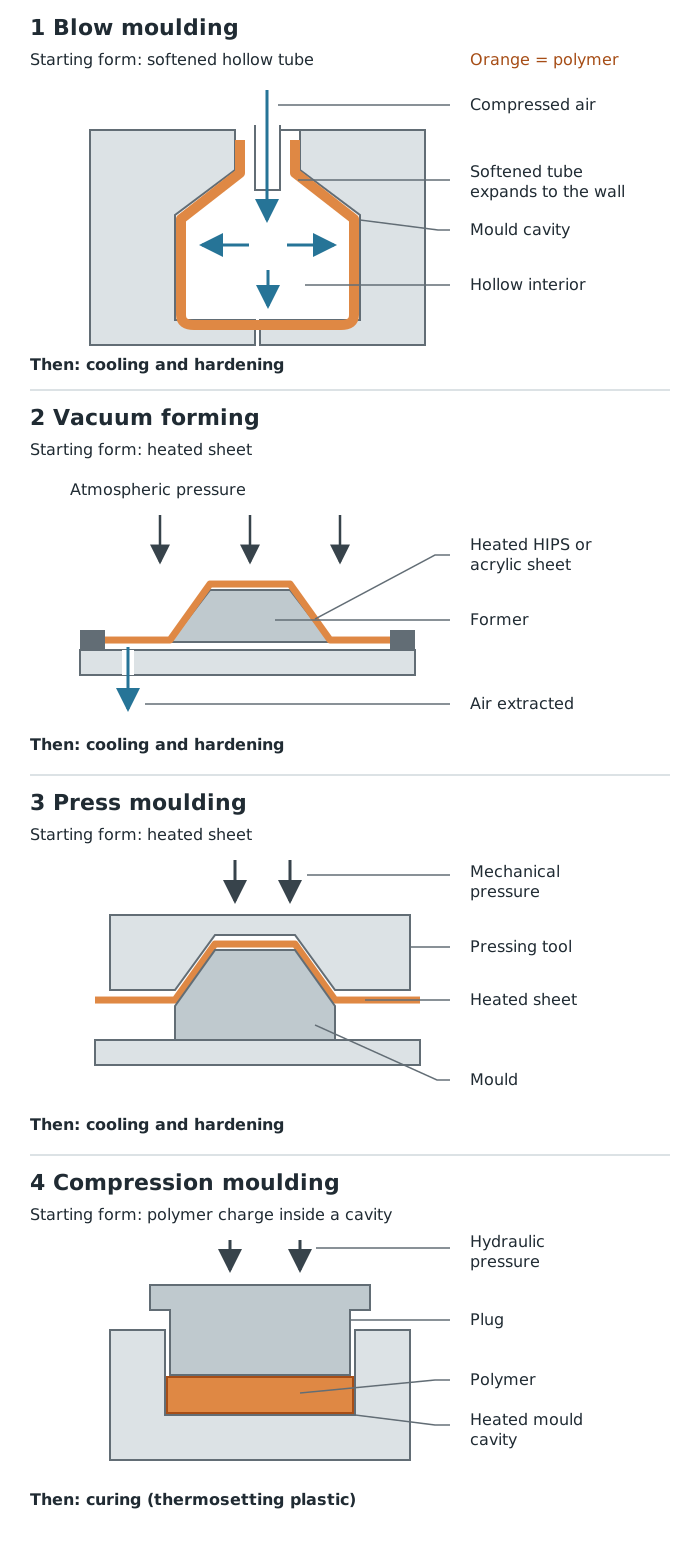
Compare the starting form of the plastic and the force that makes it take the mould’s shape.
Some plastics are self-finishing: after moulding, their surfaces need no further finishing. In vacuum forming, a flat, glossy sheet takes the shape of the former, and its contact surface reproduces the former’s surface. The condition of the mould or former therefore matters as well as its shape.
Self-finishing describes the surface finish. It does not mean that every manufacturing task is complete: for example, excess material from a blow-moulded product may still need trimming.
Explain what shapes the plastic: compressed air in blow moulding, air removal in vacuum forming, direct pressing in press moulding, and a hydraulic press in compression moulding.
Keep press moulding and compression moulding distinct: press moulding starts with a heated sheet placed over a mould; compression moulding starts with polymer placed inside a heated mould cavity.
For a process explanation, link the starting material, shaping action and setting stage rather than just naming machinery.
It can see this note and what your specification asks for.
Answers are free with an account.
1 free note left this week
Get more free notesYour answer sets when this note comes back for review, or marks it complete.
Was this note helpful?
Log in to tell us whether it helped, or to report a problem.
Last updated
Polymer
A material made from long-chain molecules; plastics are polymer-based materials.
Thermoforming plastic
A plastic that softens when heated and hardens when cooled, allowing it to be reshaped by reheating.
Thermosetting plastic
A plastic that sets permanently during curing and cannot subsequently be softened and reshaped by heating.
Mould
A shaped tool whose cavity or surface determines the shape of a product during manufacture.
Blow moulding
A manufacturing process that inflates softened plastic inside a mould to produce a hollow product.
Vacuum forming
A manufacturing process that removes air beneath a heated plastic sheet so that atmospheric pressure pushes it against a mould or former.
Press moulding
A manufacturing process in which a heated polymer sheet is placed over a mould and pressed against it to take its shape.
Compression moulding
A manufacturing process in which polymer placed in a heated mould cavity is compressed by a closing plug using a hydraulic press.
Curing
The permanent setting of a material through a chemical change, as occurs when a thermosetting plastic is moulded.
Self-finishing polymer
A plastic whose moulded surface needs no further surface finishing after forming.
Put your knowledge into practice — try past paper questions for Design and Technology
Polymer
A material made from long-chain molecules; plastics are polymer-based materials.
Thermoforming plastic
A plastic that softens when heated and hardens when cooled, allowing it to be reshaped by reheating.
Thermosetting plastic
A plastic that sets permanently during curing and cannot subsequently be softened and reshaped by heating.
Mould
A shaped tool whose cavity or surface determines the shape of a product during manufacture.
Blow moulding
A manufacturing process that inflates softened plastic inside a mould to produce a hollow product.
Vacuum forming
A manufacturing process that removes air beneath a heated plastic sheet so that atmospheric pressure pushes it against a mould or former.
Press moulding
A manufacturing process in which a heated polymer sheet is placed over a mould and pressed against it to take its shape.
Compression moulding
A manufacturing process in which polymer placed in a heated mould cavity is compressed by a closing plug using a hydraulic press.
Curing
The permanent setting of a material through a chemical change, as occurs when a thermosetting plastic is moulded.
Self-finishing polymer
A plastic whose moulded surface needs no further surface finishing after forming.