

Loading…
Loading…
Loading…
Eduqas GCSE Design and Technology · C600
Eduqas C600 · Properties and Ecological Footprint Check the specification (PDF) (opens in a new tab)
Non-ferrous metals do not contain iron as a constituent. Aluminium, copper and silver are examples; brass, bronze, pewter and duralumin are non-ferrous alloys. An alloy combines a metal with other elements to obtain useful properties. Being an alloy does not make a material ferrous: its composition determines its category.
Non-ferrous metals do not rust, because rust is an iron corrosion product. However, this does not mean their surfaces never change. Polished copper is orange-brown but can oxidise to form a green surface; golden brass darkens with age. A designer must consider appearance and corrosion resistance as well as strength and ease of manufacture.
Physical properties describe characteristics such as melting point and conductivity. Melting point matters when casting a product or selecting a safe heat-treatment temperature. An alloy may melt over a range rather than at one temperature. Heat treatment changes a solid metal’s properties without melting the workpiece. Thermal conductivity describes how easily heat passes through a material; electrical conductivity describes how easily electric current passes through it.
Mechanical properties describe how a material responds to forces. Tensile strength is resistance to failure under a pulling force. Toughness is resistance to fracture when force or impact is applied. Hardness is resistance to indentation, scratching and wear. A hard surface may resist abrasion well without necessarily being tough.
Plasticity is the ability to change shape permanently without breaking. Malleability is particularly important when pressing, hammering or bending sheet into shape. Ductility matters when drawing a material into wire or stretching it during forming. These properties affect both the finished product and the processes used to make it.
Aluminium is lightweight, malleable and a good conductor of heat and electricity. Malleability helps manufacturers form drinks cans from thin metal, while thermal conductivity helps a saucepan transfer heat to its contents. Aluminium can undergo substantial permanent deformation without breaking, making it suitable for processes such as rolling and drawing.
Low weight does not automatically mean high strength. Pure aluminium has a tensile strength of around 90 MPa; suitable aluminium alloys can be much stronger. A drinks can needs to be formed easily, whereas a cycle frame must carry loads without adding unnecessary weight. The material’s grade and condition must suit the job.
Duralumin is an aluminium alloy containing copper and magnesium. It can be strengthened by age hardening. Rivets are an example of its use: the material can be processed before ageing develops its final strength. Alloying and heat treatment therefore provide ways of changing the properties available from an aluminium-based material.
Copper is tough, ductile and very malleable. Its excellent electrical conductivity makes it useful for wiring, while its ability to be shaped and its thermal conductivity make it suitable for plumbing and central-heating applications. Ductility allows wire to be drawn; malleability allows tubes and other components to be formed.
Pure copper melts at approximately 1083 °C. Its melting point is distinct from its annealing temperature: softening it for further forming does not require melting it.
Copper has good corrosion resistance, although its surface appearance changes through oxidation. This matters when a designer wants a polished orange-brown finish rather than a green surface. Its ease of forming is useful during manufacture, but repeated cold forming also changes its mechanical properties.
Brass is an alloy of copper and zinc. It is strong, ductile, a good conductor of heat and works well when cast. Its golden appearance, workability and durability explain its use for taps, door fittings, hinges, locks and handles. It is also used for musical instruments. Its appearance is not permanent: the surface darkens with age.
Bronze is a family of copper-based alloys, including copper–tin and copper–aluminium alloys. Bronze is hard and corrosion-resistant, and commonly has a darker, reddish-brown appearance. Its hardness and low friction make it useful for bearings, where surfaces move against one another. Corrosion resistance makes it suitable for outdoor mechanical components, monuments and nautical applications.
The distinction is functional as well as visual. Brass offers useful workability for fittings and instruments; bronze offers useful wear and corrosion resistance for moving components and exposed products. Their exact composition and condition still matter: not every brass or bronze has identical forming or heat-treatment behaviour.
Pewter is a tin-rich alloy. Modern lead-free pewter commonly contains over 90% tin, with smaller amounts of antimony and copper. It is used for tankards, goblets, candlesticks, plaques and jewellery.
Its low melting point and good flow when molten allow intricate designs and thin-walled vessels to be cast. Pewter is also highly ductile: sheet can be stretched, hammered and bent into shape. These properties make it useful where decorative detail and ease of manufacture are more important than carrying large loads.
Low strength is its main limitation. A designer must avoid sections that are too thin to support the product, particularly where it will become warm. Pewter is therefore not a substitute for a high-strength structural alloy simply because both can be shaped easily.
Pewter also behaves differently during forming. Rather than work-hardening like copper, it can soften during rolling or spinning. Intermediate annealing is normally unnecessary. Certain specially modified pewter alloys can recover hardness through controlled heat treatment, but this is not a general treatment for every pewter product.
Silver is a precious metal used in jewellery. It is soft, malleable when hot, highly corrosion-resistant and a good conductor. Its formability helps a maker produce shaped decorative pieces.
Softness is also a limitation: a surface that is easy to shape is less suitable where resistance to scratching and wear is the main requirement. A designer therefore weighs appearance and formability against the demands placed on the finished item. Pure silver and silver alloys should not be assumed to have identical properties or treatment requirements.
Bending, rolling or drawing a metal without heating it is called cold working. In metals such as aluminium, copper and silver, and suitable copper alloys, continued cold working increases strength and hardness but reduces the ability to stretch without fracture. This is work hardening. A piece that was initially easy to form may eventually become difficult to shape further.
Annealing uses controlled heating, holding at an appropriate temperature and cooling to restore a softer, more workable condition. In soft annealing, new, undeformed crystals form within the metal. This restores ductility and allows further shaping, but reduces hardness and strength compared with the work-hardened condition.
For example, copper sheet being formed into a curved component may need annealing between stages of cold forming. This allows further deformation rather than forcing a hardened piece until it cracks. Aluminium and silver can likewise be annealed to restore formability after cold working. Pewter is an important exception because it can work-soften instead.
There is no single annealing temperature or time for every non-ferrous metal. Indicative soft-annealing ranges are 400–500 °C for copper, 450–600 °C for brass and 475–675 °C for wrought tin-bronze. Sterling silver has a typical annealing range of 600–650 °C. These are material-specific examples, not interchangeable workshop instructions: composition, previous forming and holding time affect the appropriate treatment.
Cooling also depends on the material and treatment. Rapidly cooling copper does not produce the hardening effect associated with steel. The purpose of the copper annealing cycle remains softening.
Heat hardening is not available for every non-ferrous metal. Suitable alloys, including duralumin, can undergo age hardening, also called precipitation hardening. Pure aluminium cannot be precipitation-hardened in this way: the process depends on suitable alloying elements.
The sequence begins with solution treatment: controlled heating allows relevant alloying elements to dissolve within the solid metal. The workpiece is then quenched, or rapidly cooled. Finally, it is aged, either at room temperature or at a controlled raised temperature. During ageing, fine particles form within the alloy and make permanent deformation more difficult, increasing hardness and strength.
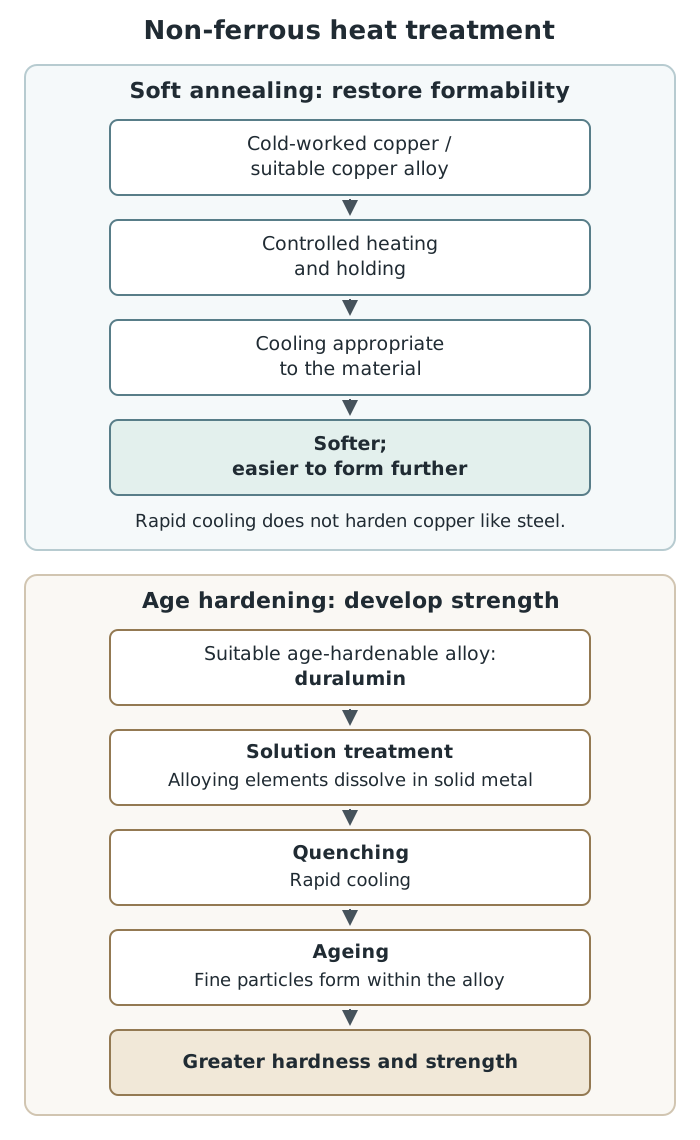
Annealing improves formability; age hardening increases strength in suitable alloys.
Quenching is therefore one stage, not the whole hardening process. Ordinary copper, brass and wrought tin-bronze are not hardened simply by heating and quenching like steel. Some specially formulated copper alloys can be age-hardened, so the alloy must be identified before choosing a treatment. Annealing and age hardening serve different manufacturing purposes: annealing makes further forming easier, while age hardening develops higher strength in an appropriate alloy.
Any workshop heat treatment needs a teacher-approved procedure for the particular material. Use eye protection, appropriate handling tools and a heat-resistant work area; treat recently heated metal as hot even when it is not glowing. Keep clear of steam or splashes during quenching. Completion is judged from the specified heating, holding, cooling and, where relevant, ageing cycle—not from appearance alone.
Link a material property to the product’s function: bronze’s hardness resists wear in a bearing, while its low friction helps the moving parts run smoothly.
Distinguish hardness from toughness: resistance to wear is not the same as resistance to fracture.
Non-ferrous metals do not rust, but they can still oxidise or corrode. Copper’s green surface is an example.
Do not apply steel-hardening rules to every metal. Quenching copper does not harden it; age-hardenable alloys need the complete treatment sequence.
When discussing heat treatment, state its purpose and whether it makes further shaping easier or increases final strength.
Do not assume every metal work-hardens: pewter can soften during forming, so intermediate annealing is normally unnecessary.
Distinguish pure aluminium from aluminium alloys: alloying and treatment can greatly increase strength, but only suitable alloys can be age-hardened.
It can see this note and what your specification asks for.
Answers are free with an account.
1 free note left this week
Get more free notesYour answer sets when this note comes back for review, or marks it complete.
Was this note helpful?
Log in to tell us whether it helped, or to report a problem.
Last updated
Non-ferrous metal
A metal or alloy that does not contain iron as a constituent.
Alloy
A mixture of a metal with one or more other elements, used to obtain particular properties.
Hardness
Resistance to permanent indentation, scratching and wear.
Toughness
The ability of a material to resist fracture when force or impact is applied.
Tensile strength
The ability of a material to withstand pulling forces before it fails.
Plasticity
The ability of a material to undergo permanent deformation without breaking.
Malleability
The ability of a material to be pressed, hammered or bent into shape without cracking.
Ductility
The ability of a material to be drawn out, for example into wire, without breaking.
Melting point
The temperature at which a solid becomes liquid. An alloy may melt over a temperature range.
Thermal conductivity
How readily a material allows heat to pass through it.
Electrical conductivity
How readily a material allows electric current to pass through it.
Annealing
A controlled heat treatment used to soften a metal and make it easier to shape.
Work hardening
An increase in hardness and strength caused by permanently deforming a metal without heating it.
Age hardening
A heat treatment that increases the strength and hardness of suitable alloys through solution treatment, quenching and ageing.
Duralumin
An aluminium-based alloy containing copper and magnesium that can be strengthened by age hardening.
Pewter
A tin-rich alloy, commonly containing antimony and copper, used for decorative objects and vessels.
Put your knowledge into practice — try past paper questions for Design and Technology
Non-ferrous metal
A metal or alloy that does not contain iron as a constituent.
Alloy
A mixture of a metal with one or more other elements, used to obtain particular properties.
Hardness
Resistance to permanent indentation, scratching and wear.
Toughness
The ability of a material to resist fracture when force or impact is applied.
Tensile strength
The ability of a material to withstand pulling forces before it fails.
Plasticity
The ability of a material to undergo permanent deformation without breaking.
Malleability
The ability of a material to be pressed, hammered or bent into shape without cracking.
Ductility
The ability of a material to be drawn out, for example into wire, without breaking.
Melting point
The temperature at which a solid becomes liquid. An alloy may melt over a temperature range.
Thermal conductivity
How readily a material allows heat to pass through it.
Electrical conductivity
How readily a material allows electric current to pass through it.
Annealing
A controlled heat treatment used to soften a metal and make it easier to shape.
Work hardening
An increase in hardness and strength caused by permanently deforming a metal without heating it.
Age hardening
A heat treatment that increases the strength and hardness of suitable alloys through solution treatment, quenching and ageing.
Duralumin
An aluminium-based alloy containing copper and magnesium that can be strengthened by age hardening.
Pewter
A tin-rich alloy, commonly containing antimony and copper, used for decorative objects and vessels.