

Loading…
Loading…
Loading…
Eduqas GCSE Design and Technology · C600
Eduqas C600 · Properties and Ecological Footprint Check the specification (PDF) (opens in a new tab)
A metal product may be strong, durable and useful, but its environmental impact begins before it reaches the user. Its metal must be obtained, processed and made into components. Later, the product may need energy or maintenance, and eventually it must be reused, recycled or disposed of.
The ecological footprint of a material or product is its effect on the environment: the resources and energy it uses, the habitats it affects, and the pollution and waste it creates. Its social footprint concerns its effects on people and communities. These are connected: pollution from metal production can damage both ecosystems and the surroundings in which people live.
Metals come from ores—naturally occurring rocks containing minerals from which metals can be extracted. Ore deposits are finite natural resources: they are not replaced on a human timescale. However, metal already extracted can often be recovered and used again. This makes what happens to metal waste particularly important.
Mining provides the ore needed for new metal production, but obtaining it can involve removing vegetation and disturbing land. This destroys or disrupts habitats and can reduce biodiversity—the variety of living organisms in an area. Mining can also pollute water and requires energy for machinery and transport.
For example, producing aluminium from ore begins with mining that can remove vegetation and disturb habitats. Processing the ore and producing usable aluminium then requires large amounts of energy. Its environmental impact therefore includes much more than the finished metal itself.
The social consequences also matter. Metal production involves high temperatures, creating hazards for workers. Safe working conditions are needed to reduce the risk of injury, while pollution must be controlled to minimise harm to nearby communities. These are impacts on people, rather than simply impacts on habitats or resources.
Extracting and refining metals, and heating them for manufacture, are energy-intensive activities. When fossil fuels supply this energy, their combustion releases carbon dioxide, a greenhouse gas. Greenhouse gases absorb heat escaping from Earth and contribute to warming the atmosphere.
Manufacturing also uses machinery, water and sometimes chemical treatments. Its impacts can include waste metal, chemical pollutants, noise and heat as well as greenhouse gas emissions. Transport between mining, processing, manufacturing and selling locations adds another demand for energy.
These impacts can be reduced rather than simply accepted. Renewable energy at production sites can lower the carbon footprint. More efficient manufacturing processes can reduce energy demand, while processes that produce less scrap reduce material waste. Recovering usable scrap prevents valuable metal from being discarded.
Life-cycle analysis (LCA) assesses the environmental impacts of a material or product across its whole life. This is often described as looking from cradle to grave: from obtaining raw materials to what happens when the product is no longer needed.
LCA helps a designer identify where the greatest impacts occur. The largest problem might be extracting the material, manufacturing it, transporting it, using the product or disposing of it. A change that improves one stage should therefore be judged alongside its effects elsewhere.
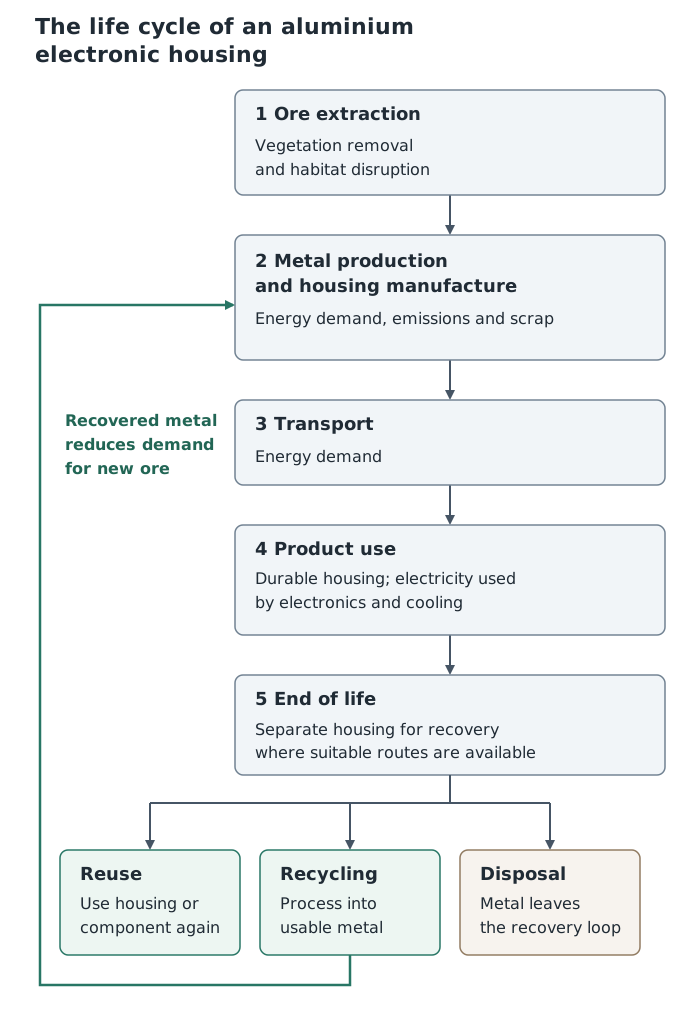
Life-cycle analysis considers every stage. Recovering aluminium can reduce demand for new ore, but does not remove all environmental impacts.
Consider an electronic product with an aluminium housing:
This analysis connects design decisions to consequences. A housing that lasts longer can reduce the need for replacements. A housing that is easy to remove makes repair and material recovery easier. Neither improvement removes the need to consider the electricity used by the electronic product throughout its life.
Reuse means using a product or component again without converting it back into raw material. Recycling means processing waste material so that it can become material for new products. For example, an aluminium can can be recycled into material for another product.
Aluminium can be recycled repeatedly, and steel is also highly recyclable. Recycling generally uses less energy and creates fewer greenhouse gas emissions than obtaining metal from ore. It also reduces the demand for further mining and keeps valuable resources out of landfill.
Recycling still needs collection, separation, transport and processing, so it does not have zero environmental impact. A metal’s ability to be recycled is only useful if the product reaches a suitable recycling route. If it is thrown into general waste, that opportunity may be lost.
Designers can improve recovery through design for disassembly: making components easy to separate at the end of a product’s life. This helps recyclers recover materials and can also make repair or component reuse easier.
Living in a greener world means reducing resource consumption, emissions, pollution and waste while still meeting people’s needs. It requires a change in how society views metal waste: discarded metal is a potential resource, not simply rubbish. Collecting and separating metal for recycling helps turn that view into action.
Designers contribute by reducing unnecessary material use, choosing lower-impact processes, improving durability and making products repairable and recyclable. Users contribute by keeping useful products in service and sending unwanted metal to appropriate collection facilities.
An evaluation should weigh the whole life cycle. Aluminium production has significant mining and energy impacts, but aluminium’s durability and repeated recyclability can reduce its long-term impact. For an electronic housing, a justified conclusion is to use these benefits while reducing production waste, supporting repair and ensuring that the housing can be recovered. Calling aluminium ‘green’ merely because it is recyclable would overlook both its initial production impacts and the energy used by the complete product.
Link each impact to its cause: mining removes vegetation, which destroys or disrupts habitats; energy-intensive metal production can create greenhouse gas emissions.
Distinguish environmental impacts, such as water pollution, from social impacts, such as unsafe working conditions.
For a life-cycle question, consider extraction, manufacture, transport, use and end of life—not just whether the metal is recyclable.
In an evaluation, weigh benefits against drawbacks and give a conclusion suited to the product. ‘Recyclable’ does not mean that a product will actually be collected and recycled.
It can see this note and what your specification asks for.
Answers are free with an account.
1 free note left this week
Get more free notesYour answer sets when this note comes back for review, or marks it complete.
Was this note helpful?
Log in to tell us whether it helped, or to report a problem.
Last updated
Ore
A naturally occurring rock containing minerals from which a metal can be extracted.
Ecological footprint
The effect that a material, process or product has on the environment, including resource use, habitat damage, pollution and waste.
Social footprint
The effect that a material’s or product’s production, use and disposal has on people and communities.
Greenhouse gas
A gas, such as carbon dioxide, that absorbs heat escaping from Earth and contributes to warming the atmosphere.
Life-cycle analysis
An assessment of a material’s or product’s environmental impacts across its life, from raw material extraction through manufacture, transport and use to disposal, reuse or recycling.
Recycling
Processing waste material so that it can be used as a material for new products.
Design for disassembly
Designing a product so that its components and materials can be separated easily for repair, reuse or recycling.
Put your knowledge into practice — try past paper questions for Design and Technology
Ore
A naturally occurring rock containing minerals from which a metal can be extracted.
Ecological footprint
The effect that a material, process or product has on the environment, including resource use, habitat damage, pollution and waste.
Social footprint
The effect that a material’s or product’s production, use and disposal has on people and communities.
Greenhouse gas
A gas, such as carbon dioxide, that absorbs heat escaping from Earth and contributes to warming the atmosphere.
Life-cycle analysis
An assessment of a material’s or product’s environmental impacts across its life, from raw material extraction through manufacture, transport and use to disposal, reuse or recycling.
Recycling
Processing waste material so that it can be used as a material for new products.
Design for disassembly
Designing a product so that its components and materials can be separated easily for repair, reuse or recycling.
Follow extraction → manufacture → transport → use → end of life.
Identify the greatest impacts, compare alternatives and explain how design changes reduce harm.
Aluminium electronic housing: mining and production have significant impacts; durability extends life; electronics and cooling use electricity; separating the housing supports recycling.
Judgement: assess the whole life cycle. A recyclable material is not automatically a low-impact product.