

Loading…
Loading…
Loading…
Eduqas GCSE Design and Technology · C600
Eduqas C600 · Properties and Ecological Footprint Check the specification (PDF) (opens in a new tab)
Metals are natural resources obtained by extracting and processing ores. An ore is a rock or mineral containing a metal compound from which a metal can be extracted. The ore is not usually a ready-to-use piece of metal: extraction separates the metal from its compound, and further processing produces material suitable for manufacture.
A designer then chooses a metal for the job it must do. A car body panel needs to be shaped and withstand knocks; a drill bit needs to retain a hard cutting edge. Calling both materials ‘metal’ does not explain why they are suitable.
Ferrous metals contain iron, while non-ferrous metals do not contain iron. Mild steel and cast iron are ferrous; copper and aluminium are non-ferrous. Ferrous metals are usually magnetic, but ‘usually’ matters: iron content, rather than a magnet test alone, defines the category.
An alloy is a mixture of metals, or a metal mixed with another element, made to change its properties. Alloying overlaps with the ferrous/non-ferrous classification. Steel is a ferrous alloy of iron and carbon; brass is a non-ferrous alloy of copper and zinc.
Pure iron is generally too soft for many engineered products. Adding carbon produces steels with more useful properties. As carbon content increases, steel generally becomes harder and stronger, but less tough and harder to form. This creates a trade-off: a hard cutting edge is useful on a tool, whereas easily formed, tough sheet is useful for a car body.
Physical properties describe behaviour such as responses to heat and electricity.
Melting point is the temperature at which a material changes from solid to liquid. Casting requires the metal to melt, so melting point affects the temperature and energy needed for manufacture. For comparison, aluminium melts at approximately 660°C, whereas titanium melts at about 1668°C: processing titanium requires much higher temperatures.
Thermal conductivity describes how readily heat passes through a material. High conductivity is useful where heat must be transferred efficiently, such as cookware and radiators. Copper is an excellent thermal conductor.
Electrical conductivity describes how readily electric current flows through a material. Copper and aluminium conduct electricity very well. Copper’s conductivity, combined with its ability to be drawn into wire, explains its use in electrical wiring. A metal being strong does not automatically make it a good electrical conductor.
Mechanical properties describe a material’s response to forces and loads. Several can matter at once, but they are not interchangeable.
Tensile strength is resistance to being pulled apart. Imagine pulling opposite ends of a metal rod: the relevant strength is its resistance to failure under that tension. By contrast, a material under compression is being squashed. Cast iron’s good compressive strength is particularly useful in machine bases.
Toughness is the ability to absorb energy and withstand impact without fracturing. A tough metal may dent or bend rather than crack when struck. Mild steel is tough; cast iron is comparatively brittle, so it is less suitable where sudden impacts are a major concern.
Plasticity means that deformation can be permanent without the material breaking. If a metal strip stays bent after the force is removed, it has undergone plastic deformation. This is useful when manufacturing a permanent shape.
Malleability is the ability to be hammered, rolled or pressed into shape without breaking. It is especially important for sheet forming. Ductility is a related property describing the ability to be stretched or drawn into shapes such as wire.
Hardness is resistance to scratching, wear and indentation. A cutting tool needs hardness so that its edge does not quickly wear away. However, hardness is not toughness: a hard tool can still chip if it is too brittle.
The ferrous family includes cast iron; mild, medium-carbon and high-carbon steels; stainless steel; high-speed steel; and high-tensile steel. They should not be treated as one interchangeable material.
| Material | Strengths and weaknesses | Suitable use and reason |
|---|---|---|
| Cast iron | Good compressive strength; readily cast into complex shapes; machines well and absorbs vibration; relatively inexpensive. Brittle, with low tensile strength; cannot be forged; rusts unless protected. | Engine blocks and machine-tool beds: complex, substantial shapes can be cast, and the material resists compressive loads. |
| Mild steel | Low carbon content; tough, ductile, malleable and relatively inexpensive. Rusts readily and is not suitable for direct hardening in the same way as higher-carbon steel. | Car bodies: sheet can be formed into shape and withstand everyday knocks. Also used for nuts, bolts and gates. |
| Medium-carbon steel |
HSS earns its extra cost where cutting generates substantial heat; for low-heat hand tools such as files and chisels, cheaper high-carbon steel is usually sufficient.
Medium-carbon steel sits between mild and high-carbon steel in carbon content and working properties. It can be hardened and then tempered, making it useful when a component needs more strength and wear resistance than mild steel without sacrificing as much toughness as a very hard cutting tool.
High-tensile steel describes a performance requirement rather than a single carbon-content class. Alloying and heat treatment can produce high tensile strength alongside other useful properties. One example is 4140 chromium-molybdenum steel, used for shafts and gears in its hardened-and-tempered condition. Its strength and toughness are valuable, but welding requires specialist control and its processing adds cost. High-tensile steel is not automatically stainless steel: tensile strength and corrosion resistance are different properties.
Mild steel may have sufficient strength for a product while being easier to form and cheaper than a harder steel. Conversely, selecting mild steel for a cutting edge would sacrifice wear resistance. Material selection therefore means balancing strengths and weaknesses against the actual use, not simply choosing the ‘strongest’ metal.
Heat treatment changes a metal’s properties through controlled heating and cooling. Unlike alloying, it does not normally involve changing the overall composition. The cooling method is crucial: slow cooling and rapid cooling can produce very different results.
Annealing involves heating the metal and then cooling it slowly. It softens the metal, relieves internal stresses and makes it easier to work. This is useful when further bending or shaping is needed. It can also restore workability after deformation has made a metal harder.
Hardening involves heating suitable steel and then cooling it rapidly by quenching in a suitable liquid, such as water or oil. Hardness increases, helping a cutting edge resist wear, but the steel also becomes more brittle. Medium- and high-carbon steels can be hardened this way; mild steel does not respond in the same way because its carbon content is too low.
Tempering follows hardening. The hardened steel is reheated to a temperature below that used for hardening and then cooled, commonly in air. This reduces brittleness and increases toughness, at the cost of some hardness. A tool needs this balance: an edge that is extremely hard but chips easily is not a successful cutting edge.
Case hardening gives low-carbon steel a hard outer layer while retaining a tough core. Carbon is added to the surface, followed by heating and quenching to harden that carbon-rich layer. A gear, for example, benefits from a wear-resistant surface without the whole component becoming brittle.
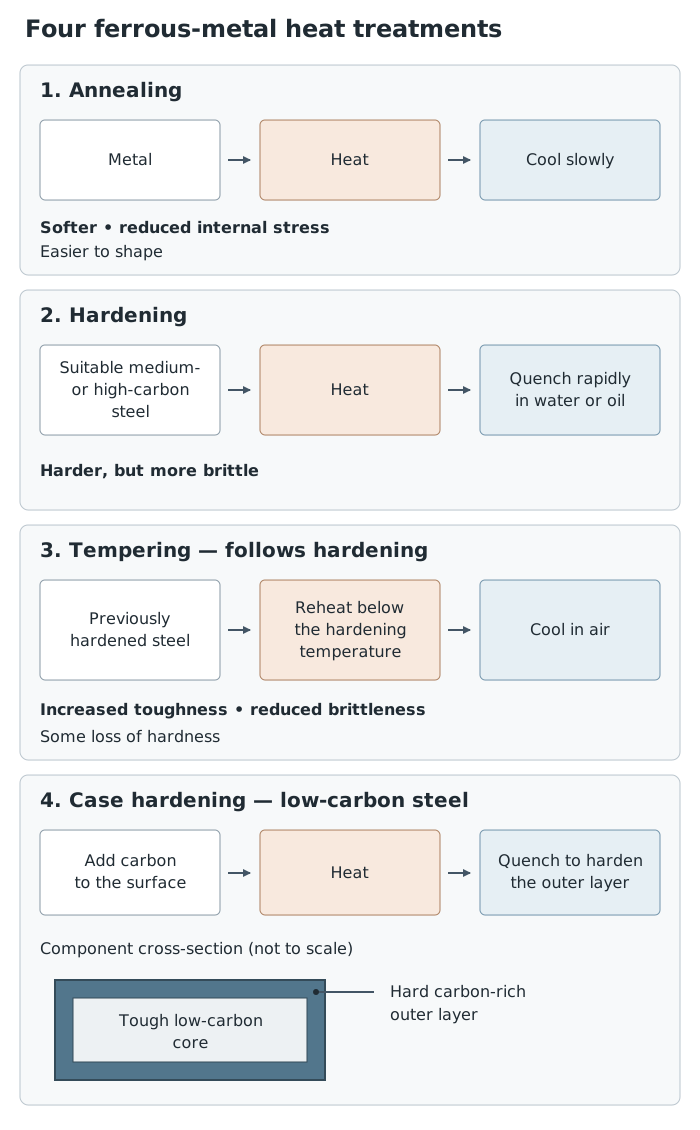
Controlled heating and cooling can make a metal easier to shape, more wear-resistant or less brittle.
The important distinction is the intended result: annealing supports further shaping; hardening improves wear resistance; tempering makes hardened steel less brittle; case hardening combines a hard surface with a tough interior.
Justify a material choice by linking a named metal, a relevant property and the product’s needs: stainless steel resists corrosion, so it is suitable for a sink exposed to water.
Distinguish hardness from toughness: a hard metal resists indentation and wear, but it may still crack under impact.
Alloy is not a third category separate from ferrous and non-ferrous: an alloy can belong to either group.
Do not describe all steels as equally suitable for hardening. Low-carbon mild steel needs surface enrichment with carbon for case hardening.
When describing heat treatment, give both the heating/cooling sequence and the resulting property change.
It can see this note and what your specification asks for.
Answers are free with an account.
1 free note left this week
Get more free notesYour answer sets when this note comes back for review, or marks it complete.
Was this note helpful?
Log in to tell us whether it helped, or to report a problem.
Last updated
Ore
A rock or mineral containing a metal compound from which a metal can be extracted.
Ferrous metal
A metal or alloy containing iron.
Non-ferrous metal
A metal or alloy that does not contain iron.
Alloy
A mixture of two or more metals, or a metal with another element, used to change its properties.
Melting point
The temperature at which a material changes from solid to liquid.
Thermal conductivity
How readily a material transfers heat.
Electrical conductivity
How readily a material allows electric current to flow.
Tensile strength
A material’s ability to resist being pulled apart under tension.
Toughness
A material’s ability to absorb energy and withstand impact without fracturing.
Plasticity
The ability to undergo permanent deformation without breaking.
Malleability
The ability to be hammered, rolled or pressed into shape without breaking.
Hardness
Resistance to scratching, wear and indentation.
Annealing
Heating and slowly cooling a metal to soften it, relieve internal stresses and make it easier to work.
Hardening
Heating suitable steel and cooling it rapidly to increase its hardness.
Quenching
Rapid cooling of heated metal, commonly in water or oil.
Tempering
Reheating hardened steel and cooling it to reduce brittleness and increase toughness, with some loss of hardness.
Case hardening
Adding carbon to the surface of low-carbon steel and hardening that surface, producing a hard outer layer around a tough core.
Medium-carbon steel
Steel with a carbon content between mild steel and high-carbon steel, offering a balance of strength and workability and responding well to hardening and tempering.
High-tensile steel
Steel developed to provide high resistance to failure under pulling forces, often through alloying and controlled heat treatment.
Put your knowledge into practice — try past paper questions for Design and Technology
Ore
A rock or mineral containing a metal compound from which a metal can be extracted.
Ferrous metal
A metal or alloy containing iron.
Non-ferrous metal
A metal or alloy that does not contain iron.
Alloy
A mixture of two or more metals, or a metal with another element, used to change its properties.
Melting point
The temperature at which a material changes from solid to liquid.
Thermal conductivity
How readily a material transfers heat.
Electrical conductivity
How readily a material allows electric current to flow.
Tensile strength
A material’s ability to resist being pulled apart under tension.
Toughness
A material’s ability to absorb energy and withstand impact without fracturing.
Plasticity
The ability to undergo permanent deformation without breaking.
Malleability
The ability to be hammered, rolled or pressed into shape without breaking.
Hardness
Resistance to scratching, wear and indentation.
Annealing
Heating and slowly cooling a metal to soften it, relieve internal stresses and make it easier to work.
Hardening
Heating suitable steel and cooling it rapidly to increase its hardness.
Quenching
Rapid cooling of heated metal, commonly in water or oil.
Tempering
Reheating hardened steel and cooling it to reduce brittleness and increase toughness, with some loss of hardness.
Case hardening
Adding carbon to the surface of low-carbon steel and hardening that surface, producing a hard outer layer around a tough core.
Medium-carbon steel
Steel with a carbon content between mild steel and high-carbon steel, offering a balance of strength and workability and responding well to hardening and tempering.
High-tensile steel
Steel developed to provide high resistance to failure under pulling forces, often through alloying and controlled heat treatment.
| Stronger and harder than mild steel, with moderate ductility. Can be hardened and tempered to balance strength and toughness. Less easily formed and welded than mild steel, and generally more expensive. |
| Shafts, axles and gears: moving components need strength and wear resistance while retaining useful toughness. |
| High-carbon steel | Hard and strong; can be hardened to resist wear. Less tough and more difficult to form than mild steel. | Saw blades and chisels: a hard working edge resists wear and deformation. |
| Stainless steel | Strong, hard and corrosion-resistant, with a shiny appearance. Relatively expensive and difficult to machine. | Sinks, cutlery and medical tools: corrosion resistance is valuable where water, cleaning and hygiene matter. |
| High-speed steel (HSS) | Very hard; keeps a sharp, wear-resistant edge at high temperatures. More expensive than high-carbon steel because of its costly alloying elements, such as tungsten and molybdenum. | Drill bits and lathe tools: cutting generates heat, but the edge must remain effective. |
| High-tensile steel | High tensile strength. Alloy grades can combine strength, toughness and wear resistance through heat treatment. For example, hardened-and-tempered chromium-molybdenum steel is difficult to weld and costs more than the same grade in its annealed condition. | Heavily loaded shafts and gears: a suitable heat-treated grade withstands high forces while resisting wear and impact. |