

Loading…
Loading…
Loading…
Eduqas GCSE Design and Technology · C600
Eduqas C600 · Smart Materials and Technical Textiles Check the specification (PDF) (opens in a new tab)
A technical textile is engineered to perform a specific task beyond the usual functions of fabric. Clothing might monitor heart rate, help manage body temperature or protect the wearer from heat. Other technical textiles work with soil rather than being worn.
A fibre is an individual strand from which yarns and fabrics can be made. Designers can change the fibres, the fabric structure or the substances incorporated into the textile to achieve particular properties. Smart textiles respond to a stimulus: something that causes a change, such as heat, ultraviolet radiation or rubbing. Not every technical textile is smart; a protective fabric can perform its task without changing in response to its surroundings.
Photo-chromic textiles contain dyes that change colour when exposed to ultraviolet (UV) radiation. These dyes can be incorporated into the fibres or applied to the garment. A printed design could therefore change colour when the wearer goes into sunlight.
Thermo-chromic textiles contain dyes that change colour when heated or cooled. For example, warmth from a hand can produce a differently coloured handprint on a suitable fabric. This makes temperature changes visible and can create interactive clothing designs.
The important distinction is the trigger: photo-chromic materials respond to UV radiation, whereas thermo-chromic materials respond to temperature. A colour change alone does not show which technology is being used.
Micro-encapsulation encloses a liquid or solid substance in tiny, thin-walled capsules incorporated into a textile. Rubbing during use can rupture capsule walls, gradually releasing the contents.
Imagine a fabric containing capsules of moisturiser. As the garment rubs against the skin, some capsules break and release moisturiser. Therapeutic oils and insecticides can also be incorporated in this way, allowing textiles to deliver a substance during use. The response here is the release of a substance, rather than a change of colour.
E-textiles, or electronic textiles, have circuits and electronic components integrated into the fabric. Conductive fibres or threads carry electrical current and connect components, performing a similar job to wires while remaining part of a flexible textile. Batteries, lights, sensors and small electronic processors can be incorporated into garments.
Biometric textiles measure information about the wearer’s body. A heart-rate monitoring garment, for example, combines sensing components with conductive pathways that relay information for electronic processing. The fabric provides a wearable way to connect the sensing technology, rather than merely serving as a pocket for a separate device.
Interactive clothing can also incorporate mobile-phone or music-player electronics, or connections to speakers and controls. GPS technology can be integrated into wearable tracking systems to provide location information. Heart-rate monitoring measures a bodily condition; GPS tracking identifies location. Both can use wearable electronics, but they perform different tasks.
Microfibres are very fine synthetic fibres, including fibres made from polyester or polypropylene. They can be made into knitted, woven or other fabric structures. Their fineness helps manufacturers produce soft, lightweight fabrics suitable for clothing such as sportswear.
Manufacturers select the fibre shape, size, combination and fabric structure to achieve the required performance. Depending on these choices, microfibre fabrics can provide absorbency, toughness, water repellency or rapid drying. These are not identical properties: a designer making an absorbent garment has a different aim from one making a water-repellent outer layer.
Microfibres are also used in cleaning cloths and filters. Their very fine strands can help pick up dust or filter particles. This is separate from micro-encapsulation: fine fibres do not automatically contain capsules.
Phase-changing materials, often shortened to PCMs, absorb or release heat as they change between solid and liquid. When the wearer becomes warmer, a suitable PCM melts and absorbs heat. When conditions cool, it solidifies and releases stored heat. Incorporating these materials into clothing helps reduce temperature fluctuations around the wearer.
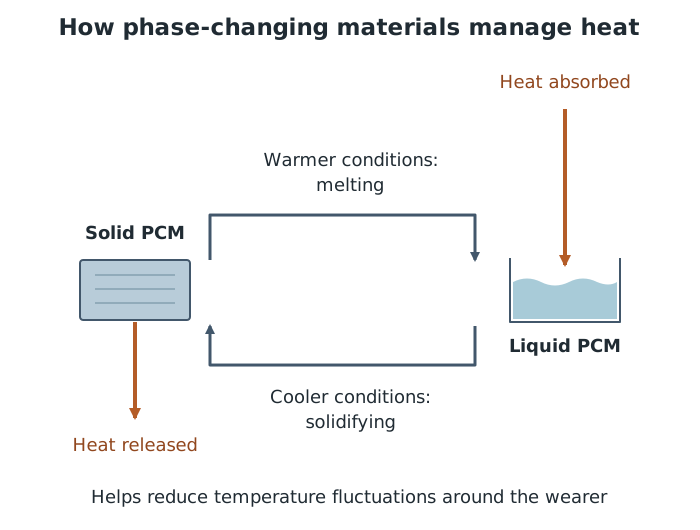
A phase-changing material absorbs heat as it melts and releases heat as it solidifies.
This is proactive heat management: the material responds as thermal conditions change, rather than simply providing a fixed insulating layer. The key mechanism is the exchange of heat during the change of state, not merely that the material becomes warm or cool.
Moisture management addresses a different problem. Water vapour from perspiration needs to escape so that clothing does not trap moisture next to the body. A breathable material allows this vapour to pass through.
Gore-Tex is an example used in outdoor clothing. It incorporates a thin membrane between an outer material and a lining. It allows water vapour to escape while preventing rainwater from passing through, combining breathability with waterproof protection. This makes it useful for walking jackets, ski wear, gloves and boots. A garment can therefore use different textile technologies to manage heat, perspiration and weather protection.
Sun-protective clothing reduces the amount of UV radiation reaching the skin. Its fabric structure provides protection, and some fabrics receive UV-inhibiting treatments during manufacture. Fabrics are rated for their level of UV protection. A colour-changing print responds to UV, but this does not by itself mean the garment provides sun protection.
Nomex has excellent thermal resistance, as well as chemical and radiation resistance for a polymer material. It is used where there is a high risk of fire exposure, such as protective clothing for firefighters or racing drivers. Its value is protection against heat and flame, not temperature regulation for everyday comfort.
Rhovyl contains an antibacterial agent integrated into the fibre. This inhibits bacterial growth, making it useful in clothing worn close to the body, such as socks. It also has fire-retardant properties. Antibacterial performance is different from absorbency: one limits bacterial growth, while the other concerns taking up moisture.
Geotextiles are permeable fabrics used with soil. Permeable means that water can pass through them. They are commonly made from polypropylene or polyester and may be woven, needle-punched or heat-bonded.
Their functions include separating materials, filtering, reinforcing, protecting and draining. For example, a geotextile can separate soil from an aggregate layer while allowing water to pass through. Its filtering function allows water through while retaining soil particles, helping prevent those particles from moving into a drainage layer.
Material selection depends on the task. A heart-rate garment needs integrated sensing and conductive pathways; outdoor clothing needs suitable moisture and weather protection; a landscaping fabric needs the right permeability and strength. The useful property is the one that solves the product’s particular problem.
Link the named textile to a specific property and then to the benefit for the product or wearer.
Distinguish photo-chromic responses to UV radiation from thermo-chromic responses to temperature.
For phase-changing materials, melting absorbs heat; solidifying releases heat.
Breathable means water vapour can escape. It does not mean that rain can pass through.
Microfibres are very fine fibres; micro-encapsulation involves tiny capsules containing another substance.
It can see this note and what your specification asks for.
Answers are free with an account.
1 free note left this week
Get more free notesYour answer sets when this note comes back for review, or marks it complete.
Was this note helpful?
Log in to tell us whether it helped, or to report a problem.
Last updated
Technical textile
A textile engineered to perform a particular task beyond the conventional functions of fabrics, such as monitoring health or protecting against heat.
Smart textile
A fibre or fabric that responds to a stimulus, such as temperature, UV radiation or rubbing.
Photo-chromic
Describes a material that changes colour when exposed to ultraviolet (UV) radiation.
Thermo-chromic
Describes a material that changes colour in response to heating or cooling.
Micro-encapsulation
Enclosing substances in tiny capsules incorporated into a textile, allowing their contents to be released when the capsule walls break.
Biometric textile
A textile incorporating technology that measures a wearer’s biological information, such as heart rate.
Conductive fibre
A fibre capable of carrying an electrical current, allowing electronic components to be connected within a textile.
E-textile
A textile with electronic components or circuits integrated into it.
Microfibre
A very fine synthetic fibre used to make fabrics with selected properties, such as softness, absorbency or rapid drying.
Phase-changing material
A material that absorbs heat as it melts and releases heat as it solidifies, helping to manage temperature.
Breathability
The ability of a material to allow water vapour from the body to escape.
Nomex
A heat-resistant synthetic fibre used in protective textiles for situations with a high risk of fire exposure.
Geotextile
A permeable textile used with soil to separate, filter, reinforce, protect or drain in landscaping and construction.
Rhovyl
A fibre containing an antibacterial agent that inhibits bacterial growth; it also has fire-retardant properties.
Put your knowledge into practice — try past paper questions for Design and Technology
Technical textile
A textile engineered to perform a particular task beyond the conventional functions of fabrics, such as monitoring health or protecting against heat.
Smart textile
A fibre or fabric that responds to a stimulus, such as temperature, UV radiation or rubbing.
Photo-chromic
Describes a material that changes colour when exposed to ultraviolet (UV) radiation.
Thermo-chromic
Describes a material that changes colour in response to heating or cooling.
Micro-encapsulation
Enclosing substances in tiny capsules incorporated into a textile, allowing their contents to be released when the capsule walls break.
Biometric textile
A textile incorporating technology that measures a wearer’s biological information, such as heart rate.
Conductive fibre
A fibre capable of carrying an electrical current, allowing electronic components to be connected within a textile.
E-textile
A textile with electronic components or circuits integrated into it.
Microfibre
A very fine synthetic fibre used to make fabrics with selected properties, such as softness, absorbency or rapid drying.
Phase-changing material
A material that absorbs heat as it melts and releases heat as it solidifies, helping to manage temperature.
Breathability
The ability of a material to allow water vapour from the body to escape.
Nomex
A heat-resistant synthetic fibre used in protective textiles for situations with a high risk of fire exposure.
Geotextile
A permeable textile used with soil to separate, filter, reinforce, protect or drain in landscaping and construction.
Rhovyl
A fibre containing an antibacterial agent that inhibits bacterial growth; it also has fire-retardant properties.
Conductive fibres connect integrated electronic components. Applications include heart-rate monitors, mobile-phone and music-player electronics, and GPS tracking systems.