

Loading…
Loading…
Loading…
Eduqas GCSE Design and Technology · C600
Eduqas C600 · Impact of Design and Technology Check the specification (PDF) (opens in a new tab)
A product can work well for its owner while creating problems elsewhere. A cotton T-shirt provides comfortable clothing, but growing cotton can use considerable water and pesticides. Making, dyeing and transporting the shirt creates further impacts, and replacing it frequently increases demand for more materials.
Sustainability means meeting today’s needs without compromising the ability of future generations to meet their needs. Designers therefore consider not only what a product does, but how it uses resources, affects people and eventually becomes waste.
Many resources are finite. Most conventional plastics are made from oil, a non-renewable resource. Recovering and reprocessing materials can reduce the demand for new resources. Energy use also matters: burning fossil fuels to power manufacturing, transport or product use releases carbon dioxide, contributing to climate change.
Sustainable design is not simply choosing a material described as ‘green’. A product must still be safe, useful and suitable for its users. A durable, repairable product may use more material initially but avoid several replacements over its working life.
Life Cycle Analysis (LCA) assesses environmental impacts across a product’s whole life. It helps a designer identify where damage occurs and where a change would be most useful. This is different from the commercial Product Life Cycle, which concerns a product’s progress in the market.
The main stages are obtaining and processing raw materials, manufacture, packaging and distribution, use and maintenance, and end of life. At each stage, consider inputs such as materials, energy and water, alongside outputs such as emissions, pollution and waste.
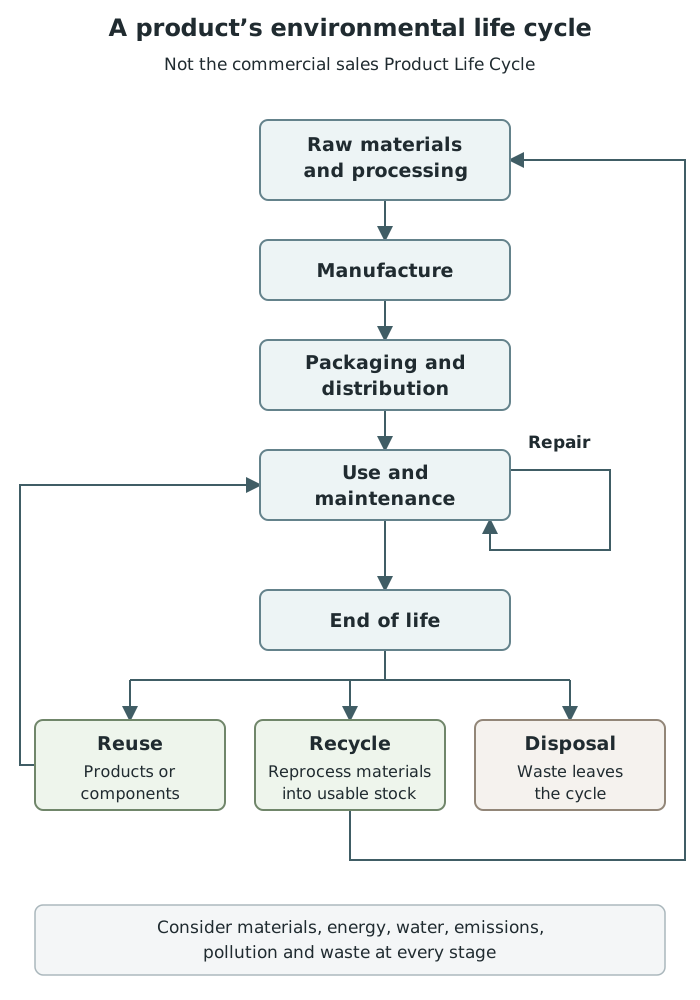
Life Cycle Analysis considers impacts at every stage. Repair, reuse and recycling can keep products or materials in use, but each route also has impacts.
Consider a wooden chair:
| Life stage | What to investigate | Possible design response |
|---|---|---|
| Raw materials | Where does the timber come from? Does harvesting damage habitats? | Specify timber from well-managed forests. |
| Manufacture | How much energy is used in cutting and finishing? How much timber becomes waste? | Plan cutting efficiently and consider whether each finish is necessary. |
| Packaging and distribution | How much packaging is needed? How much space does the chair occupy during transport? | Use protective but minimal packaging; consider flat-pack construction. |
| Use and maintenance | Will joints remain strong? Can damaged parts be replaced? | Use durable construction and accessible, replaceable fixings. |
| End of life | Can the chair be taken apart? Can materials and components be recovered? | Design for disassembly and avoid unnecessarily mixing materials permanently. |
To carry out a useful analysis, first identify the product and the service it provides. Then trace its stages, record the likely impacts, identify the most significant problems and recommend changes. Where quantities are available, they can help compare alternatives. Without them, explain the likely effects rather than claiming an exact reduction.
Comparisons must be fair. Comparing one disposable container with one reusable container ignores the reusable container’s repeated uses. Its manufacture and cleaning must be considered alongside the disposable containers it replaces.
An improvement at one stage can create a problem at another. Reducing packaging saves material, but if the product is damaged in transit, replacing it may cause greater waste. Similarly, local manufacture can reduce transport distance but does not guarantee a lower overall impact if its production process uses much more energy.
The six Rs offer different ways to reduce resource use, waste and harm to people. They are strategies to consider, not six compulsory steps in a fixed order.
Rethink asks whether the product is needed and whether the need could be met differently. Instead of designing a cheap appliance that is replaced whenever it fails, a designer could develop a longer-lasting version with replaceable components.
Refuse means rejecting unnecessary or harmful choices. A consumer can refuse an unwanted disposable carrier bag; a designer can refuse excessive packaging that adds no useful protection.
Reduce means using less material and energy. A bottle could have thinner walls, provided it remains strong enough. Efficient cutting layouts reduce offcuts, while lighter products can reduce transport loads. Reduction must not compromise safety or function.
Reuse keeps a product or component in use without reprocessing its material. A jar can become a storage container, or a wooden pallet can be converted into furniture. Reusing components also avoids making replacements from new materials.
Repair restores a faulty product so it can keep working. Designers can support this through accessible parts, standard screws, spare components and repair instructions. Replacing one broken part rather than the whole product delays disposal.
Recycle reprocesses waste material into material for new products. Aluminium, glass, paper and some plastics can be recycled. Designers can make recovery easier by using fewer material types and allowing them to be separated.
Reuse and recycling are not the same: using a glass jar for storage is reuse; processing its glass to make new glass products is recycling. Recycling still requires collection, sorting and energy, so it does not remove the need to reduce waste or extend product life.
Designers, manufacturers and consumers make different decisions, but all influence sustainability. Designers specify materials, construction and repairability. Manufacturers control production methods and working conditions. Consumers decide what to buy, how to maintain it and when to replace or dispose of it.
These decisions carry several connected responsibilities:
These responsibilities can conflict. Recycled materials or better working conditions may increase production costs. However, choosing the cheapest option without considering its effects can transfer costs to workers, communities or the environment. A responsible decision explains how these competing needs have been balanced.
Fair trade aims to improve producers’ pay, working conditions and long-term opportunities, particularly where producers have limited bargaining power. Fair-trade policies guide purchasing decisions towards fair treatment rather than price alone.
For a cotton T-shirt, ethical sourcing means considering the people growing the cotton as well as those making the garment. Relevant concerns include fair wages, reasonable working hours, safe conditions and avoiding child labour. Fair-trade sourcing can support livelihoods and give customers confidence in the purchasing decision, although the product may cost more.
Fair trade is not a complete environmental assessment. Better treatment of producers does not remove the need to investigate water use, dyeing processes, transport or disposal. Social and environmental responsibilities must both be considered.
A carbon footprint concerns greenhouse gas emissions associated with a product or activity. For an electrical product, this includes emissions from making its materials, manufacturing and transporting it, supplying electricity during use, and managing it at end of life.
Designers can reduce these emissions through energy-efficient products and processes, less material, suitable lower-impact transport and longer product life. Transport distance matters, but distance alone cannot establish the total carbon footprint: the transport method and the rest of the life cycle also matter.
An ecological footprint measures demand on nature in terms of biologically productive land and sea area. It includes the area needed to provide renewable resources and absorb waste, particularly carbon dioxide. It can be compared with the biological capacity available to regenerate resources and absorb those wastes. It is commonly expressed in global hectares.
The distinction is emissions versus productive area. Carbon footprint focuses on greenhouse gases; ecological footprint expresses demands on biological capacity. Ecological footprint is not a complete measure of every environmental problem: it does not directly measure biodiversity loss or freshwater consumption. LCA therefore considers other impacts as well.
New technology is not automatically sustainable or ethical. A designer should compare its benefits and drawbacks for the intended product, the people affected and the conditions in which it will be used.
For example, 3D-printed prosthetic limbs can offer customisation to suit an individual user. That may improve usefulness and access to a suitable product. However, a designer must also consider affordability, access to equipment and skills, the availability of repairs, and what happens to the materials at end of life. A promising production method is not enough if the finished product cannot be maintained.
Contemporary decisions concern what is workable now. Potential future scenarios ask how the decision would perform if circumstances changed. For example, a product with replaceable components may remain useful when technology develops, rather than requiring complete replacement. Its value depends on compatible parts remaining available.
A justified conclusion brings the evidence together: choose the technology if it meets user needs safely and affordably while offering worthwhile social and environmental benefits. Where drawbacks remain, identify design changes or conditions needed to make the choice responsible.
Meet today’s needs without compromising future generations. Balance social, cultural, economic and environmental responsibilities with function and safety.
Rethink, reuse, recycle, repair, , .
Link each impact to a specific product, material or design decision: explain who or what is affected and why.
Distinguish reuse from recycling: reuse keeps a product or component in use; recycling reprocesses its material.
For Life Cycle Analysis, consider the whole life, not just manufacture or disposal.
When evaluating, weigh benefits against drawbacks and give a justified conclusion that considers function, safety, cost and user needs.
Do not assume that natural, local or recycled automatically means more sustainable. Consider the complete life cycle and any trade-offs.
It can see this note and what your specification asks for.
Answers are free with an account.
1 free note left this week
Get more free notesYour answer sets when this note comes back for review, or marks it complete.
Was this note helpful?
Log in to tell us whether it helped, or to report a problem.
Last updated
Sustainability
Meeting today’s needs without compromising the ability of future generations to meet their needs.
Life Cycle Analysis
An assessment of a product’s environmental impacts from obtaining raw materials through manufacture, distribution and use to the end of its life.
Rethink
Questioning whether a product is needed and whether a different design approach could better meet people’s needs with less environmental impact.
Reuse
Using a product or component again, for its original purpose or another purpose, without reprocessing its material.
Recycle
Reprocessing waste material so that it can be made into new materials or products.
Repair
Fixing a faulty or damaged product so that it can continue to be used.
Reduce
Using less material or energy and producing less waste.
Refuse
Choosing not to buy an unnecessary product or use a material or product that harms people or the environment.
Fair trade
A trading approach that aims to give producers fair pay, safer working conditions and better long-term opportunities.
Carbon footprint
The total greenhouse gas emissions associated with a product, process or activity, including emissions across its life cycle.
Ecological footprint
The biologically productive land and sea area needed to supply the resources used by a population or activity and absorb its waste, particularly carbon dioxide emissions.
Social impact
The effect of a product or process on people, including workers, users and local communities.
Put your knowledge into practice — try past paper questions for Design and Technology
Sustainability
Meeting today’s needs without compromising the ability of future generations to meet their needs.
Life Cycle Analysis
An assessment of a product’s environmental impacts from obtaining raw materials through manufacture, distribution and use to the end of its life.
Rethink
Questioning whether a product is needed and whether a different design approach could better meet people’s needs with less environmental impact.
Reuse
Using a product or component again, for its original purpose or another purpose, without reprocessing its material.
Recycle
Reprocessing waste material so that it can be made into new materials or products.
Repair
Fixing a faulty or damaged product so that it can continue to be used.
Reduce
Using less material or energy and producing less waste.
Refuse
Choosing not to buy an unnecessary product or use a material or product that harms people or the environment.
Fair trade
A trading approach that aims to give producers fair pay, safer working conditions and better long-term opportunities.
Carbon footprint
The total greenhouse gas emissions associated with a product, process or activity, including emissions across its life cycle.
Ecological footprint
The biologically productive land and sea area needed to supply the resources used by a population or activity and absorb its waste, particularly carbon dioxide emissions.
Social impact
The effect of a product or process on people, including workers, users and local communities.
Reuse retains a product or component; recycling reprocesses its material. Repair and durability delay replacement and disposal.
Raw materials → manufacture → packaging and distribution → use and maintenance → end of life.
At each stage, assess materials, energy, water, emissions, pollution and waste. Identify significant impacts and recommend improvements. Compare alternatives providing the same service; check that improvements do not shift problems elsewhere.
Neither fair trade nor a low carbon footprint proves that every sustainability issue has been addressed.
Weigh benefits against drawbacks for users, workers, communities and the environment. Consider present conditions and possible future changes, including repair and component availability. Finish with a justified design decision.