

Loading…
Loading…
Loading…
Eduqas GCSE Design and Technology · C600
Eduqas C600 · Impact of Design and Technology Check the specification (PDF) (opens in a new tab)
A designer needs to consider both where energy comes from and how it reaches the product. A factory needs power for production machinery; a vehicle needs energy for movement; a household product might need electricity for light, heat or communication.
Generation means converting energy into a useful form, commonly electricity. A generator converts mechanical movement into electrical energy. Storage means keeping energy available for later use. Neither process creates energy from nothing.
A wind turbine can generate electricity while the wind blows. A storage system can keep some of that energy for a time when it is needed. This distinction matters because having an energy source does not necessarily mean having power available at the right moment.
A renewable energy source is replenished naturally. Wind, solar, geothermal, hydroelectric, wood/biomass and wave energy are renewable sources. Biomass needs particular care: replacement plants must be grown if the supply is to be maintained.
A non-renewable energy source exists in finite amounts and cannot be replaced on a human timescale. Coal, oil, gas and nuclear fuels belong to this group. Coal, oil and gas are fossil fuels; nuclear fuel is not.
Renewables are often called ‘green’ energy, but this does not mean every renewable installation is harmless. Its location, construction, land requirements and effects on wildlife still matter.
Wind power uses moving air to turn turbine blades. A transmission shaft connects this movement to a generator. Wind turbines can supply electricity without burning fuel during operation, but their output depends on wind conditions. Installation is expensive, some people object to their appearance, and turbines can affect wildlife, particularly birds.
Solar power can be used in different ways. Passive solar design positions a building to gain heat from sunlight, for example through south-facing windows. A photovoltaic cell converts light directly into electricity; a solar panel combines cells to provide a useful electrical output.
Photovoltaic panels are most productive in strong sunlight. They can still generate some electricity on cloudy days, but do not generate from sunlight at night. Location and exposure therefore affect the suitability of solar power. Panels also require space. Roof-mounted panels make use of existing buildings rather than occupying additional land, although the available roof area limits the installation. There is no fuel to buy during operation, but installation and any storage system add costs.
Hydroelectricity uses water to drive turbines connected to generators. In a dam system, a dam blocks a valley to hold water in a reservoir. Water is then channelled through turbines, which turn generators to produce electricity.
Where sufficient stored water is available, hydroelectric generation provides a controllable supply and can start quickly when demand rises. It requires no purchased fuel and produces no carbon dioxide from burning fuel during operation. However, suitable sites are limited. Creating a reservoir may flood a large area, damaging habitats and affecting wildlife. A reliable water supply must therefore be weighed against the effects of building the dam and reservoir.
Wave energy uses the movement of the sea. The up-and-down motion can operate rams or pistons, or compress air that is forced through a turbine. Waves vary in size and power, so choosing an effective position is important. Wave installations generate without burning fuel, but are expensive and can affect coastal environments and marine life.
Geothermal energy uses heat within the Earth. In suitable locations, hot rock heats water underground; deeper resources may require drilling. The heat can be used to produce steam that drives a turbine and generator. Geothermal energy avoids relying on sunlight or wind and can provide a reliable supply, but suitable locations are limited and accessing the heat can be costly. Some geothermal developments also carry a risk of triggering earthquakes, so the site's geology matters.
These sources show why an energy choice must consider the place as well as the technology. A source that suits one manufacturing site may be impractical at another.
Biomass is plant or animal material used as an energy source. Wood and crops such as willow can be burnt to produce heat. Decaying organic material can also be used to provide energy. Some used vegetable oils can be processed into fuel suitable for diesel engines, including delivery vehicles and small-scale electricity generation.
Growing replacement crops can maintain a supply, and using waste material can reduce reliance on fossil fuels. Unlike wind or solar generation, stored biomass fuel can be burnt when needed. However, burning biomass causes atmospheric pollution, so pollution-control measures are needed. Land devoted to energy crops could instead grow food, and harvesting crops can damage habitats. Biomass is therefore not an unlimited or automatically pollution-free solution.
Coal, oil and gas store energy chemically. In a steam-based power station, the fuel is burnt to heat water and produce steam. The steam turns a turbine, and the turbine turns a generator, which produces electricity. The turbine supplies the movement; the generator converts that movement into electrical energy.
Fossil-fuel power stations can provide a controllable supply and large power output at relatively low cost. That is useful when a factory needs power throughout a working shift rather than only when the weather is favourable.
However, coal, oil and gas are finite resources. Their extraction and processing can damage environments and produce pollution. Burning them releases carbon dioxide, a greenhouse gas that contributes to climate change. Some fossil fuels, particularly coal and oil containing sulphur, also release sulphur dioxide, an air pollutant.
The choice is therefore a trade-off: an established, controllable supply is useful, but continued use consumes finite resources and maintains the environmental problems associated with extraction and combustion.
A nuclear power station uses a nuclear fuel such as uranium. A nuclear reaction in a reactor releases heat, which heats water to produce steam. The steam turns a turbine, which drives a generator. The turbine–generator pathway is similar to a steam-based fossil-fuel station, but the heat comes from a nuclear reaction rather than burning fuel.
Nuclear stations can provide a reliable supply and large power output without releasing greenhouse gases from fuel combustion during generation. They do not depend on wind or daylight.
However, nuclear fuel is non-renewable. Radioactive waste is harmful and must be stored safely for a long time. Nuclear stations are also expensive to build and commission, and to decommission safely at the end of their working lives. A steady supply alone does not settle whether nuclear power is the most appropriate choice.
A battery stores energy chemically and supplies electricity through chemical reactions. It provides electrical power where mains electricity is unavailable, making it useful in portable household products and vehicles.
Disposable batteries, such as many alkaline batteries used in torches, clocks and toys, are mainly single-use. They are convenient and can have a long shelf life, but must be replaced when depleted. Repeated replacement creates waste and requires more batteries to be manufactured. Used batteries should go through suitable collection and recycling schemes.
Rechargeable batteries receive electrical energy during charging, restoring their chemical energy store for later use. They can be used repeatedly in small electronic devices and large vehicles. Their higher initial cost can be offset by avoiding repeated purchases, and repeated use reduces the need to manufacture and dispose of replacement batteries.
Rechargeable batteries still have a limited operating time between charges and need access to a charger and electricity. For an electric vehicle, suitable battery storage and access to charging facilities are important constraints. The battery does not determine whether the original energy source was renewable: that depends on how the charging electricity was generated.
A storage system receives energy first and releases it later. It can help when demand increases quickly or when a product cannot remain connected to a supply. It does not replace the need for an original energy source.
A flywheel stores energy in a heavy spinning mass. Energy is transferred to it to make it rotate faster; it slows as stored energy is released. Low-friction bearings reduce energy losses. Flywheel systems have been used in buses, including systems that store energy during braking.
A wind-up mechanism stores energy in a spring. Turning a key or handle deforms the spring; as it unwinds, gears control the release of energy and produce movement. This is used in toys and other mechanical devices. The user supplies the energy, so the mechanism does not need a disposable battery, but it must be wound again when its stored energy runs out.
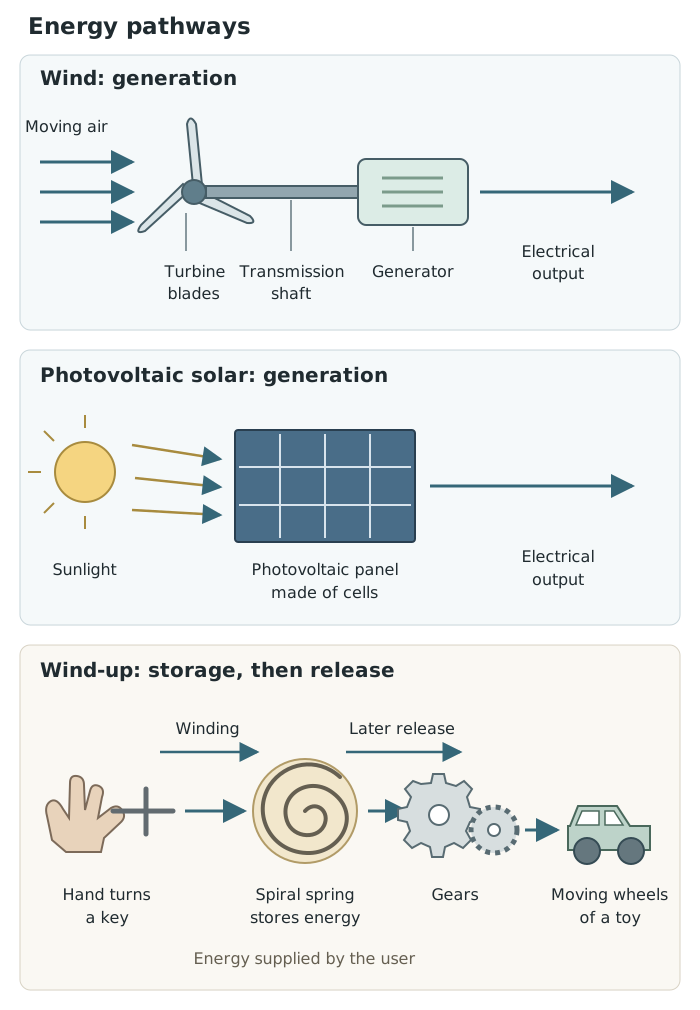
Wind and photovoltaic systems generate electricity; a wind-up spring stores energy supplied by the user and releases it through gears.
The three pathways distinguish a natural energy input from a storage mechanism. Sunlight and wind supply energy from the environment; a wind-up product first receives energy from its user.
In a petrol or diesel vehicle, fuel is stored in a tank until needed. Both fuels are derived from oil and store energy chemically. An internal combustion engine burns fuel inside the engine, converting stored chemical energy into mechanical movement. The transmission transfers this movement to the wheels. A petrol engine typically ignites a fuel–air mixture using a spark; a diesel engine uses compression ignition.
Fuel storage allows the vehicle to carry its energy supply, but burning petrol or diesel produces exhaust emissions and uses a non-renewable resource. A conventional vehicle also has a battery to start the engine and power electrical equipment; this is different from using a battery as the main energy store for driving.
In a battery-electric vehicle, a rechargeable battery stores energy received during charging. It supplies electricity to an electric motor, which produces movement to drive the wheels. There is no petrol or diesel combustion in the vehicle and no exhaust emissions from that combustion. However, its wider environmental impact depends partly on how the charging electricity is generated. The vehicle must also have enough stored energy for the journey and access to charging when required.
The key comparison is fuel tank → engine → wheels versus rechargeable battery → electric motor → wheels. Both vehicles carry stored energy; they convert and use it in different ways.
A manufacturing site can fit solar panels to its roof or use wind turbines to supply electricity for production. This can reduce reliance on fossil-fuel electricity and uses renewable inputs. However, neither installation guarantees that output will match the factory's demand throughout the day. Storage or another supply may be needed, and installation costs, space and local conditions must be considered.
For example, roof-mounted photovoltaic panels can use a factory's existing roof area without taking additional land. They may contribute electricity during a daytime shift, but cannot alone maintain production after dark. A wind turbine may complement them at a suitably windy site, although wind is also variable. A justified recommendation would consider both the renewable contribution and how uninterrupted production will be maintained.
For a small outdoor product, photovoltaic cells may be appropriate because light is available where the product operates. If the product must work after dark, solar generation alone is insufficient: energy must have been stored or another supply provided.
For a portable mechanical toy, a wind-up spring avoids charging equipment and disposable batteries. Its disadvantages are the effort of winding and the limited time before rewinding is needed.
For a household appliance used in one place, mains electricity provides a continuing supply without routine battery replacement. Mains is a way of delivering electricity, not an original energy source: that electricity may have been generated using renewable or non-renewable sources. For a portable household product, batteries allow movement away from a socket, but their stored energy is limited.
A justified choice begins with the task: how much power is needed, for how long, where the product operates and whether interruptions are acceptable. Then weigh running and installation costs, environmental effects, space, portability and the practicalities of storage. There is no single best source for every product or system.
Separate the original energy source from the storage device: a rechargeable battery stores energy supplied during charging.
Nuclear energy is non-renewable, but it is not a fossil fuel. Coal, oil and gas are fossil fuels.
Renewable does not mean pollution-free: burning wood or other biomass produces atmospheric pollution.
For an evaluation, connect each advantage or disadvantage to the product or site, then justify your choice. Cost alone is rarely enough.
Distinguish photovoltaic cells, which produce electricity, from a wind-up spring, which stores energy transferred by the user.
It can see this note and what your specification asks for.
Answers are free with an account.
1 free note left this week
Get more free notesYour answer sets when this note comes back for review, or marks it complete.
Was this note helpful?
Log in to tell us whether it helped, or to report a problem.
Last updated
Renewable energy source
An energy source replenished naturally, such as sunlight, wind or biomass that is regrown.
Non-renewable energy source
An energy source available in finite amounts that cannot be replaced on a human timescale.
Fossil fuel
Coal, oil or natural gas: a finite fuel formed from ancient organic material.
Photovoltaic cell
A device that converts energy from light directly into electrical energy.
Turbine
A rotating device driven by moving air, water or steam, which can drive a generator.
Generator
A device that converts mechanical movement into electrical energy.
Biomass
Plant or animal material used as an energy source, including wood and specially grown crops.
Hydroelectricity
Electricity produced when flowing or falling water drives turbines connected to generators.
Battery
A device that stores energy chemically and supplies electricity through chemical reactions.
Rechargeable battery
A battery whose chemical energy store can be restored by supplying electrical energy during charging, allowing repeated use.
Internal combustion engine
An engine that burns fuel inside it to produce mechanical movement.
Flywheel
A heavy rotating component that stores energy in its spinning motion.
Clockwork
A mechanism that stores energy in a wound spring and releases it through gears to produce movement.
Put your knowledge into practice — try past paper questions for Design and Technology
Renewable energy source
An energy source replenished naturally, such as sunlight, wind or biomass that is regrown.
Non-renewable energy source
An energy source available in finite amounts that cannot be replaced on a human timescale.
Fossil fuel
Coal, oil or natural gas: a finite fuel formed from ancient organic material.
Photovoltaic cell
A device that converts energy from light directly into electrical energy.
Turbine
A rotating device driven by moving air, water or steam, which can drive a generator.
Generator
A device that converts mechanical movement into electrical energy.
Biomass
Plant or animal material used as an energy source, including wood and specially grown crops.
Hydroelectricity
Electricity produced when flowing or falling water drives turbines connected to generators.
Battery
A device that stores energy chemically and supplies electricity through chemical reactions.
Rechargeable battery
A battery whose chemical energy store can be restored by supplying electrical energy during charging, allowing repeated use.
Internal combustion engine
An engine that burns fuel inside it to produce mechanical movement.
Flywheel
A heavy rotating component that stores energy in its spinning motion.
Clockwork
A mechanism that stores energy in a wound spring and releases it through gears to produce movement.
Generation converts energy into a useful form; storage keeps energy for later use.
Justify choices using power demand, operating time, location, reliability, cost, environmental impact and storage needs.