

Loading…
Loading…
Loading…
Eduqas GCSE Design and Technology · C600
Eduqas C600 · Impact of Design and Technology Check the specification (PDF) (opens in a new tab)
Computer-aided design (CAD) means using computer software to design products. A designer can create a two-dimensional drawing, such as the outline of a component, or a three-dimensional model showing its shape. CAD is concerned with developing and communicating the design; it does not itself make the physical product.
Computer-aided manufacture (CAM) uses computer-controlled machinery to make products or parts. Digital designs are prepared as manufacturing instructions that tell the equipment what to do. Computer numerical control (CNC) describes machines whose movements and operations follow programmed numerical instructions. These instructions can specify where a machine moves and at what speed. Many machines use movement along X, Y and Z axes to position a tool or printing head relative to the material.
The connection between CAD and CAM allows a design developed on screen to become a manufactured object. However, this is not simply a matter of sending any picture to any machine: the design must be prepared in a form that the chosen equipment can use.
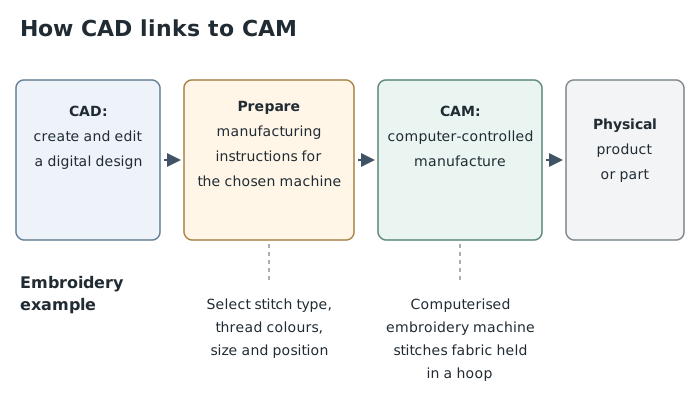
CAD develops the design; preparation turns it into instructions suitable for CAM equipment.
CAD allows dimensions to be specified accurately. This helps a designer communicate the intended size of a component clearly, which is important when parts must fit together. A design can also be edited without redrawing it from the beginning: changing a dimension or moving a feature makes it easier to develop and compare alternatives.
Three-dimensional models can be rotated to inspect a product from different viewpoints. Rendering applies colours and textures to show its proposed appearance; lighting can also help create a realistic presentation. This allows clients and users to give feedback before the product is made. Suitable software can simulate how an assembled product behaves, allowing designers to investigate problems before committing to manufacture.
Libraries of standard components save time because designers do not need to draw every familiar part again. Electronic files can be stored securely and shared with colleagues or manufacturers. Cloud-based sharing supports collaboration between people in different locations, including simultaneous development of different components, and can reduce the need to travel. The same digital design can then provide the starting point for a CAM-produced prototype. Together, these benefits can shorten the time needed to bring a product to market.
These benefits have costs. CAD software can be expensive to purchase and keep up to date, and powerful computers may be needed for complex 3D modelling and rendering. Designers need training and expertise to use the software efficiently. For quickly exploring initial ideas, pen and paper can be faster than constructing a CAD model.
A business must weigh the time saved through editing, checking and sharing designs against the cost of software, hardware and learning to use it. CAD is particularly valuable when a design needs repeated changes or detailed communication, but its benefits depend on skilled use.
CAM can produce parts accurately and consistently. When a machine repeats the same programmed operation, variation between parts can be reduced. This helps maintain product quality, especially when many matching components are needed.
Computer-controlled production can also be fast and can continue for long periods. Automation reduces the human intervention needed for repetitive operations, potentially lowering production costs over time. It can improve worker safety by reducing direct involvement in some manufacturing operations, although operators are still needed to set up, monitor and maintain equipment.
CAM can reduce material waste through accurate manufacture. Nevertheless, this is a potential benefit rather than a guarantee: a faulty design or incorrect set-up can still result in rejected products. Changing the digital instructions also supports flexible manufacture, allowing equipment to produce different designs or personalised versions rather than only identical products.
The disadvantages include high initial equipment costs, running costs and the need to train staff to programme and operate machines effectively. Regular servicing and maintenance add expense, while breakdowns can interrupt production and delay orders. Automation may also displace workers and reduce demand for traditional manufacturing skills.
For a business repeatedly making the same component, accurate and consistent CAM production may justify the investment. For a small quantity, the initial cost and preparation time may be harder to justify. However, this depends on the process: relatively affordable vinyl cutters and 3D printers can make some small-scale applications practical.
CNC embroidery uses computer-controlled stitching to apply a CAD design to textiles. Typical applications include school-uniform logos, branding and personalised garments with names or dates. Designs can be saved and shared for either short or long production runs.
An artwork file is prepared in embroidery software, where features such as stitch type, thread colours, size and position can be selected. The resulting embroidery design is transferred to the machine. Fabric is held in a hoop, and the machine follows the prepared design to stitch the pattern.
A manufacturer can therefore repeat a logo across many garments, or edit the design to personalise individual items. Computer control does not prevent customisation, although preparing and setting up each variation still takes time.
A vinyl cutter follows a CAD outline with a sharp blade, cutting a pattern into self-adhesive vinyl supplied on a roll. The colour comes from the vinyl loaded into the machine, rather than from the cutter printing colour onto it.
This process is useful for lettering and shapes used in signs or vehicle branding. For example, a business name can be designed digitally and cut from coloured adhesive vinyl. Vinyl cutters are relatively affordable CAM machines, making them common in schools as well as useful for commercial sign-making.
A CNC router uses a rotating cutting tool to remove material along a path determined by the digital design. It can produce grooves, shaped edges, cut-outs and signs in timber or manufactured board. It can also machine prototypes from materials such as polyurethane modelling foam.
The cutting tool determines the profile it produces, so changing the tool changes the shape of the cut. The instructions also control cutting depth; different colours in a CAD drawing can be assigned different cutting depths during preparation. The workpiece must be held securely because the rotating cutter applies force to it.
Routing is useful when a product needs more than a simple flat outline, such as a recessed feature or a shaped surface. Some CNC routers have attachments that rotate the workpiece, allowing more complex three-dimensional shapes to be machined.
A laser cutter directs a laser beam along a digitally controlled path. The beam cuts through or vaporises material to produce a high-quality, accurate cut. It can also engrave a design into the surface rather than cutting completely through it.
School machines commonly work with suitable thin sheet materials such as card, plywood and acrylic. Applications include decorative greetings cards, jigsaw pieces and acrylic components with engraved details. Some more powerful industrial machines can cut metal, but this does not mean every laser cutter can process every material or thickness.
Unlike a router or blade, the laser does not apply a mechanical cutting force to the workpiece. This makes it easier to hold the material and cut intricate patterns. The choice depends on whether the product needs a cut outline, surface engraving or both.
3D printing is additive manufacture: it builds a physical shape by adding material in layers rather than cutting material away. In a common filament-based process, a spool supplies polymer filament, which is heated and extruded through a moving head. The head deposits one layer following the prepared digital instructions, then its height relative to the build platform changes so the next layer can be added. In some printers, the bed moves down between layers.
The strength of the printed object depends on both the material used and its internal structure. A designer can use printing to create a physical prototype, such as a new handle, and test its shape and function before developing the final product.
Printing can avoid the expensive tooling needed by other plastic-manufacturing methods, making prototypes and small production runs practical. However, large objects or complex prints can take a long time, so 3D printing is not automatically the fastest choice for high-volume production.
Under Armour’s ArchiTech footwear illustrates this trade-off. Generative design, which uses mathematical algorithms to develop designs from set requirements, was used to develop a sole with a complex lattice structure for cushioning. 3D printing enabled this intricate structure to be manufactured, but the time taken to print each sole limited the scale of production.
CAD and CAM offer different benefits at different stages. CAD supports accurate design development, visualisation and communication; CAM supports controlled physical production. Their strongest advantage is often the link between the two, allowing design information to move into manufacture without recreating it entirely by hand.
A justified decision connects a benefit or limitation to a particular need. Embroidery suits a stitched logo on fabric; vinyl cutting suits adhesive lettering; routing suits a machined groove or shaped surface; laser cutting suits intricate sheet shapes and engraving; 3D printing suits a three-dimensional prototype built in layers.
The final judgement must also consider quantity, accuracy, cost, training and reliability. Repeatable production may justify investment for a large order, while equipment cost or slow processing may outweigh the benefits for another task. The best choice meets the product’s requirements within the practical constraints of the business.
| Technology | Advantages | Disadvantages |
|---|---|---|
| CAD | Accurate dimensions; easy editing; realistic presentation; user feedback; secure storage and collaboration; links to CAM | Software and update costs; powerful hardware; training and expertise; initial sketching may be quicker by hand |
| CAM | Accuracy and repeatability; fast, sustained production; potentially less waste; flexible manufacture | Equipment and running costs; training; maintenance and breakdown delays; displacement of traditional skills and workers |
| Process | Operation | Typical application |
|---|---|---|
| CNC embroidery | Programmed stitching into fabric | Uniform logos; personalised names |
| Vinyl cutting | Blade cuts self-adhesive vinyl; loaded vinyl determines colour | Signs; vehicle branding |
| CNC routing | Rotating cutter removes material along a programmed path | Grooves; shaped edges; machined prototypes |
| Laser cutting | Laser beam cuts or engraves material | Intricate card designs; jigsaws; acrylic parts |
| 3D printing | Adds material layer by layer | Working prototypes; small production runs |
Judge suitability using the product, quantity, accuracy required, budget, training and reliability. CAM is not always economical for small quantities, and 3D printing can be slow for large objects or high-volume production.
Distinguish CAD, which helps design a product, from CAM, which controls its manufacture.
Explain each advantage or disadvantage through its consequence: accurate repeat production can improve consistency; a machine breakdown can delay an entire batch.
Link your judgement to the product, quantity required, available budget and staff training rather than claiming that CAD or CAM is always the best choice.
Do not assume that computer control guarantees a correct product: an incorrect design or set-up can still produce faulty parts.
Distinguish the processes: embroidery stitches, vinyl cutting uses a blade, routing uses a rotating cutter, laser cutting uses a laser beam and 3D printing adds layers.
It can see this note and what your specification asks for.
Answers are free with an account.
1 free note left this week
Get more free notesYour answer sets when this note comes back for review, or marks it complete.
Was this note helpful?
Log in to tell us whether it helped, or to report a problem.
Last updated
Computer-aided design (CAD)
The use of computer software to create, edit and develop product designs, including two-dimensional drawings and three-dimensional models.
Computer-aided manufacture (CAM)
The use of computer-controlled machinery and manufacturing instructions derived from digital designs to make products or parts.
Computer numerical control (CNC)
The control of a machine’s movements and operations using programmed numerical instructions.
Automation
The use of machines or control systems to carry out processes with less human intervention.
Additive manufacture
The process of building a physical object by adding material layer by layer, as in 3D printing.
Rendering
The application of colours and textures to a digital drawing or model to communicate its proposed appearance.
Put your knowledge into practice — try past paper questions for Design and Technology
Computer-aided design (CAD)
The use of computer software to create, edit and develop product designs, including two-dimensional drawings and three-dimensional models.
Computer-aided manufacture (CAM)
The use of computer-controlled machinery and manufacturing instructions derived from digital designs to make products or parts.
Computer numerical control (CNC)
The control of a machine’s movements and operations using programmed numerical instructions.
Automation
The use of machines or control systems to carry out processes with less human intervention.
Additive manufacture
The process of building a physical object by adding material layer by layer, as in 3D printing.
Rendering
The application of colours and textures to a digital drawing or model to communicate its proposed appearance.