

Loading…
Loading…
Loading…
Edexcel GCSE Physical Education · 1PE0
Edexcel 1PE0 · 3.2.1 Check the specification (PDF) (opens in a new tab)
Sport provides competition and entertainment that people want to watch, read about and discuss. This interest creates opportunities for businesses to earn money. is the process of developing an activity or product to generate income and financial gain. In sport, it includes selling and attracting .
Commercialisation connects sport closely with the media, which communicate information and entertainment to large audiences, and with sponsors, which provide support in return for publicity. Here, ‘sport’ can mean an individual performer, a team, an event or a sporting organisation—not just a whole activity such as football.
Different types of media communicate sport in different ways:
These channels help a sport reach people beyond those attending an event. Meanwhile, sport supplies the media with content that attracts viewers, listeners and readers.
A media company may pay event organisers for broadcasting rights: permission to transmit coverage of an event. This brings income into sport. Coverage also raises the sport’s profile, making it more familiar to a wider audience and potentially attracting sponsors.
In return, a popular sporting event attracts an audience to the media company. That audience can generate income through subscriptions, newspaper sales or advertising. For example, fans may pay for a sports channel because it shows the competitions they want to watch.
The relationship therefore works in both directions: the media gain valuable sporting content, while sport gains exposure and revenue.
Sponsorship is support provided by a business to a performer, team, event or organisation, usually in return for publicity. It can take several forms: money, clothing and footwear, equipment, or facilities.
The sporting individual or organisation receives resources that can support training and competition. The sponsor receives exposure to an audience: its name or logo might appear on a team’s kit or at an event. This can raise awareness of the business and attract potential customers.
For example, suppose a business supplies a football team’s kit with its logo on the shirts. The team receives clothing, while people watching the team see the business’s name. Sponsorship can operate at local as well as elite levels; it is not restricted to famous professional performers.
Media coverage can greatly extend a sponsor’s exposure. A logo on a shirt may be seen by spectators at the ground, but televised coverage can show it to a much larger audience. This makes widely covered sports attractive to businesses seeking publicity.
Businesses can also pay media companies for advertising slots during sporting broadcasts or sponsor a programme. The business gains access to the audience, while the media company earns income. Paying for an advertising slot is distinct from sponsoring a team, although both use interest in sport to promote a business.
The three-way relationship between sport, sponsorship and the media is called the golden triangle. Each side depends on what the others provide.
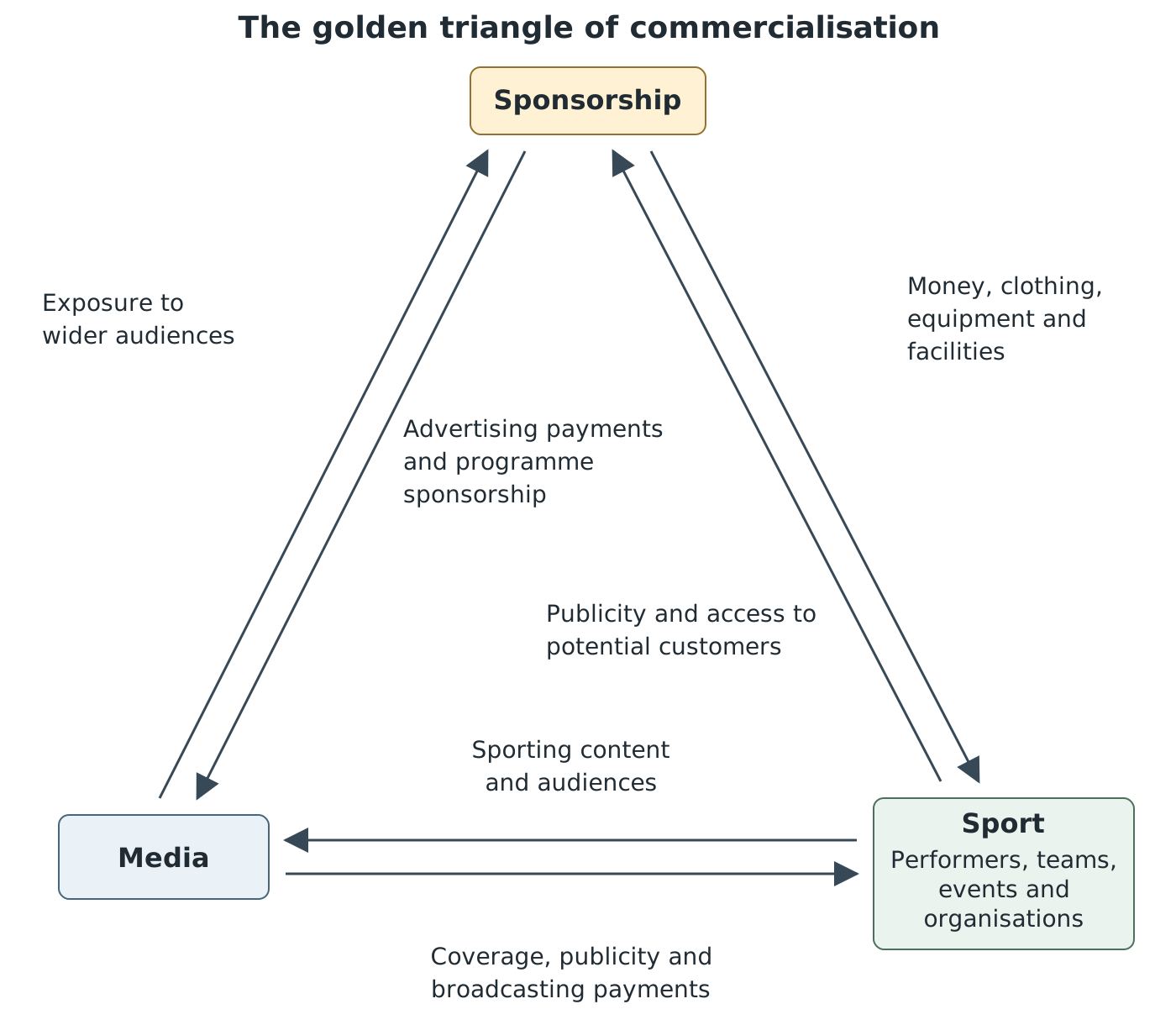
Each side of the golden triangle exchanges something valuable with the other two.
The links can reinforce one another. A popular event attracts media coverage; coverage increases exposure for sponsors; sponsorship and broadcasting payments provide funds for sport. Those funds can support the sporting activity that attracts audiences in the first place.
This is not an automatic guarantee that every sport receives equal funding or coverage. The commercial relationship depends partly on how attractive its audience is to media companies and sponsors. The central connection is the exchange of sporting content, money, resources and publicity.
Sport ↔ Media ↔ Sponsorship ↔ Sport
Popular sport → larger media audience → greater sponsor exposure → potential commercial income and investment in sport.
Remember: commercialisation is the wider income-generating process; sponsorship is one part of it.
When explaining a relationship, show both directions: what each party provides and what it receives.
Link media coverage to audience size, sponsor exposure and potential sales rather than simply saying that it ‘makes money’.
Sponsorship is not always a cash payment: clothing, footwear, equipment and facilities can also be provided.
Apply the relationship to the sport or performer in the question rather than just naming the golden triangle.
It can see this note and what your specification asks for.
Answers are free with an account.
1 free note left this week
Get more free notesYour answer sets when this note comes back for review, or marks it complete.
Was this note helpful?
Log in to tell us whether it helped, or to report a problem.
Last updated
Commercialisation
The process of developing an activity or product to generate income and financial gain. In sport, this includes selling broadcasting rights and attracting sponsorship.
Media
The channels used to communicate information and entertainment to large audiences, including television, radio, newspapers, the internet and social media.
Sponsorship
Support provided by a business to a performer, team, event or organisation, usually in return for publicity. Support can include money, clothing, equipment or facilities.
Golden triangle
The three-way relationship between sport, sponsorship and the media, in which each helps support the others.
Broadcasting rights
Permission to transmit coverage of an event, which media companies may purchase from its organisers.
Put your knowledge into practice — try past paper questions for Physical Education
Commercialisation
The process of developing an activity or product to generate income and financial gain. In sport, this includes selling broadcasting rights and attracting sponsorship.
Media
The channels used to communicate information and entertainment to large audiences, including television, radio, newspapers, the internet and social media.
Sponsorship
Support provided by a business to a performer, team, event or organisation, usually in return for publicity. Support can include money, clothing, equipment or facilities.
Golden triangle
The three-way relationship between sport, sponsorship and the media, in which each helps support the others.
Broadcasting rights
Permission to transmit coverage of an event, which media companies may purchase from its organisers.