Loading…


Loading…
Loading…
Loading…
Edexcel GCSE Combined Science · 1SC0
Edexcel 1SC0 · Newton's laws and weight Check the specification (PDF) (opens in a new tab)
A force can change an object's motion, but the effect depends on all the forces acting on it together. The resultant force is the single force equivalent to their combined effect. Direction matters: forces in the same direction add, while opposing forces subtract. For example, a driving force of forwards and resistance of backwards give a resultant force of forwards.
Velocity means speed in a specified direction. Acceleration is the rate of change of velocity, so an object accelerates when it speeds up, slows down or changes direction. It does not have to become faster.
Newton's first law states that an object remains at rest or continues moving at constant velocity unless a non-zero resultant force acts on it.
When forces balance, the resultant force is zero and there is no acceleration. A book resting on a table has a downward gravitational force balanced by an upward contact force from the table. A car travelling at constant velocity has a forward driving force balanced by friction and air resistance. Both objects have forces acting on them, but neither changes its velocity.
A moving object does not need a resultant force to keep moving. A bicycle slows when the rider stops pedalling because friction and air resistance produce a backward resultant force. Without that resultant force, it would continue at constant velocity.
A non-zero resultant force causes acceleration in the direction of the resultant force. A forward resultant can make a moving car speed up; a backward resultant can make it slow down. A force acting across the direction of travel can change the direction of motion.
In free fall, gravity is the only force acting: air resistance is absent or negligible. Near Earth's surface, use the acceleration due to gravity:
This means a falling object's downward velocity increases by about every second. Without air resistance, objects of different masses have the same acceleration.
To estimate an everyday acceleration, estimate the change in velocity and divide it by the time taken. A typical family car might increase its speed from rest to about in , giving an average acceleration of : a few metres per second squared, smaller than free-fall acceleration.
For a simple walking estimate, suppose someone starts from rest and reaches in . Their average acceleration would be . These estimates are not fixed values for every person or vehicle; they help you judge a sensible magnitude.
Newton's second law connects resultant force, mass and acceleration:
Here, is resultant force in newtons, is mass in kilograms and is acceleration in metres per second squared. One newton gives a mass of an acceleration of .
For a fixed mass, doubling the resultant force doubles the acceleration: acceleration is directly proportional to resultant force. For a fixed resultant force, doubling the mass halves the acceleration: acceleration is inversely proportional to mass.
The equation can be rearranged to find either acceleration or mass:
For example, a van has a driving force of and resistance of . First find the resultant: forwards. Then forwards. The driving force alone would give the wrong answer because resistance also acts.
For example, a trolley accelerating at requires a resultant force of . If an object instead accelerates at under a resultant force, its mass is .
A trolley attached by a light string to hanging masses can be used to investigate Newton's second law. The string passes over a pulley, so the falling masses pull the trolley along a runway. A motion sensor and data logger can record a velocity–time graph; its gradient gives acceleration.
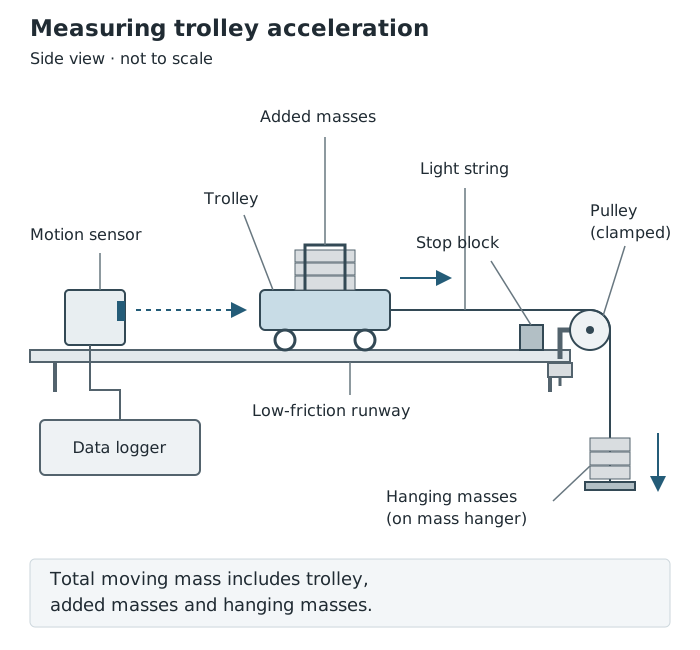
Keep the hanging mass fixed while adding masses to the trolley to investigate how acceleration depends on total moving mass.
Measure the masses using a balance. The mass being accelerated includes the trolley, any added masses and the hanger with its masses: they move together as one system. Secure the runway and pulley, keep the string taut and parallel to the runway, and use a stop block to prevent the trolley hitting the pulley. Keep feet clear of the falling hanger.
To investigate mass, keep the hanging mass unchanged and add known masses to the trolley. The hanging weight then provides approximately the same pulling force on the whole system, while its total mass increases.
Release the trolley from the same marked position without pushing it. Record its acceleration, repeat each measurement and calculate a mean. Repeat for several different added masses, recording the total moving mass each time. Keep the runway angle, pulley arrangement and release position unchanged.
At approximately constant resultant force, increasing the total moving mass decreases acceleration. An acceleration–mass graph is a downward curve; plotting acceleration against gives a straight line through the origin for the ideal relationship.
To investigate force, transfer masses from the trolley to the hanger rather than introducing extra masses. This increases the hanging weight while keeping the total moving mass constant. Repeat the acceleration measurements for each force. Ideally, an acceleration–resultant-force graph is a straight line through the origin.
Friction and pulley resistance oppose motion, so the hanging weight is not exactly the resultant force on the whole system. A low-friction runway helps the results approach the ideal relationships. Releasing consistently and repeating measurements improves the reliability of the comparison.
An object moving in a circular orbit at constant speed still has a continuously changing velocity because its direction continually changes. At each point, its velocity is along the tangent to the circle—the direction it is travelling at that instant.
Changing velocity means the object is accelerating. Circular motion therefore needs a non-zero resultant force towards the centre of the circle, called the centripetal force. This inward force continually turns the direction of motion rather than increasing the speed. Gravity provides the centripetal force for a satellite in orbit.
Centripetal force describes the role of the resultant force, not a new type of force. If the inward force disappeared, the object would travel along a straight-line tangent rather than continuing around the circle.
Inertial mass measures how difficult it is to change an object's velocity, including getting it moving from rest. It is defined as the ratio of resultant force to acceleration:
A larger inertial mass means a smaller acceleration for the same resultant force. An empty trolley is easier to accelerate than a heavily loaded trolley: the loaded trolley has greater resistance to a change in velocity.
Get unlimited access to all revision notes, key terms, and exam tips.
: resultant force in N; : mass in kg; : acceleration in .
Get unlimited access to all revision notes, key terms, and exam tips.
Use the resultant force in : subtract opposing forces before substituting.
Zero resultant force means balanced forces, not necessarily no forces.
Constant speed is not constant velocity unless the direction is also constant.
Use kilograms for mass, newtons for force and for acceleration.
In the trolley practical, include the hanging masses in the total moving mass. Transfer masses between trolley and hanger when changing force at constant total mass.
Resultant force
The single force that has the same effect as all the forces acting on an object, taking their sizes and directions into account.
Velocity
Speed in a specified direction.
Acceleration
The rate of change of velocity, measured in .
Balanced forces
Forces whose combined effect gives a resultant force of zero.
Free fall
Motion under gravity alone, with air resistance absent or negligible.
Centripetal force
The resultant force towards the centre of a circle that keeps an object moving in a circular path.
Inertial mass
A measure of an object's resistance to a change in velocity, including starting from rest; defined by , where is resultant force.
Put your knowledge into practice — try past paper questions for Combined Science
Resultant force
The single force that has the same effect as all the forces acting on an object, taking their sizes and directions into account.
Velocity
Speed in a specified direction.
Acceleration
The rate of change of velocity, measured in .
Balanced forces
Forces whose combined effect gives a resultant force of zero.
Free fall
Motion under gravity alone, with air resistance absent or negligible.
Centripetal force
The resultant force towards the centre of a circle that keeps an object moving in a circular path.
Inertial mass
A measure of an object's resistance to a change in velocity, including starting from rest; defined by , where is resultant force.