Loading…


Loading…
Loading…
Loading…
Edexcel GCSE Combined Science · 1SC0
Edexcel 1SC0 · Distance, velocity, and acceleration Check the specification (PDF) (opens in a new tab)
Velocity is speed in a specified direction. Acceleration measures how quickly velocity changes. In straight-line motion, an object accelerates when it speeds up or slows down.
The average acceleration over a time interval is:
Here, is the initial velocity and is the final velocity, both in metres per second (m/s). The time taken, , is in seconds (s), and acceleration, , is in metres per second squared (m/s²).
An acceleration of means that velocity increases by each second. If this acceleration stays constant, it is uniform acceleration: equal time intervals produce equal changes in velocity. If acceleration varies, the equation gives the average acceleration over the chosen interval.
Take the direction of travel as positive. When an object slows down without changing direction, its final velocity is smaller than its initial velocity, so is negative. Its acceleration is therefore negative; this slowing down is called deceleration.
A velocity–time graph shows time on the horizontal axis and velocity on the vertical axis. Each point tells you the object's velocity at that time. The following graph shows straight-line motion.
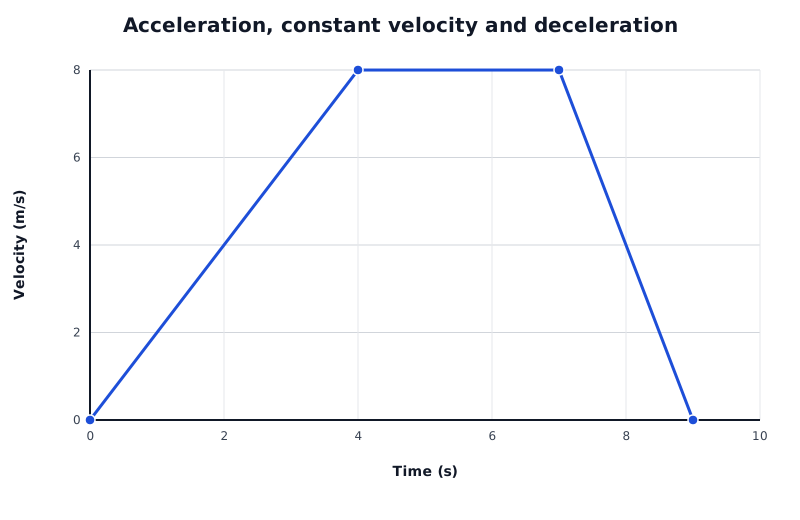
Straight-line motion: the gradients show acceleration, while the two triangles and rectangle between the line and time axis give the total distance travelled.
Data for Acceleration, constant velocity and deceleration
| Series | Time (s) | Velocity (m/s) |
|---|---|---|
| Illustrative motion | 0 | 0 |
| Illustrative motion | 4 | 8 |
| Illustrative motion | 7 | 8 |
| Illustrative motion | 9 | 0 |
From 0 to 4 seconds, velocity rises steadily from 0 to . From 4 to 7 seconds, velocity stays at . From 7 to 9 seconds, the object slows steadily to rest.
The gradient gives acceleration:
On the same axes, a steeper slope means a greater magnitude of acceleration. The falling section here is steeper than the rising section, so the object slows down more rapidly than it initially speeds up. A curved line has a changing gradient, showing changing acceleration.
Choose two points on the same straight section. A gradient triangle shows the change in velocity vertically and the corresponding change in time horizontally:
For the rising section of the illustration:
For the falling section:
The negative sign describes the direction of the acceleration. Its magnitude is : the velocity decreases by each second. These gradient calculations apply to straight sections, where acceleration is uniform.
For motion in one direction with non-negative velocity, the area between a velocity–time graph and the time axis gives the distance travelled. A rectangle represents constant velocity: its width is time and its height is velocity, so its area is velocity multiplied by time.
For straight sections showing uniform acceleration or deceleration, split the area into rectangles and triangles:
In the illustration, the three sections give:
The total distance is . The units explain why graph area represents distance: seconds multiplied by metres per second gives metres. A section that starts above zero velocity can be split into a rectangle with a triangle above it.
For uniform acceleration, another useful equation is:
Here, is the distance travelled in metres; , and have the meanings and units used earlier. This equation is useful when time is not given or needed.
For example, a car accelerates steadily from rest at until it reaches . Starting from rest means . Rearranging to find distance:
The car travels 51.2 metres while gaining this speed. The same equation can be rearranged to find acceleration, , or final velocity. For final velocity, first calculate , then take the square root, choosing the positive value for motion in the positive direction.
Get unlimited access to all revision notes, key terms, and exam tips.
: initial velocity; : final velocity, both in m/s. : elapsed time in s. : acceleration in m/s².
Uniform acceleration means equal velocity changes in equal time intervals. For positive-direction motion, slowing down gives negative acceleration.
is distance in metres. Use only for uniform acceleration.
Rectangle: base × height. Triangle: ½ × base × height. Use time intervals for bases and velocities for heights.
Get unlimited access to all revision notes, key terms, and exam tips.
Calculate change in velocity as final velocity minus initial velocity, and use the elapsed time rather than the final time reading.
For a graph gradient, choose two well-separated points on the same straight section and show a large gradient triangle.
In v² − u² = 2ax, square each velocity separately. If finding v, remember to take the square root.
For distance from a velocity–time graph, calculate areas using the axis values, not the number of squares alone.
Include units: acceleration in m/s² and distance in m.
Velocity
Speed in a specified direction, measured in metres per second (m/s).
Acceleration
The rate of change of velocity, measured in metres per second squared (m/s²).
Uniform acceleration
Acceleration that remains constant: velocity changes by equal amounts in equal time intervals.
Deceleration
A decrease in speed; for motion in the positive direction, this corresponds to negative acceleration.
Gradient
The change in the vertical-axis quantity divided by the corresponding change in the horizontal-axis quantity. On a velocity–time graph, gradient gives acceleration.
Put your knowledge into practice — try past paper questions for Combined Science
Velocity
Speed in a specified direction, measured in metres per second (m/s).
Acceleration
The rate of change of velocity, measured in metres per second squared (m/s²).
Uniform acceleration
Acceleration that remains constant: velocity changes by equal amounts in equal time intervals.
Deceleration
A decrease in speed; for motion in the positive direction, this corresponds to negative acceleration.
Gradient
The change in the vertical-axis quantity divided by the corresponding change in the horizontal-axis quantity. On a velocity–time graph, gradient gives acceleration.