Loading…


Loading…
Loading…
Loading…
Edexcel GCSE Combined Science · 1SC0
Edexcel 1SC0 · Energy stores and transfers Check the specification (PDF) (opens in a new tab)
A moving ball, a raised book and a hot kettle all have energy, but it is stored in different ways. A moving object has energy in its kinetic store. An object raised in a gravitational field has energy in its gravitational potential store. A hot object has energy in its thermal store, while fuels, batteries and food have energy in chemical stores. Energy is measured in joules (J).
When something changes, energy is transferred. The store tells us where energy is held; the transfer pathway tells us how it moves between stores. A force moving an object transfers energy mechanically. Moving charge transfers energy electrically. Energy can also be transferred by heating, because of a temperature difference, or by radiation, such as light.
For example, a kettle receives energy electrically. This increases the energy in the heating element's thermal store. Energy then transfers by heating from the hot element to the water.
A system is an object or group of objects chosen for study. You might study just a falling ball, or the ball together with Earth and the surrounding air. Choosing the system helps you decide which transfers to include.
Conservation of energy means that energy cannot be created or destroyed: it can only be transferred between stores. In a closed system, energy transfers cause no net change in the total energy. Individual stores can increase or decrease while their total remains constant.
For a falling ball, the gravitational potential store decreases as the kinetic store increases. If air resistance is negligible, the decrease in gravitational potential energy equals the increase in kinetic energy. With air resistance, some energy also transfers to thermal stores of the ball and surroundings. The ball gains less kinetic energy, but energy has not disappeared.
The boundary matters. A kettle and its water receive energy from outside through the mains supply, so their total stored energy increases while the kettle heats. This does not contradict conservation of energy: the energy has been transferred into the chosen system.
Lifting an object transfers energy to its gravitational potential store. The increase depends on its mass, the gravitational field strength and the vertical height gained:
Here, is the change in gravitational potential energy in joules (J), is mass in kilograms (kg), is gravitational field strength in newtons per kilogram (N/kg), and is the change in vertical height in metres (m). The symbol , pronounced ‘delta’, means ‘change in’.
Gravitational field strength describes the gravitational force on each kilogram of mass. Near Earth it is approximately 10 N/kg. Raising a greater mass, raising it higher or raising it in a stronger gravitational field requires a greater transfer of energy.
For example, a 4 kg box is lifted through a vertical height of 1.5 m where :
The box's gravitational potential store increases by 60 J. Lowering it through the same height decreases that store by 60 J. The height change is vertical: carrying it up a long slope to the same height gives the same increase in gravitational potential energy.
Kinetic energy is the energy associated with motion. It depends on mass and speed:
is measured in joules (J), in kilograms (kg), and speed in metres per second (m/s).
For example, a 2 kg trolley moving at 3 m/s has:
This is the energy in its kinetic store. At the same speed, doubling the mass doubles the kinetic energy. Speed has a larger effect because it is squared: doubling the speed gives four times the kinetic energy.
An object projected upwards or up a slope: during the launch, energy transfers mechanically from the thrower's chemical store to the object's kinetic store. As the object rises, its kinetic store decreases and its gravitational potential store increases. It slows down as it gains height. Ignoring air resistance or friction, the kinetic energy lost equals the gravitational potential energy gained. At the highest point of a straight vertical throw, the object's speed is momentarily zero.
A moving object hitting an obstacle: the object's speed falls rapidly, so its kinetic store decreases. Forces during the collision transfer energy mechanically, causing deformation and increasing thermal stores of the object, obstacle and surroundings. Sound also carries some energy away. The kinetic energy has been transferred, not destroyed.
An object accelerated by a constant force: a resultant force acting in the direction of motion transfers energy mechanically to the object's kinetic store. Its speed and kinetic energy increase. For example, a person pushing a trolley transfers energy from their chemical store to the trolley's kinetic store. A constant force does not mean a constant speed.
A vehicle slowing down: the vehicle's kinetic store decreases. Friction during braking transfers energy to thermal stores of the brakes, tyres, road and surroundings. The brakes warm up as the vehicle loses speed.
Water brought to the boil in an electric kettle: energy transfers electrically from the mains supply to the heating element's thermal store, then by heating to the water's thermal store. The water's temperature rises towards boiling. Some energy also transfers to the kettle and surrounding air.
A flow diagram represents stores with labelled boxes and transfers with labelled arrows. To draw one, identify the store that decreases, the store that increases and the pathway connecting them. Add branches if energy transfers to more than one destination.
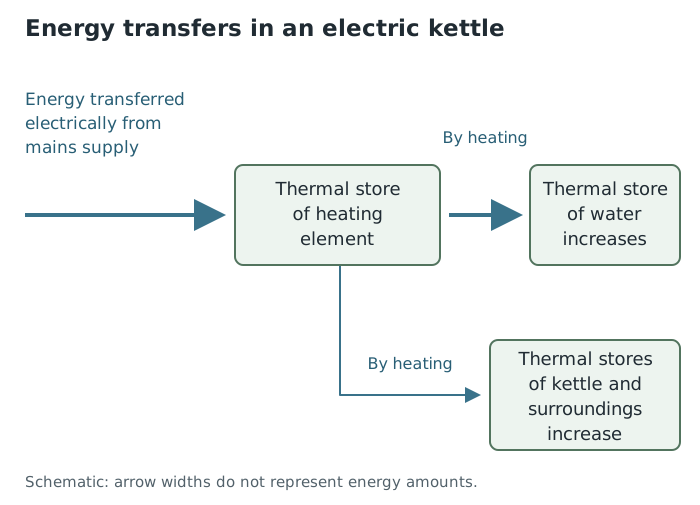
The kettle receives energy electrically; its hot element transfers energy to the water by heating.
Read this diagram from left to right. ‘Electrically’ and ‘by heating’ label pathways, whereas the boxes identify thermal stores. The branch to the surroundings shows why not all the energy supplied ends up in the water.
A Sankey diagram shows the amounts transferred as well as their destinations. Arrow widths are proportional to energy: a wider arrow represents a larger transfer. The input arrow must be as wide as the output arrows combined.
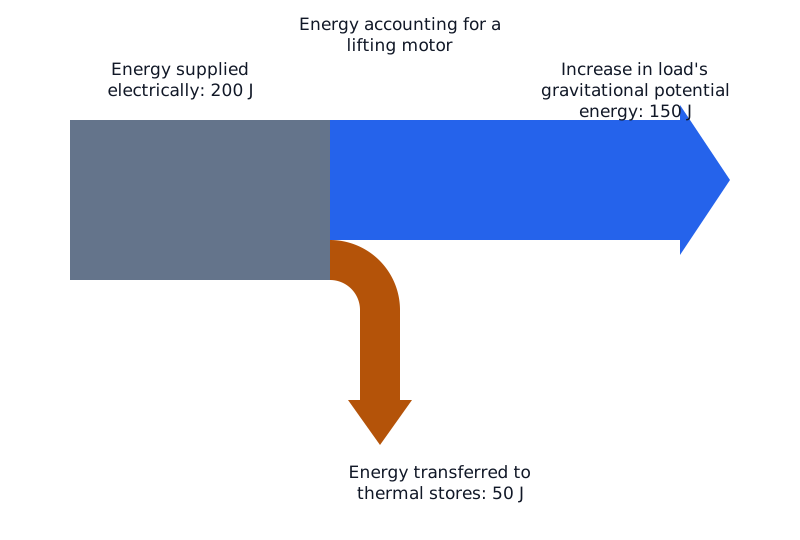
Values for a motor lifting a load: the output arrows together account for all the energy supplied.
Energy supplied electrically: 200 J. Increase in load's gravitational potential energy: 150 J. Energy transferred to thermal stores: 50 J. Wasted energy = 200 − 150 = 50 J. Efficiency = 150 ÷ 200 × 100% = 75%. Arrow shaft widths are proportional to energy.
In this motor example, 200 J is supplied electrically and 150 J increases the raised load's gravitational potential store. The remaining transfers to thermal stores. This is called wasted energy because it does not perform the intended job of lifting the load, not because it has been destroyed.
To draw this Sankey diagram, you could use 1 mm of arrow width for every 10 J: the input would be 20 mm wide, and the outputs 15 mm and 5 mm wide. To interpret any Sankey diagram, check that all output amounts add up to the input:
Get unlimited access to all revision notes, key terms, and exam tips.
: kg; : N/kg; : vertical height change in m; : J.
: kg; : m/s; : J. Double the mass → double . Double the speed → four times .
Ignoring resistance, gravitational potential energy gained equals kinetic energy lost during upward motion.
Get unlimited access to all revision notes, key terms, and exam tips.
Use mass in kilograms, speed in metres per second and vertical height change in metres. Give energy answers in joules.
In kinetic energy calculations, square the speed before multiplying by the mass and by one half.
For gravitational potential energy, use the vertical height gained, not the distance travelled along a slope or staircase.
Use the value of gravitational field strength given in the question. Near Earth, it is approximately 10 N/kg.
Describe an energy transfer by naming the starting store, the transfer pathway and the receiving store. Light and sound are transfers, not energy stores.
When energy appears to be lost, identify where it has been transferred, including to the surroundings.
System
An object or group of objects chosen for study.
Closed system
A system in which energy transfers cause no net change in the total energy. Energy may move between stores within it.
Conservation of energy
The principle that energy cannot be created or destroyed, only transferred between stores.
Gravitational potential energy
Energy associated with an object's height in a gravitational field.
Kinetic energy
Energy associated with the motion of an object.
Gravitational field strength
The gravitational force per kilogram of mass at a location, measured in newtons per kilogram (N/kg).
Energy transfer pathway
A way in which energy is transferred between stores: mechanically, electrically, by heating or by radiation.
Sankey diagram
A diagram showing energy transfers using arrows whose widths are proportional to the amounts of energy transferred.
Put your knowledge into practice — try past paper questions for Combined Science
System
An object or group of objects chosen for study.
Closed system
A system in which energy transfers cause no net change in the total energy. Energy may move between stores within it.
Conservation of energy
The principle that energy cannot be created or destroyed, only transferred between stores.
Gravitational potential energy
Energy associated with an object's height in a gravitational field.
Kinetic energy
Energy associated with the motion of an object.
Gravitational field strength
The gravitational force per kilogram of mass at a location, measured in newtons per kilogram (N/kg).
Energy transfer pathway
A way in which energy is transferred between stores: mechanically, electrically, by heating or by radiation.
Sankey diagram
A diagram showing energy transfers using arrows whose widths are proportional to the amounts of energy transferred.