Loading…


Loading…
Loading…
Loading…
Edexcel GCSE Combined Science · 1SC0
Edexcel 1SC0 Check the specification (PDF) (opens in a new tab)
This lesson covers Higher-tier content.
A wire carrying an electric current produces its own magnetic field. If the wire is placed near a magnet, its field overlaps with the magnet’s field. The two magnetic fields interact, producing a force on the wire. This is the motor effect: an electrical current can produce movement.
The force is not simply the magnet attracting the wire’s material. A copper wire can experience this force when it carries a current, even though copper is not a magnetic material.
The interaction also produces an equal and opposite force on the magnet. If the magnet pushes the wire upwards, the wire pushes the magnet downwards with the same size of force. These forces do not cancel on the wire because they act on different objects. A secured magnet may remain still while a freely moving wire moves.
For a conductor at right angles to the magnetic field, the force acts perpendicular to both the current and the field. There are therefore three directions to keep track of.
Hold your left thumb, first finger and second finger mutually at right angles:
Rotate your whole hand until two fingers match the two known directions. The remaining finger then gives the unknown direction. The thumb shows the force, whether or not the conductor is free to move.
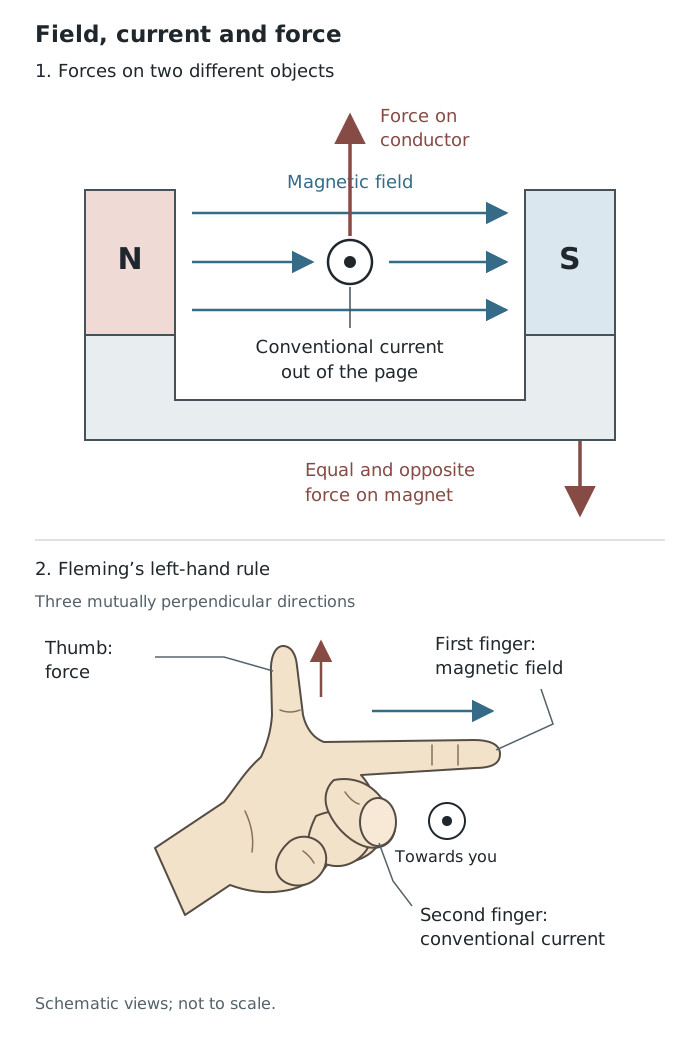
With the field to the right and current towards you, Fleming’s left-hand rule gives an upward force on the conductor.
For example, suppose the field points from left to right and the current flows out of the page towards you. Point your first finger right and your second finger towards you: your thumb points upwards, so the force on the wire is upwards. The force on the magnet is downwards.
Reversing the current reverses the wire’s magnetic field and therefore reverses the force. Reversing the magnet’s field also reverses the force. Reversing both leaves the force in its original direction.
When the current-carrying conductor is at right angles to the magnetic field, use:
Here:
Magnetic flux density measures how strong the magnetic field is. One tesla is equivalent to one newton per ampere metre, written .
For example, a wire carries a current of , with of wire at right angles to a field of magnetic flux density :
This is the size of the force on the wire. The magnet experiences a force of the same size in the opposite direction; Fleming’s rule determines the direction on the wire.
The equation shows that increasing the magnetic flux density, current or length of wire in the field increases the force. Doubling any one of these, while keeping the others unchanged, doubles the force.
Orientation matters too. The force is greatest when the conductor is perpendicular to the field. A conductor parallel to the field experiences no motor-effect force. The equation applies to the perpendicular case, not to every possible angle.
If another quantity is unknown, rearrange the equation:
Get unlimited access to all revision notes, key terms, and exam tips.
Fleming’s left-hand rule, with all three directions mutually perpendicular:
Reverse current or field → reverse force. Reverse both → force unchanged.
For a conductor at right angles to the field:
: N; : T or N/(A m); : A; : m of conductor within the field.
Force increases with , and . It is greatest at right angles and zero when the conductor is parallel to the field.
Get unlimited access to all revision notes, key terms, and exam tips.
Use your left hand for Fleming’s rule. The current direction is conventional current, not electron flow.
For F = BIl, use the length of conductor inside the magnetic field, in metres—not necessarily the total wire length.
Check that the conductor is at right angles to the field before using F = BIl.
The equal and opposite forces act on different objects: one on the conductor and one on the magnet.
Motor effect
The force on a current-carrying conductor in a magnetic field, caused by the interaction between the conductor’s magnetic field and the external magnetic field.
Magnetic field
A region in which a magnet, magnetic material or current-carrying conductor can experience a magnetic force.
Magnetic flux density
A measure of magnetic field strength, represented by and measured in tesla (T). A field of 1 T exerts a force of 1 N on a 1 m conductor carrying 1 A at right angles to the field.
Fleming’s left-hand rule
A rule relating three mutually perpendicular directions: the left thumb indicates force, the first finger magnetic field and the second finger conventional current.
Conventional current
The direction in which positive charge would flow: from the positive terminal towards the negative terminal through the external circuit.
Put your knowledge into practice — try past paper questions for Combined Science
Motor effect
The force on a current-carrying conductor in a magnetic field, caused by the interaction between the conductor’s magnetic field and the external magnetic field.
Magnetic field
A region in which a magnet, magnetic material or current-carrying conductor can experience a magnetic force.
Magnetic flux density
A measure of magnetic field strength, represented by and measured in tesla (T). A field of 1 T exerts a force of 1 N on a 1 m conductor carrying 1 A at right angles to the field.
Fleming’s left-hand rule
A rule relating three mutually perpendicular directions: the left thumb indicates force, the first finger magnetic field and the second finger conventional current.
Conventional current
The direction in which positive charge would flow: from the positive terminal towards the negative terminal through the external circuit.